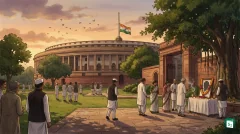
Prime Minister Narendra Modi joined the Janjatiya Gaurav Diwas 2026 programme at Gadchiroli in Maharashtra through video conferencing on 15 November 2026. He inaugurated and laid foundation stones for 246 tribal development projects worth about ₹3000 crore. The national event marked the 151st birth anniversary of tribal freedom fighter Dharti Aaba Bhagwan Birsa Munda.
What Is Janjatiya Gaurav Diwas and Why Is It Celebrated on 15 November?
Janjatiya Gaurav Diwas is the national day observed every year on 15 November to honour tribal freedom fighters and tribal heritage. The date is the birth anniversary of Bhagwan Birsa Munda. The day also remembers the contribution of Santhal, Khol, Bhil, Mizo and other tribal movements to the freedom struggle.
The Union Cabinet decided on 10 November 2021 that 15 November would be observed as Janjatiya Gaurav Diwas. The Ministry of Tribal Affairs, which was set up in 1999 as the nodal ministry for Scheduled Tribes, coordinates the celebrations with state governments. The first observance took place on 15 November 2021, when the Bhagwan Birsa Munda Memorial Park cum Freedom Fighter Museum at Ranchi in Jharkhand was inaugurated.
The 2026 event was the culmination of the Janjatiya Gaurav Pakhwada, observed from 1 to 15 November 2026. More than 25,000 events with over 60 lakh participants were held across 34 states and Union Territories during the fortnight. Tributes were also paid at Prerna Sthal in the Parliament premises and at Ulihatu in Jharkhand, the birthplace of Birsa Munda. The year 2024 to 2025 had been observed as Janjatiya Gaurav Varsh to mark his 150th birth anniversary.
Who Was Birsa Munda and Why Is He Called Bhagwan?
Birsa Munda was a tribal freedom fighter and social reformer from the Munda tribe of the Chotanagpur plateau. He was born on 15 November 1875 at Ulihatu village in present day Khunti district of Jharkhand. He died in Ranchi jail on 9 June 1900 at the age of 24.
People call him Dharti Aaba, which means Father of the Earth, and Bhagwan because his followers saw him as a divine guide. He asked the Mundas to give up liquor, stop belief in witchcraft, keep villages clean and live honestly. He also opposed both missionary pressure and the control of moneylenders, landlords and colonial officials. His message joined social reform with a clear call for self rule.
The Ulgulan Movement and the Fight for Abua Raj
Ulgulan means Great Tumult. It was the uprising led by Birsa Munda in 1899 to 1900 against British rule and outsiders called dikus. The slogan of the movement was that diku raj would end and Abua Raj, or our own rule, would begin.
The revolt had clear material causes. British land settlements broke the traditional shared land system of the Mundas known as Khuntkatti. Fertile land passed to landlords and moneylenders. Forced labour and high rents spread. Many tribals also felt their customs and faith were under threat.
Birsa Munda had been jailed for two years in 1895 on charges of rioting. After his release on 30 November 1897, he toured villages and mobilised people with traditional symbols. His followers attacked police stations and the property of moneylenders and raised a white flag as the sign of Birsa Raj. The British crushed the rising at Dombari Buru hill in January 1900. Birsa Munda was arrested on 3 February 1900 from the forests of Chaibasa and died months later in custody.
The movement forced the colonial government to protect tribal land rights. Its best known result was the Chotanagpur Tenancy Act of 1908, which restricted the transfer of tribal land to non tribals. The 15 November date also carries a second meaning. Jharkhand was formed on 15 November 2000, choosing the birth anniversary of Birsa Munda as its foundation day.
What 246 Projects Worth About ₹3000 Crore Were Announced in Gadchiroli?
The main national programme was held at the District Sports Complex in Gadchiroli, Maharashtra. Gadchiroli has a large tribal population and is associated with tribal warriors such as Raghoji Bhangre, Bhagoji Naik and Veer Baburao Shedmake. The Prime Minister joined through video conferencing. The event was attended by the Governor of Maharashtra, the Union Minister for Tribal Affairs, the Chief Minister of Maharashtra and other ministers.
Of the 246 projects, 173 projects were inaugurated and foundation stones were laid for 73 new projects. They cover education, health, livelihoods, marketing of tribal produce and village infrastructure in several states.
| Category | Number | Detail |
|---|---|---|
| Projects inaugurated | 173 | Includes schools, health units, marketing centres and village works |
| Foundation stones laid | 73 | Includes new schools, marketing centres and village projects |
| Total value | About ₹3000 crore | Spread across states |
Key projects inaugurated included 38 Eklavya Model Residential Schools, 100 Multipurpose Centres under PM-JANMAN, the new building of the Tribal Research Institute at Itanagar in Arunachal Pradesh and the Ropuiliani Tribal Freedom Fighter Museum at Kelsih near Aizawl in Mizoram. The government also laid foundation stones for 19 new Eklavya Model Residential Schools, 12 Tribal Multipurpose Marketing Centres and 42 projects under PM-JANMAN and the Dharti Aaba Janjatiya Gram Utkarsh Abhiyan.
The Ropuiliani museum honours the 19th century Mizo chieftainess Ropuiliani of Denlung, who refused to accept British demands for tax and forced labour in the Lushai Hills. She was captured in 1893 and died in custody at Rangamati on 3 January 1895. The museum complex includes a museum building, open air theatre, traditional hut, heritage walk and cafeteria. On the same day, Maharashtra dedicated 22 Ashram Schools and 51 hostels built by the state Tribal Development Department.
What Is the PM-JANMAN Mission for Particularly Vulnerable Tribal Groups?
PM-JANMAN stands for Pradhan Mantri Janjati Adivasi Nyaya Maha Abhiyan. It is a central mission for the social and economic development of Particularly Vulnerable Tribal Groups (PVTGs). The Prime Minister launched it on 15 November 2023 at Khunti in Jharkhand. The Ministry of Tribal Affairs is the nodal ministry.
The Union Cabinet has approved a total outlay of ₹24104 crore for the mission, with a central share of ₹15336 crore and state share of ₹8768 crore. The mission works through 11 critical interventions run by 9 ministries. It aims to provide safe housing, clean drinking water, sanitation, education, health and nutrition, road and telecom links, electricity for unelectrified homes and support for livelihoods. Progress is tracked through a portal on the PM Gati Shakti platform.
The 100 Multipurpose Centres inaugurated at Gadchiroli serve as village hubs for services, training and community activities in remote PVTG habitations. They bring several schemes to one place so families do not have to travel far.
How Many PVTGs Are There in India?
India has 75 PVTGs living in 18 states and the Union Territory of Andaman and Nicobar Islands. PVTGs are the most vulnerable sub group within the Scheduled Tribes, who number more than 705 communities with a population of 10.45 crore as per Census 2011.
The idea of a separate category came from the Dhebar Commission of 1960 to 1961, which found uneven development among tribes. The category was created as Primitive Tribal Groups in 1975 with 52 groups and later expanded to 75. The name was changed to Particularly Vulnerable Tribal Groups in 2006. No new group has been added since.
A group is identified on four tests: pre agricultural technology, stagnant or declining population, very low literacy and subsistence level economy. Odisha has the highest number with 13 groups, followed by Andhra Pradesh including Telangana with 12. Maharashtra has 3 PVTG groups, the Katkari, Kolam and Maria Gond. The Saharia community of Madhya Pradesh and Rajasthan is among the largest PVTGs in population.
The Gadchiroli announcements must be read with the larger Dharti Aaba Janjatiya Gram Utkarsh Abhiyan, launched on 2 October 2024. That programme has an outlay of ₹79156 crore over five years, with a central share of ₹56333 crore and state share of ₹22823 crore. It plans 25 interventions through 17 ministries to saturate infrastructure gaps in 63843 villages across 549 districts for more than 5 crore tribal people.
How Are Eklavya Model Residential Schools Expanding Tribal Education?
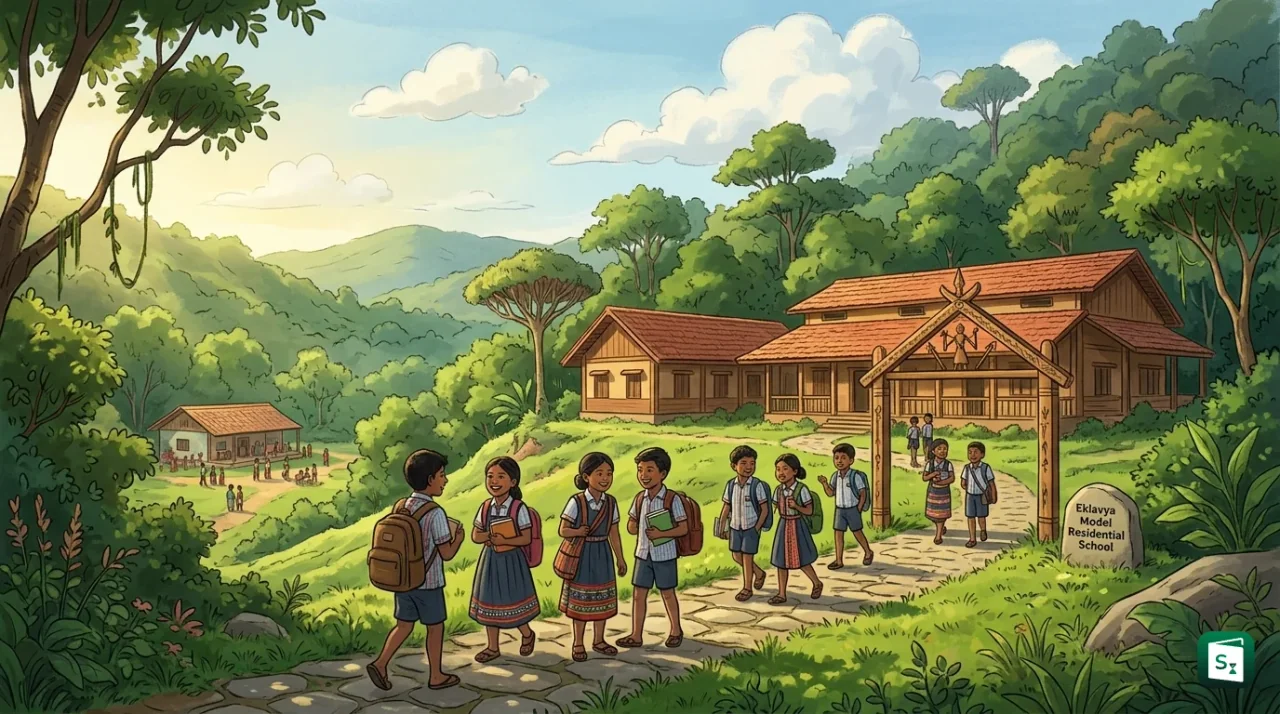
Eklavya Model Residential Schools (EMRS) are residential schools for Scheduled Tribe students from Class 6 to Class 12. Each school has capacity for 480 boys and girls with separate hostels, dining and kitchen, staff quarters, modern classrooms, science and computer laboratories, libraries, playgrounds and skill training facilities. The model is kept at par with Navodaya Vidyalayas, with added focus on tribal art, culture, music and sports.
The scheme started in 1997 to 1998 to give quality education to tribal children in remote areas. It was expanded in Budget 2018 to 2019. Under the revamped plan, an EMRS is set up in every block with more than 50 percent tribal population and at least 20,000 tribal persons as per Census 2011. EMRS is now a Central Sector Scheme. The National Education Society for Tribal Students (NESTS), an autonomous body under the Ministry of Tribal Affairs registered on 1 April 2019, runs the programme with state societies.
As of mid 2026, 728 schools have been approved and 508 schools are functional across the country. Enrolment has risen from about 105463 students in 2021 to 2022 to more than 156593 students in 2025 to 2026. The 38 schools inaugurated at Gadchiroli and the foundation stones for 19 more add to this network. Each functional school has sanctioned posts for 31 teaching and 21 non teaching staff, with large scale recruitment underway through NESTS.
Key Takeaways
- The Prime Minister joined Janjatiya Gaurav Diwas 2026 from Gadchiroli, Maharashtra through video conferencing on 15 November 2026 and launched 246 projects worth about ₹3000 crore.
- Janjatiya Gaurav Diwas is observed every year on 15 November, the birth anniversary of Birsa Munda, following a Union Cabinet decision on 10 November 2021.
- Birsa Munda of the Munda tribe was born on 15 November 1875 at Ulihatu and led the Ulgulan of 1899 to 1900 for Abua Raj before his death on 9 June 1900.
- PM-JANMAN, launched on 15 November 2023 with an outlay of ₹24104 crore, serves 75 PVTGs in 18 states and one Union Territory through 11 interventions by 9 ministries.
- 38 Eklavya Model Residential Schools for Classes 6 to 12 and 100 Multipurpose Centres under PM-JANMAN were inaugurated, with 728 EMRSs approved and 508 functional across India.