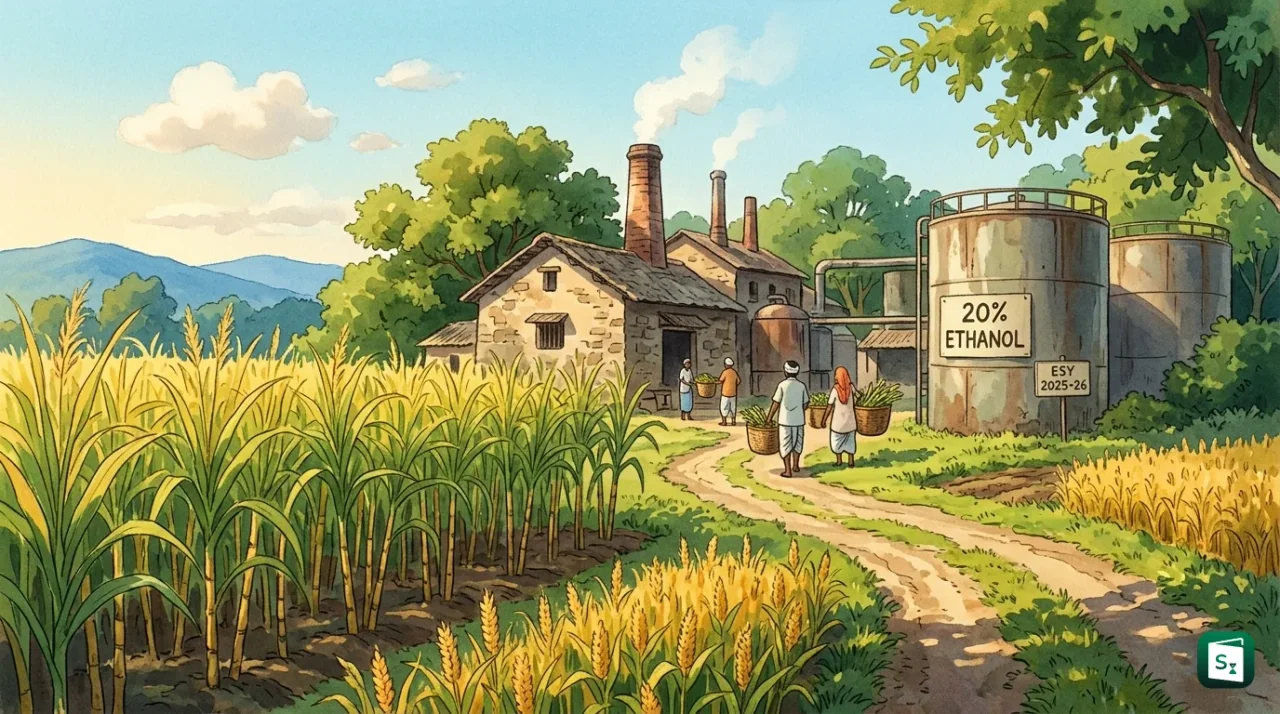
India effectively achieved its 20 percent ethanol blending target in Ethanol Supply Year (ESY) 2025-26, recording an average blending level of 19.99 percent as of 31 October 2026. The All India Distillers Association (AIDA) reported that oil companies blended 1,134.36 crore litres of ethanol during the year. Grain based sources, led by maize, supplied nearly three fourths of the ethanol for the first time.
What Is Ethanol Blending in Petrol?
Ethanol blending in petrol means mixing ethanol with petrol before sale at fuel stations. E20 petrol contains 20 percent ethanol and 80 percent petrol by volume. Similarly, E10 petrol contains 10 percent ethanol, E85 contains 85 percent ethanol and E100 is nearly pure ethanol for special flex fuel vehicles.
Ethanol, also called ethyl alcohol (C2H5OH), is a renewable biofuel. It is produced by fermentation of sugar rich or starch rich materials, followed by distillation. In India, the main raw materials are sugarcane juice, molasses, maize, surplus rice from the Food Corporation of India (FCI) and damaged foodgrains.
Ethanol has a high octane number of about 108.5, compared with about 84.4 for plain petrol. Octane number measures resistance to knocking, or uneven burning inside the engine. This is why ethanol suits modern high compression engines. At the same time, ethanol has lower energy per litre than petrol, so it gives slightly less mileage per litre.
India divides ethanol by generation of feedstock. 1G ethanol comes from food crops such as sugarcane juice, B heavy molasses, C heavy molasses, maize and rice. 2G ethanol comes from non food waste such as rice straw, corn cobs, bagasse and cotton stalk. The country has set up dedicated 2G bio refineries to use farm waste without affecting food supply.
India Records 19.99 Percent Blending in ESY 2025-26
The Ethanol Supply Year (ESY) in India runs from 1 November to 31 October of the next year. ESY 2025-26 therefore ended on 31 October 2026. The All India Distillers Association (AIDA) released provisional data for this period in November 2026.
India blended 1,134.36 crore litres of ethanol during the year against a requirement of 1,050 crore litres. Total allocations to suppliers stood at 1,196.90 crore litres, while actual supplies reached 1,088.91 crore litres. The difference between allocation, supply and blending reflects stocks held in storage and ethanol lifted across year end. The average blending level touched 19.99 percent, which the government treats as effective achievement of the 20 percent target.
The biggest change was the feedstock mix. Grain based ethanol supplied 800.53 crore litres, or 73.52 percent of total supplies. Sugar based ethanol supplied 288.38 crore litres, or 26.48 percent. This marks a clear shift away from the earlier dependence on sugarcane molasses.
| Feedstock | Ethanol supplied (crore litres) | Share of total supply |
|---|---|---|
| Maize | 489.71 | About 46 percent |
| Surplus FCI rice | 233.95 | About 21.5 percent |
| Damaged foodgrains | 76.87 | About 7 percent |
| Sugarcane juice | 153.36 | About 14 percent |
| B heavy molasses | 118.04 | About 11 percent |
| C heavy molasses | 16.98 | About 1.5 percent |
The Ministry of Petroleum and Natural Gas is the nodal ministry for the blending programme. Public sector Oil Marketing Companies (OMCs) such as Indian Oil, Bharat Petroleum (BPCL) and Hindustan Petroleum (HPCL) procure the ethanol and blend it with petrol at depots before dispatch to retail outlets.
When Ethanol Blending Started in India
The Ethanol Blended Petrol (EBP) Programme began with pilot projects in 2001 using 5 percent blended fuel. The government formally launched the programme in January 2003 for sale of E5 in nine states and four Union Territories. In September 2006, the Ministry of Petroleum and Natural Gas extended 5 percent blending to 20 states and four Union Territories.
Progress remained slow for years. Average blending stayed between 0.1 percent and 1.5 percent till 2013-14. Only 38 crore litres were supplied in ESY 2013-14, with blending at 1.53 percent. Supply rose to 173 crore litres in ESY 2019-20, yet blending was still only 5 percent.
The turnaround began after 2014 through assured pricing, wider feedstocks and interest support for distilleries. The National Policy on Biofuels 2018, notified on 4 June 2018 by the Ministry of Petroleum and Natural Gas, set an initial target of 20 percent blending by 2030. The Cabinet amended the policy on 18 May 2022 and advanced the 20 percent target to ESY 2025-26. It also allowed more feedstocks, production in Special Economic Zones and export of biofuels in specific cases.
The Roadmap for Ethanol Blending in India 2020-25, prepared by NITI Aayog in June 2021, laid out the phased rollout. It called for pan India E10 availability by April 2022, rollout of E20 material compliant vehicles from April 2023, and nationwide E20 availability by April 2025. India reached 10 percent blending in June 2022, five months early. Blending then rose steadily, as shown below.
| Ethanol Supply Year | Average blending achieved |
|---|---|
| 2020-21 | About 8.1 percent |
| 2021-22 | 10 percent |
| 2022-23 | 12.1 percent |
| 2023-24 | 14.6 percent |
| 2024-25 | About 19.2 percent |
| 2025-26 (till 31 October 2026) | 19.99 percent |
Ethanol production capacity also expanded sharply. Capacity grew from about 421 crore litres in 2014 to nearly 2,000 crore litres by 2026, covering both molasses based and grain based distilleries.
Why Ethanol Blending Is Done in Petrol
The blending programme has four stated aims. These are energy security, foreign exchange saving, farmer income and cleaner air.
India imports close to 88.5 percent of the crude oil it uses. Every litre of home grown ethanol replaces imported petrol. From ESY 2014-15 to mid 2026, the programme substituted more than 316 lakh metric tonnes of crude oil and saved over ₹1.97 lakh crore in foreign exchange. In ESY 2024-25 alone, forex saving was ₹43,307.6 crore. At full 20 percent blending, yearly payments to farmers are expected to be about ₹40,000 crore.
The rural impact is direct. More than ₹1.66 lakh crore has been paid to farmers and distillers since 2014-15. This has helped clear sugarcane dues, improved the viability of maize farming and created a steady market for surplus rice and damaged grain. The government often describes farmers as Urjadaatas (energy providers) in addition to Annadaatas (food providers).
The climate gain is also large. A NITI Aayog life cycle study found that sugarcane based ethanol cuts greenhouse gas emissions by 65 percent compared with petrol, while maize based ethanol cuts them by 50 percent. Cumulative carbon dioxide reduction since 2014-15 has crossed 952 lakh metric tonnes. Use of E20 also cuts carbon monoxide by about 30 percent in cars and 50 percent in two wheelers, and cuts hydrocarbon emissions by about 20 percent, because ethanol adds oxygen and burns more completely.
Does E20 Fuel Reduce Mileage and Damage Engines?
Does E20 fuel reduce mileage? Yes, by a small margin in older vehicles. Ethanol holds less energy per litre than petrol. Studies by the Automotive Research Association of India (ARAI), Indian Oil (IOCL), the Indian Institute of Petroleum (IIP) and the Society of Indian Automobile Manufacturers (SIAM) found an efficiency drop of 6 to 7 percent for cars designed for plain petrol and tuned for E10, 3 to 4 percent for two wheelers in the same class, and 1 to 2 percent for cars designed for E10 and tuned for E20. The government puts the gap at about 3 to 5 percent for E10 designed vehicles running on E20. Vehicles with factory tuned E20 engines show better acceleration and smoother running because of the higher octane value.
Does ethanol blending damage engines? Tests over 40,000 km for cars and 20,000 km for two wheelers found no major problem with starting, driving, metal parts or plastic parts. More than 20 crore two wheelers and over 3 crore petrol cars have run on high blends for more than two years without verified mass failures. In certain older vehicles, some rubber hoses and gaskets may harden earlier and need one time replacement during routine service. Makers continue to honour warranty for E20 use under prescribed standards.
Is E20 fuel safe and available? The Ministry of Petroleum and Natural Gas states that E20 is safe under Bureau of Indian Standards (BIS) norms and BS-VI emission standards. E20 is now the standard petrol sold across India. The average procurement cost of ethanol in ESY 2024-25 was ₹71.32 per litre including transport and tax, which was higher than refined petrol at crude prices near $70 per barrel. So blending did not make retail petrol cheaper, but it shielded prices from sharper import shocks.
What Is Next After the 20 Percent Target?
Is E20 fuel mandatory and will blending rise beyond 20 percent? E20 is the standard grade sold at most pumps, with no separate non blended option at the same outlet. The government has said no decision has been taken to move beyond 20 percent. Any higher blend will follow detailed scientific tests and talks with vehicle makers, oil companies, ethanol producers and research bodies.
India has started limited trials of higher blends. E85, with 85 percent ethanol, has been launched at select outlets for flex fuel vehicles that can run on any petrol ethanol mix. Brazil, the global leader, already mandates 27 percent blending and allows flex fuel cars to use pure hydrous ethanol. The United States also blends large volumes, mainly from corn.
India is also pushing global cooperation through the Global Biofuel Alliance (GBA), launched during its G20 presidency in 2023. The alliance now brings together more than 20 member countries and 12 international bodies to expand sustainable biofuel markets and share technology.
The near term challenge is feedstock security. Weak monsoon rainfall can lower maize and sugarcane output and tighten ethanol supply in ESY 2026-27. Policy will therefore focus on water efficient crops like maize, faster growth of 2G capacity from farm waste, and careful use of foodgrains only from surplus stocks approved by the Department of Food and Public Distribution (DFPD).
Key Takeaways
- India effectively met the 20 percent ethanol blending target in ESY 2025-26 with average blending of 19.99 percent as of 31 October 2026.
- Oil companies blended 1,134.36 crore litres of ethanol in ESY 2025-26, with supplies of 1,088.91 crore litres against allocations of 1,196.90 crore litres.
- Maize was the largest feedstock at 489.71 crore litres, while grain sources together supplied 73.52 percent of ethanol.
- The Ethanol Blended Petrol Programme started in January 2003, and the National Policy on Biofuels 2018 target of 20 percent was advanced to ESY 2025-26 by the 2022 amendment.
- The programme is run by the Ministry of Petroleum and Natural Gas through OMCs and follows the NITI Aayog Roadmap for Ethanol Blending 2020-25.