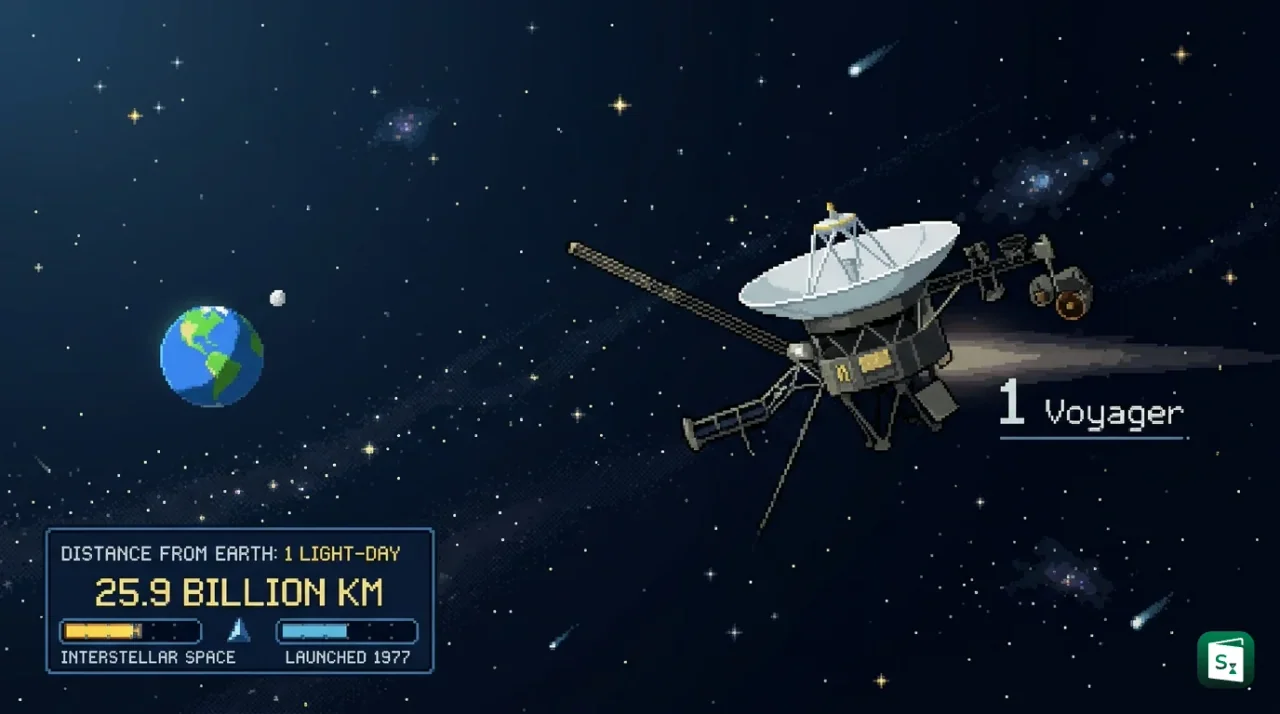
NASA’s Voyager 1 became the first human-made object to reach one light-day from Earth on 18 November 2026. The spacecraft is now about 25.9 billion km away, a distance light takes a full 24 hours to cross. Launched in 1977, it keeps flying in interstellar space after more than 49 years.
What Is One Light-Day and How Far Did Voyager 1 Travel?
A one light-day is the distance that light travels in empty space in 24 hours. Light moves at about 299,000 km per second (about 186,000 miles per second). Over a full day, that adds up to about 25.9 billion km (about 16.1 billion miles).
NASA confirmed that Voyager 1 reached this distance at 10:16:07 UTC on 18 November 2026, which was 5:16 a.m. in eastern US time. The journey took 49 years, two months and 11 days from Earth. Engineers at NASA’s Jet Propulsion Laboratory (JPL) in California confirmed the mark a day later, when the faint radio signal from the spacecraft finished its one day trip back to Earth.
To understand the scale, it helps to compare smaller light travel times:
| Light Travel Time | Distance | Example |
|---|---|---|
| 1.3 seconds | About 384,400 km | Earth to the Moon |
| 8 minutes | About 150 million km | Earth to the Sun, equal to one astronomical unit (AU) |
| About 4 hours | About 4.5 billion km | Sunlight reaching Neptune |
| 24 hours | About 25.9 billion km | Earth to Voyager 1 on 18 November 2026 |
| One year | About 9.46 trillion km | One light-year |
In AU terms, Voyager 1 was about 173.14 AU from Earth at the milestone. That means it is more than 173 times farther from Earth than Earth is from the Sun, and nearly six times farther than Neptune.
Where Is Voyager 1 Now and How Fast Is It Moving?
Voyager 1 is in interstellar space, the region between stars that lies outside the Sun’s protective bubble. It is moving northward, out of the plane in which the planets orbit, in the general direction of the constellation Ophiuchus. The spacecraft no longer fires engines for speed. It coasts on momentum gained at launch and from gravity assists at Jupiter and Saturn.
Voyager 1 travels at about 61,155 km per hour (about 38,000 miles per hour), which is about 17 km every second. NASA also expresses this as about 3.5 AU per year, or about one million miles per day. Even at this pace, space is so large that the probe has barely left home in cosmic terms. The nearest star system, Proxima Centauri, is 4.24 light-years away, more than 1,500 times farther than Voyager 1 was on 18 November 2026.
Voyager 1 is still active. NASA listens to it every day through the Deep Space Network. In the distant future, NASA estimates that Voyager 1 will reach the inner edge of the Oort Cloud, a vast shell of icy bodies around the Sun, in about 300 years. It may take about 30,000 years to pass through it. In about 40,000 years, Voyager 1 is expected to pass within 1.7 light-years of a star called AC+79 3888, also linked in reports to Gliese 445, in the constellation Ursa Minor.
What Is Voyager 1 and Why Was It Launched?
Voyager 1 is a NASA space probe built and operated by the Jet Propulsion Laboratory (JPL) in Pasadena, California. JPL is managed for NASA by the California Institute of Technology (Caltech). The spacecraft weighs about 722 kg and launched on 5 September 1977 from Cape Canaveral in Florida on a Titan IIIE-Centaur rocket. Its twin, Voyager 2, had launched a little earlier on 20 August 1977.
NASA planned the two Voyagers to take advantage of a rare alignment of the outer planets that occurs only about once in 176 years. This alignment allowed one spacecraft to swing past several planets in a row using gravity assists. A gravity assist uses a planet’s gravity to increase speed and change direction without using much fuel.
The first goal was short. Both spacecraft were built to last five years and study Jupiter and Saturn. Voyager 1 flew past Jupiter in March 1979 and Saturn in November 1980. It found new moons, studied Saturn’s rings in detail, and spotted active volcanoes on Jupiter’s moon Io. Voyager 1 overtook Voyager 2 on 15 December 1977 because it followed a faster path. After Saturn, its path took it north out of the planets’ plane, so it did not go on to Uranus and Neptune.
How Voyager 1 Entered Interstellar Space in 2012
After the planet flybys, NASA extended the mission as the Voyager Interstellar Mission (VIM), which formally began on 1 January 1990. The new goal was to study the far edge of the Sun’s influence and then sample the space between stars.
The Sun constantly releases charged particles called the solar wind. This wind blows a huge bubble around the Sun called the heliosphere. The inner shock where the solar wind slows is called the termination shock. The outer layer is called the heliosheath. The outer edge of the bubble, where the Sun’s wind gives way to material from other stars, is called the heliopause. Interstellar space is the region beyond it, filled with gas and dust left by stars that exploded millions of years ago.
Voyager 1 crossed these zones step by step:
| Date | Milestone | Distance From Sun |
|---|---|---|
| 17 February 1998 | Overtook Pioneer 10 to become the farthest human-made object | About 69.4 AU |
| 16 December 2004 | Crossed the termination shock and entered the heliosheath | About 94 AU |
| 25 August 2012 | Crossed the heliopause and entered interstellar space | About 122 AU, about 18 billion km |
Scientists confirmed the 2012 entry using a rise in cosmic rays from outside the bubble, a drop in particles from the Sun, and later readings of denser plasma around the probe by its plasma wave instrument. Voyager 1 was the first human-made object to make this crossing. Voyager 2 crossed the same boundary on 5 November 2018 on a different path.
Crossing the heliopause did not mean leaving the Solar System. The Sun’s gravity still holds the distant Oort Cloud, and Voyager 1 will stay inside that gravitational family for thousands of years more.
How Voyager 1 Stays Powered and Talks to Earth
Voyager 1 does not use solar panels. It runs on three radioisotope thermoelectric generators (RTGs). These devices convert heat from decaying plutonium-238 into electricity. At launch the three units produced about 470 watts. The output falls by about 4 watts every year as the fuel decays and the converters age.
Power is now very tight. Voyager 1 launched with 10 science instruments. Many were switched off after the planet encounters, including the cameras soon after the famous Pale Blue Dot image of Earth in 1990. The remaining active instruments study magnetic fields, plasma waves and charged particles. In September 2026, engineers completed an energy saving swap nicknamed Big Bang. They turned off three high power heaters and switched on three lower power units. The move was meant to keep the current instruments running at least until the 50th launch anniversary in 2027 and possibly into the 2030s.
Voyager 1 talks to Earth with a 3.7 metre high gain antenna through NASA’s Deep Space Network (DSN). The DSN has large dishes at three sites in California in the United States, Madrid in Spain and Canberra in Australia. Commands travel up at about 2.1 GHz. Data comes down mainly at about 8.4 GHz in X-band, at only about 160 bits per second. At one light-day, a command takes 24 hours to reach Voyager 1 and the reply takes another 24 hours. A simple hello and answer therefore takes two full days. NASA sends commands about once a week and listens daily. In October 2026 the link briefly dropped for two days before returning, a reminder that the 49 year old hardware can behave in unexpected ways.
What Is on the Voyager Golden Record?
Both Voyagers carry a Golden Record, a 12 inch gold plated copper disk packed in an aluminium cover. It is a time capsule meant for any advanced civilisation that might find the spacecraft in interstellar space. A committee chaired by astronomer Carl Sagan of Cornell University selected the contents in only a few months in 1977.
The cover carries diagrams that explain how to play the record and show the position of the Sun relative to 14 pulsars, which are fast spinning stars that give off regular radio pulses. The record itself holds 115 images encoded in analog form, greetings in 55 languages, a 12 minute mix of sounds of Earth, and about 90 minutes of music.
The sounds include wind, rain, surf, thunder, birds, whales, footsteps, laughter and a kiss, along with human tools, trains, a tractor and the launch of Saturn V. The greetings range from ancient languages such as Akkadian and Sumerian to modern ones. The Hindi message says greetings from the inhabitants of this world. The English message, spoken by six year old Nick Sagan, says hello from the children of planet Earth. The record also carries written messages from then US President Jimmy Carter and then UN Secretary General Kurt Waldheim. The music spans Bach, Mozart and Beethoven to Chuck Berry, along with classical Indian, Japanese, Chinese and many folk traditions.
How Voyager 1 Compares With Voyager 2
Voyager 1 and Voyager 2 are twins with almost identical hardware, but they took different paths and set different records. Voyager 1 launched second but moved faster and soon pulled ahead. Voyager 2 kept to the planetary plane and completed the full Grand Tour of four giants.
| Feature | Voyager 1 | Voyager 2 |
|---|---|---|
| Launch date | 5 September 1977 | 20 August 1977 |
| Planets visited | Jupiter and Saturn | Jupiter, Saturn, Uranus and Neptune |
| Key flybys | Jupiter in 1979, Saturn in 1980 | Jupiter in 1979, Saturn in 1981, Uranus on 24 January 1986, Neptune on 25 August 1989 |
| Unique record | Farthest human-made object since 1998, first in interstellar space | Only spacecraft to visit Uranus and Neptune |
| Speed away from Sun | About 3.5 AU per year | About 3.1 AU per year |
| Interstellar entry | 25 August 2012 | 5 November 2018 |
| Direction | North out of the planetary plane toward Ophiuchus | South out of the planetary plane toward Sagittarius and Pavo |
At Uranus, Voyager 2 found 10 new moons and two new rings and measured a magnetic field tilted sharply away from the spin axis. At Neptune, it found five moons, four rings and a large storm called the Great Dark Spot. To this day, no other spacecraft has made close visits to either ice giant. Voyager 1, by contrast, remains the distance leader and the first craft to send direct data from beyond the heliopause.
Key Takeaways
- Voyager 1 reached one light-day from Earth on 18 November 2026, becoming the first human-made object to do so.
- One light-day equals about 25.9 billion km (about 16.1 billion miles or 173.14 AU).
- Voyager 1 launched on 5 September 1977 from Cape Canaveral and flew past Jupiter in 1979 and Saturn in 1980.
- Voyager 1 became the farthest human-made object on 17 February 1998 and entered interstellar space on 25 August 2012.
- Voyager 2, launched on 20 August 1977, is the only spacecraft to visit Uranus in 1986 and Neptune in 1989.
- Voyager 1 runs on plutonium-238 RTGs and communicates through NASA’s Deep Space Network, with signals now taking 24 hours each way.