Chennai based OrbitAID Aerospace plans to conduct India’s first commercial on-orbit satellite refuelling mission by the end of 2027. The company’s first refuelling payload, AayulSAT, flew aboard the Indian Space Research Organisation’s PSLV-C62 mission launched on 12 January 2026. The plan marks India’s entry into satellite servicing, a technology that can extend satellite life by refilling fuel in space instead of discarding healthy satellites.
Do Satellites Need Fuel to Stay in Orbit?
Yes. Satellites need fuel to hold their assigned orbit and to point their antennas and cameras in the right direction. Without regular small thrusts, the pull of the Moon and Sun, uneven Earth gravity and thin air drag slowly push them off course.
This routine correction is called station keeping. Most satellites carry small thrusters for north-south and east-west corrections, plus extra fuel to dodge debris and to move to a safe graveyard orbit at the end of life. When the fuel runs out, an otherwise healthy satellite can no longer stay in position and is retired.
A typical satellite works for 5 to 15 years, and fuel exhaustion is often the reason it stops. Chemical fuels like hydrazine have powered this job for decades. Newer satellites also use electric propulsion, which uses gases such as xenon and needs less mass but more electrical power.
What Is AayulSAT and How Does It Refuel Satellites?
AayulSAT is India’s first satellite refuelling payload. The name Aayul means life in Tamil. OrbitAID Aerospace, a Chennai company founded in 2021 by Sakthikumar Ramachandran, Nikhil Balasubramanian and Mano Balaji K, built the 25 kg spacecraft to show that fuel, power and data can be moved between tanks and systems in orbit.
The first version was designed to work in low Earth orbit in a Sun-synchronous orbit about 600 to 800 km above Earth. In its first test, AayulSAT was to transfer green propellant between two tanks placed inside the same satellite. This internal transfer helps engineers study how liquid moves in microgravity, where fuel floats freely instead of settling at the bottom of a tank.
| Feature of AayulSAT | Detail |
|---|---|
| Weight | About 25 kg |
| Orbit | Low Earth orbit, Sun-synchronous |
| Main test | Internal fuel transfer between two tanks |
| Other tests | Power transfer and data transfer |
| Future role | Act as target for a chaser satellite to dock and refuel |
How the SIDRP Docking and Refuelling Port Works
The core of AayulSAT is the Standard Interface for Docking and Refuelling Port (SIDRP). SIDRP is a small docking unit that joins a satellite fuel valve with a docking mechanism. It lets a servicing craft latch onto a client satellite and pass fuel across a sealed connection.
OrbitAID says the unit weighs about 250 grams and can handle pressures up to 35 bar. It includes dual docking points and backup systems for safety. The company tested the design on a zero-gravity flight in Florida in December 2024 and reached Technology Readiness Level 7, which means a prototype has been shown to work in a space-like environment. The Technology Development Board under the Department of Science and Technology later supported further development of the system.
What Happened to AayulSAT on the PSLV-C62 Mission?
The PSLV-C62 mission lifted off on 12 January 2026 at about 10.17 am from the First Launch Pad at the Satish Dhawan Space Centre in Sriharikota. It was the 64th flight of the Polar Satellite Launch Vehicle and used the PSLV-DL version with two strap-on boosters. NewSpace India Limited (NSIL), the commercial arm of the Department of Space, managed the flight as a commercial mission.
The main passenger was EOS-N1, also called Anvesha. The Defence Research and Development Organisation built this hyperspectral Earth observation satellite for surveillance. Along with it were 15 co-passenger satellites from India, Nepal, Thailand, the United Kingdom, Brazil, Spain and France. This list included student technology demonstrators, Internet of Things payloads, and AayulSAT listed as an in-orbit fuelling demonstration. The flight also carried the Kestrel Initial Demonstrator (KID), a small re-entry capsule from a Spanish startup meant to splash down in the South Pacific Ocean for study.
The first two stages worked as planned. Near the end of the third stage, known as PS3, the vehicle showed unexpected changes in roll rates and moved away from its planned path. The satellites could not be placed in their intended orbit. The mission did not reach its goals, and AayulSAT was lost before it could begin its tests.
What Is OrbitAID Planning Next After the Setback?
OrbitAID rebuilt its spacecraft within about six months and set a two-step flight plan to prove the technology. The company is based in Chennai, with research and testing units in Bengaluru, and is backed by Unicorn India Ventures and the Tamil Nadu Startup and Innovation Mission. It has also received support from the Technology Development Board and selection for seed aid under IN-SPACe’s AI INSPIRED programme for pose estimation work.
The first step is AayulSAT-1A, a spacecraft weighing about 25 to 30 kg. It is planned for a Small Satellite Launch Vehicle ride to low Earth orbit. Onboard are two small satellite buses, two tanks and an inspection camera. The goal is to repeat the internal fuel, power and data transfer test lost on PSLV-C62 and to show close inspection of hardware in orbit.
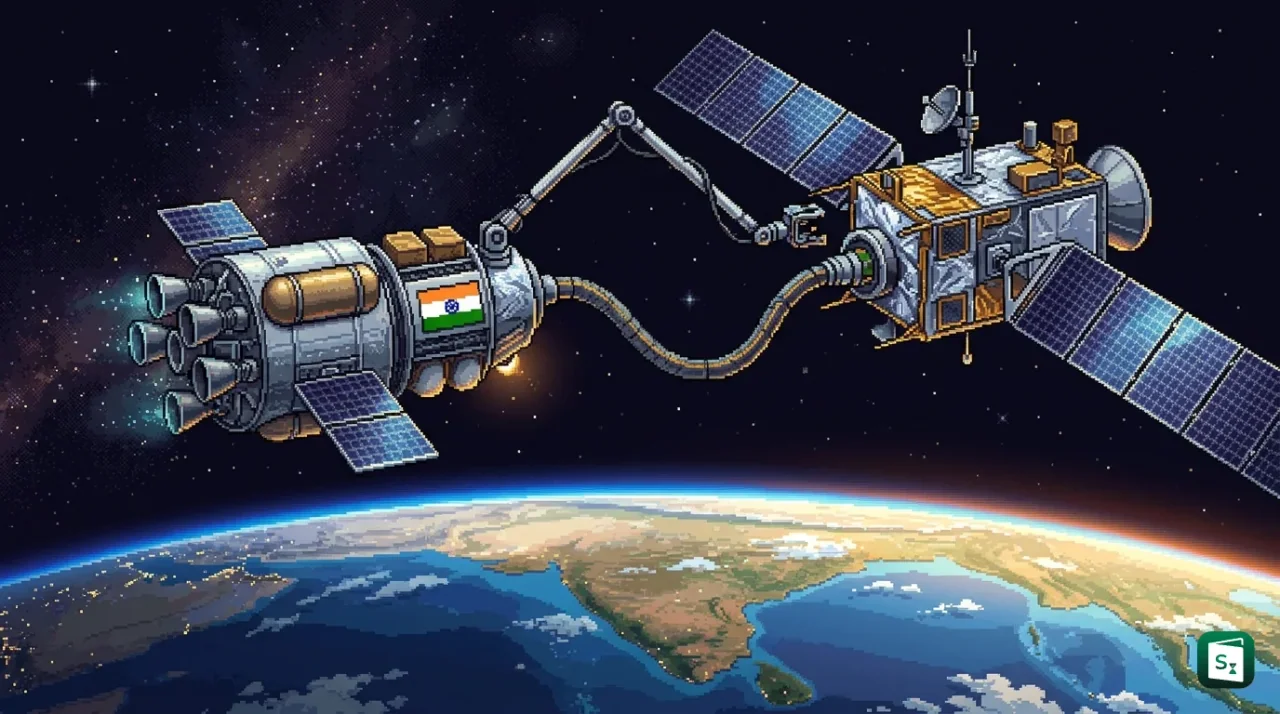
The second step is a two-satellite docking test planned for early 2027. It will use a chaser spacecraft called AayulSAT-2A and a target called AayulSAT-2B, each weighing about 70 kg. The planned sequence is separation, approach, docking, fuel transfer and an orbit-raising test. For docking, OrbitAID is building a system called ARCAS that grips the launch adapter ring found on most satellites. This design means a future client satellite would not need special docking hardware fitted in advance.
OrbitAID says its tanker can also work as a jetpack for older satellites without a refuelling port. In that mode, the tanker stays attached for three to four years and uses its own engine to hold the client in position. The company plans its first commercial on-orbit refuelling service by the end of 2027 and says it has agreements with two international satellite operators, one in Europe and one in Asia-Pacific, for that mission.
How ISRO’s SpaDeX Docking Mission Supports Refuelling
The Space Docking Experiment (SpaDeX) is the Indian Space Research Organisation’s technology demonstrator for joining two spacecraft in orbit. ISRO launched the mission on 30 December 2024 on PSLV-C60. It placed two spacecraft of about 220 kg each, SDX01 as chaser and SDX02 as target, into a 470 km circular orbit.
ISRO brought the two craft together through a series of holds at 5 km, 1.5 km, 500 m, 225 m, 15 m and 3 m. The first docking took place on 16 January 2025. With that success, India became the fourth country to achieve space docking after the United States, Russia and China. ISRO later showed undocking, a second fully autonomous docking on 20 April 2025, and two-way electrical power transfer on 21 April 2025 by running a heater on one satellite with power from the other for about four minutes.
SpaDeX proved the base skills needed for refuelling: rendezvous, proximity operations, soft capture, rigid joining and composite control. The same skills are needed to assemble the Bharatiya Antariksh Station planned by 2035, to bring Moon samples back on Chandrayaan-4, and to support crew missions under Gaganyaan. For refuelling, docking is the first step. Power and data sharing come next. Fuel transfer is the final and hardest step because liquids behave differently in weightlessness and seals must stay leak-free for years.
How India Fits Into Global Satellite Servicing Efforts
No company has yet refuelled a client satellite in orbit on a commercial basis as of late 2026. Governments have moved fuel between purpose-built test craft, and one firm has extended life by docking and steering. India is trying to join this small group through private startups working with ISRO.
| Player | What has been demonstrated |
|---|---|
| Northrop Grumman, United States | Mission Extension Vehicles MEV-1 and MEV-2 docked with Intelsat satellites in 2020 and 2021 and used their own thrusters to keep the clients in position for years |
| DARPA Orbital Express, United States | Transferred fuel between two test satellites in 2007 |
| Orbit Fab and Astroscale, United States | Building depots and refuellers for a United States Space Force demonstration planned in 2027 to deliver hydrazine in geostationary orbit |
| Shijian-21 and Shijian-25, China | Towed a dead navigation satellite to a higher orbit in 2022 and tested close approach and docking for life extension work in 2025 |
| OrbitAID and ISRO, India | SpaDeX proved docking and power transfer in 2025. OrbitAID aims to prove internal fuel transfer and then satellite to satellite refuelling by 2027 |
For India, the stakes are practical. Refuelling can cut replacement launches, lower costs for operators and reduce debris. ISRO has set a goal of debris-free space missions by 2030. A domestic refuelling service, with fuel stations and tanker craft placed near busy orbits, would support longer missions, help move satellites to new slots when needs change, and strengthen India’s role in on-orbit servicing, assembly and manufacturing.
Key Takeaways
- OrbitAID Aerospace plans India’s first commercial on-orbit satellite refuelling mission by the end of 2027.
- The 25 kg AayulSAT payload flew on ISRO’s PSLV-C62 mission launched on 12 January 2026, which failed near the end of the third stage.
- AayulSAT tests the SIDRP, a docking and refuelling port rated at Technology Readiness Level 7 for fuel, power and data transfer.
- ISRO’s SpaDeX mission achieved India’s first space docking on 16 January 2025, making India the fourth country with this capability.
- OrbitAID’s next steps are AayulSAT-1A for internal fuel transfer and a two-satellite chaser and target docking test with the ARCAS mechanism.