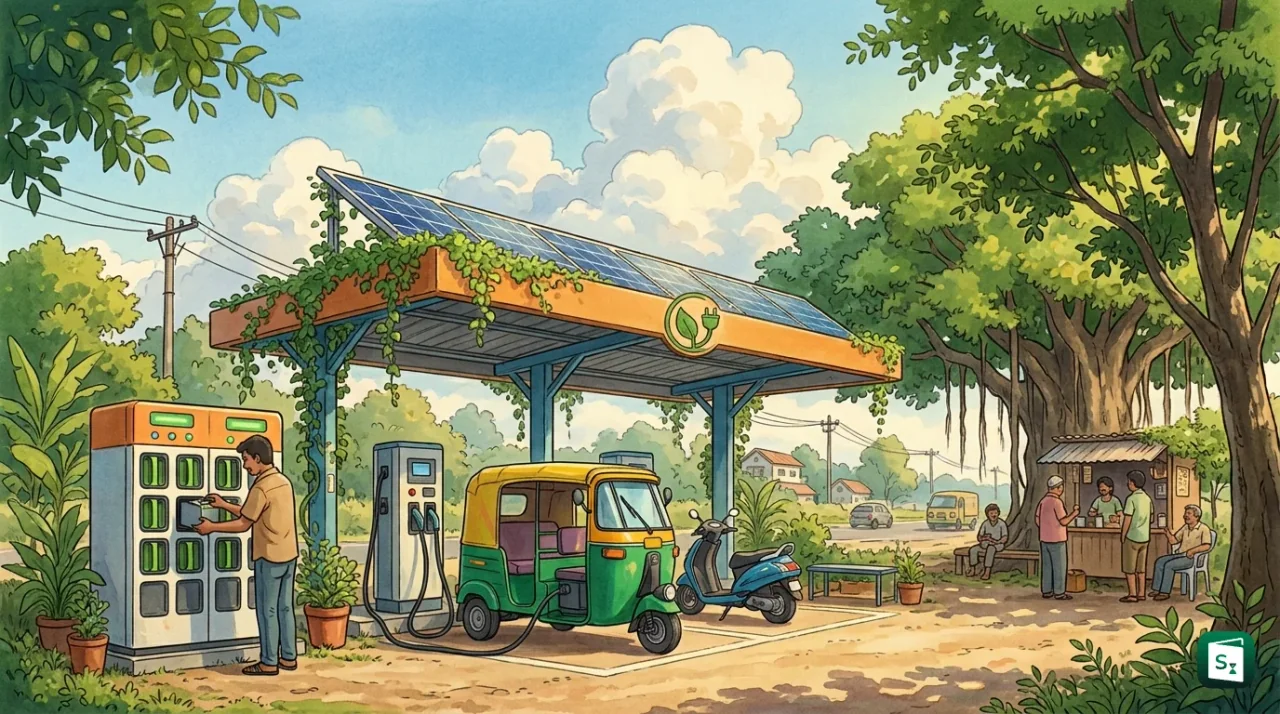
Bank of Baroda launched bob Green PLUG on 19 November 2026 to fund the setting up and expansion of electric vehicle charging stations and battery swapping units across India. The scheme offers term loans or demand loans from above ₹10 lakh to ₹5 crore to micro, small and medium enterprises. It aims to build a reliable charging network as electric vehicle sales rise under national schemes such as PM E-DRIVE.
What Is bob Green PLUG and Who Can Borrow?
bob Green PLUG is a dedicated financing scheme from Bank of Baroda for businesses that build and run electric vehicle charging infrastructure. Bank of Baroda is an Indian public sector bank founded on 20 July 1908 by Maharaja Sayajirao Gaekwad III of Baroda. The bank was nationalised on 19 July 1969. It is headquartered in Vadodara, Gujarat, with its corporate centre in Mumbai, and is the second largest public sector bank in India after the State Bank of India.
The bank announced the scheme on 19 November 2026. Bank of Baroda Executive Director Lal Singh said the scheme will give tailored loans for viable charging and battery swapping projects in cities, on highways and at key commercial places.
The scheme is open to micro, small and medium enterprises, known as MSMEs. MSMEs are businesses defined under the Micro, Small and Medium Enterprises Development Act with limits on investment and turnover. The eligible borrowers include:
- Startups working in electric mobility
- EV charging point operators
- Fuel stations and fleet operators
- Commercial establishments, logistics hubs and residential societies
- Other entities that set up public, private or captive charging facilities
What EV Charging and Battery Swapping Facilities Are Covered?
Bank of Baroda will finance both new charging sites and the expansion of existing sites. The loan covers public charging stations open to all users, private stations for a company fleet, captive stations for own use inside a campus or depot, and commercial EV charging networks that sell charging as a service.
The scheme also covers battery swapping stations and allied EV facilities. It supports renewable energy linked charging infrastructure, including rooftop solar powered charging stations. In such units, solar panels on the roof produce power that feeds the chargers and reduces grid load.
Funding for ancillary facilities such as cafeterias and utilities is capped. Bank of Baroda will fund such parts up to the lower of ₹1 crore or 25 percent of the total sanctioned loan. This keeps the focus on chargers and electrical work while allowing basic customer amenities at the site.
How Much Loan, At What Interest Rate and Repayment Terms?
Bank of Baroda offers the loan as a term loan or a demand loan. A term loan is repaid in fixed instalments over a set period. A demand loan is repayable when the bank asks for it, subject to agreed terms. The loan size under bob Green PLUG is fixed as follows.
| Loan Feature | Detail Under bob Green PLUG |
|---|---|
| Loan amount | Above ₹10 lakh to ₹5 crore |
| Loan type | Term loan or demand loan |
| Interest rate | 8.15 percent to 9.60 percent per year |
| Rate linkage | Linked to Baroda Repo Linked Lending Rate (BRLLR), loan amount and credit rating |
| Maximum tenure | 120 months, including moratorium |
| Moratorium | Up to 12 months |
BRLLR is the Baroda Repo Linked Lending Rate. It is the benchmark that moves with the repo rate. The repo rate is the rate at which the Reserve Bank of India (RBI) lends money to banks. RBI is the central bank of India established in 1935 and headquartered in Mumbai. When the repo rate changes, BRLLR also changes. The final rate for a borrower depends on the loan size and the credit rating of the firm.
The moratorium is the initial period when the borrower does not pay full instalments. Under this scheme, a project can get up to 12 months of moratorium to complete construction and start operations.
Eligible loans can get cover under the Credit Guarantee Fund Trust for Micro and Small Enterprises (CGTMSE). CGTMSE is a trust set up by the Government of India and the Small Industries Development Bank of India (SIDBI) to give guarantee cover for collateral free loans to micro and small firms. The cover helps small borrowers who lack property to pledge as security, subject to scheme rules.
What Is Battery Swapping in EVs?
Battery swapping is a system where an electric vehicle owner exchanges a discharged battery for a fully charged one at a swapping station instead of waiting to recharge. The station charges the returned batteries separately and keeps them ready for the next user. This cuts waiting time to a few minutes and lowers the upfront price when the vehicle is sold without the battery.
The model is called Battery as a Service (BaaS). Under BaaS, the user pays for battery use as a service and does not own the battery. It suits two wheelers, three wheelers, e-rickshaws and e-carts that run fixed routes in cities and need quick turnaround.
NITI Aayog released a draft battery swapping policy in April 2022. NITI Aayog is the public policy think tank of the Government of India formed on 1 January 2015 and headquartered in New Delhi. The draft proposed common technical and safety standards so batteries from one maker can work in vehicles from another maker. This quality is called interoperability. It also proposed a Unique Identification Number (UIN) for each battery and swapping station to track use, safety and life cycle, and better management of used batteries through reuse and recycling.
The policy noted tax and power issues. Lithium ion batteries attract 18 percent goods and services tax, while electric vehicle supply equipment attracts 5 percent. It suggested time of day power tariffs so stations can charge batteries at night when power is cheaper. Under the PM E-DRIVE scheme, battery swapping stations and battery charging stations get capital subsidy of 80 percent on upstream infrastructure such as transformers, cables and civil works.
What Is Green Finance and Where Does Green PLUG Fit?
Green finance is lending and investment that supports projects which cut carbon emissions, save energy, build climate resilience and protect nature. In banking, green finance means banks raise money through instruments such as green deposits and green bonds and lend that money only to verified green projects such as solar plants and clean transport.
The RBI issued the Framework for Acceptance of Green Deposits on 11 April 2023, effective from 1 June 2023. The framework was later folded into the RBI Commercial Banks Climate Finance Directions of 2025. It defines a green deposit as an interest bearing fixed period deposit where the proceeds are kept aside for green lending. It lists nine eligible uses, including renewable energy, energy efficiency and clean transportation. Building charging infrastructure for electric vehicles is listed under clean transportation. Banks must adopt a board approved financing framework, show the policy on the website and get third party verification and impact assessment of the use of funds.
Bank of Baroda raises such funds through the bob Earth Green Term Deposit. The product offers tenors such as 1 year, 1.5 years, 777 days, 1111 days, 1717 days and 2201 days for amounts up to ₹10 crore. Deposits below ₹3 crore earn extra interest for senior citizens. The bank channels the money to green projects and publishes framework and assurance reports under its BOB Earth drive.
On the borrowing side, the Government of India approved the Framework for Sovereign Green Bonds on 9 November 2022. The government raised ₹16,000 crore through sovereign green bonds in 2022-23 in two tranches of ₹8,000 crore each. The proceeds support public sector projects in renewable energy, clean transportation and related areas. bob Green PLUG sits on the lending side of this chain. It gives banks a ready way to lend for clean transport, which is a recognised green use under both the RBI framework and the sovereign bond framework.
Why Bank Funding Matters for EV Charging Infrastructure in India
India has a large gap between electric vehicle sales and public chargers. The government has reported 49,909 public charging stations as on 30 March 2026 and 67,657 chargers as on 7 August 2026, including 1,139 battery swapping stations. Under FAME-II, which ran from April 2019 to March 2024 with support of ₹11,500 crore, about 9,583 public charging stations were installed.
The PM E-DRIVE scheme was notified in September 2024 with an original outlay of ₹10,900 crore and later extended to 31 March 2028. The scheme supports around 28.3 lakh electric vehicles and has earmarked ₹2,000 crore for public charging stations. Operational guidelines for charging stations were issued on 26 September 2025. No chargers had been installed under the scheme as on 22 July 2026, though proposals for over 5,800 chargers across nine states were approved.
Setting up a station is costly. Costs include land, power connection from the distribution company, civil works, transformers and cables, and the charger itself. Upstream electrical works alone can form a large share of the total cost. The Bureau of Energy Efficiency (BEE) sets benchmark costs for subsidy calculation. BEE operates under the Ministry of Power and was established in 2002 under the Energy Conservation Act, 2001. Current benchmarks include ₹3.40 lakh for a 60 kW CCS-II charger, ₹5 lakh for 120 kW, ₹8 lakh for 240 kW and ₹12.50 lakh for 360 kW. Subsidy under PM E-DRIVE is a share of the lower of the benchmark or the actual cost, up to 100 percent at government premises and lower shares elsewhere.
Private players can set up stations without a licence under Ministry of Power guidelines dated 17 September 2024. But many charge point operators face thin margins and low use in early years. Long term bank loans with a moratorium reduce this pressure. A loan of up to 10 years with up to one year of moratorium, as offered under bob Green PLUG, lets the operator build the site, secure power and grow usage before full repayment starts. Solar linked charging can further cut running costs.
Key Takeaways
- Bank of Baroda launched bob Green PLUG on 19 November 2026 to finance EV charging and battery swapping projects.
- The scheme offers term loans or demand loans from above ₹10 lakh to ₹5 crore to MSME borrowers.
- Interest is 8.15 percent to 9.60 percent per year linked to BRLLR, with tenure up to 120 months including 12 months moratorium.
- Eligible loans can seek guarantee cover under CGTMSE, which supports collateral free lending to micro and small firms.
- Charging infrastructure is a recognised clean transportation use under the RBI green deposit framework of 2023 and the sovereign green bond framework of 2022.