India observes Public Service Broadcasting Day, or Jan Prasaran Diwas, every year on 12 November. The day marks Mahatma Gandhi’s first and only visit to the All India Radio studio at Broadcasting House in New Delhi on 12 November 1947. On that Diwali afternoon, Gandhi addressed more than two lakh Partition refugees sheltered at Kurukshetra through a live broadcast.
What Is Public Service Broadcasting?
Public service broadcasting is radio and television run to serve public interest rather than profit. Its mandate is to inform, educate and entertain all citizens, with special attention to education, health, agriculture, national integration and cultural diversity. In India, Akashvani and Doordarshan perform this role under Prasar Bharati.
The word prasaran means broadcast in Hindi. Jan Prasaran Diwas therefore means People’s Broadcast Day. The word Akashvani means voice from the sky. It has been the popular name for All India Radio since 1956.
Commercial channels earn mainly from advertising and focus on ratings. Public service channels give priority to school education, farm weather, health messages, disaster alerts and programmes in many languages and dialects. They reach remote areas where private stations may not go.
In India, this duty is written in law. The Prasar Bharati (Broadcasting Corporation of India) Act, 1990 says the corporation must organise public broadcasting to inform, educate and entertain the public. The Act lists goals such as protecting national unity, giving citizens fair and truthful information, spreading literacy, supporting agriculture and rural development, covering diverse cultures and languages, and serving women, youth, minorities, tribal communities and border areas. Prasar Bharati came into existence on 23 November 1997. Its headquarters is in New Delhi. Its radio arm is Akashvani, earlier called All India Radio. Its television arm is Doordarshan. Its motto is Bahujan Hitaya Bahujan Sukhaya, which means welfare and happiness of the masses.
Why Is November 12 Special in India?
November 12 is special in India because Mahatma Gandhi made his first and only visit to the All India Radio studio in New Delhi on this date in 1947. He spoke live to displaced families at Kurukshetra on Diwali day. India has observed the date as Jan Prasaran Diwas since 2001.
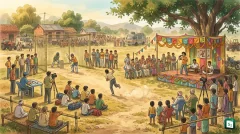
Partition in August 1947 forced millions to leave their homes. Large numbers of refugees from newly formed Pakistan gathered in camps across northern India. The camp at Kurukshetra in present day Haryana held more than two lakh people, and more were arriving daily.
Gandhi wanted to meet them in person. He could not leave Delhi because meetings of the Congress Working Committee required his presence. Industrialist Ghanshyamdas Birla suggested that Gandhi speak to the camp through radio.
What Happened During Gandhi’s 1947 Visit to All India Radio
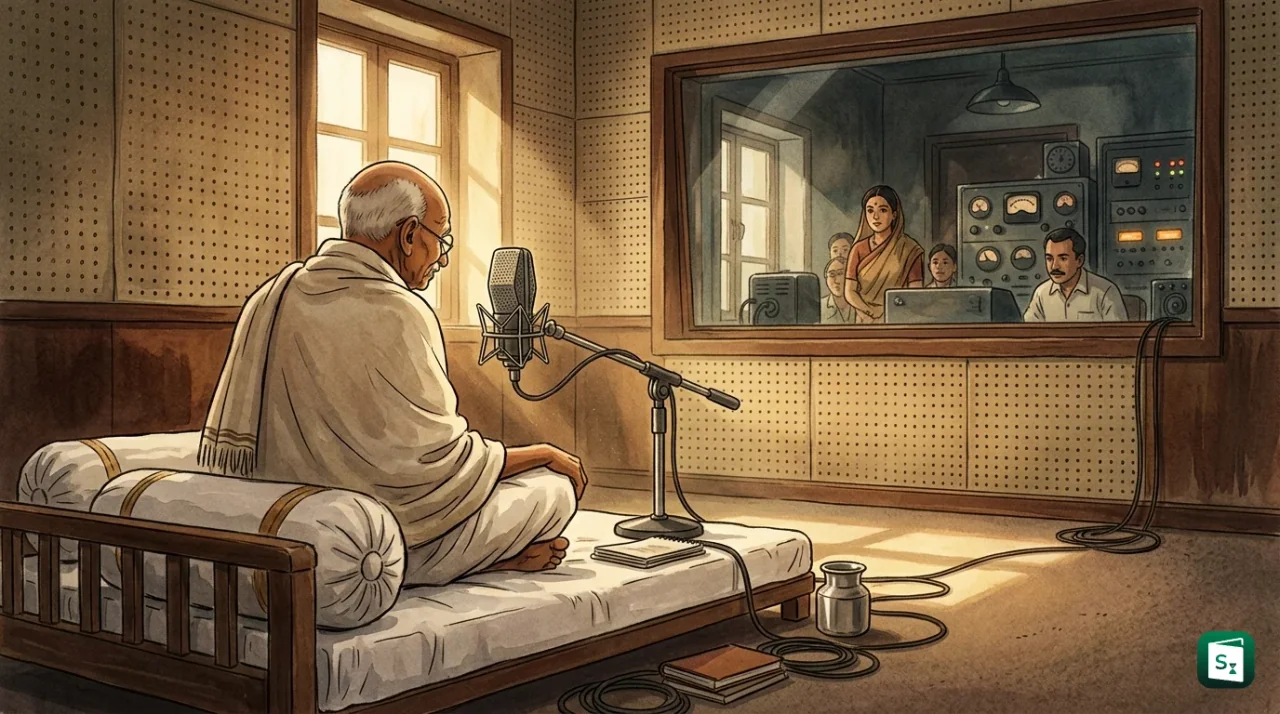
Gandhi reached Broadcasting House in New Delhi at about 3:30 pm on 12 November 1947. Freedom fighter and Health Minister Rajkumari Amrit Kaur went with him. Staff had arranged the studio to resemble his daily prayer meeting. They placed a low wooden seat called a takhposh for him to sit on.
On entering the studio, Gandhi described radio as a wondrous thing. He said he saw in it shakti, the miraculous power of God. This was only his second experience with radio. His first had been a brief address during the Round Table Conference in London on 13 September 1931.
He spoke in Hindustani for about 20 minutes. He opened with the words, “My suffering brothers and sisters.” He said he longed to be among the refugees and share their pain. He asked them to face suffering with patience and courage.
Gandhi noted that the day was Diwali. He said there could be no lighting of lamps that year. True celebration, he said, lay in service to the displaced and in camp residents living like brothers. He urged clean surroundings, fair sharing of rations, community kitchens and useful work instead of dependence on relief. He also said he would work to ensure that displaced families could return to their homes with honour and safety.
The address was carried to Kurukshetra, where officials had placed large radio sets and loudspeakers for the crowd. The speech was later published in Harijan on 23 November 1947. After this visit, All India Radio began recording Gandhi’s evening prayer speeches at Birla House. Young programme officer K. D. Madan recorded the talks each evening from September 1947 to 29 January 1948. The station broadcast them at 8:30 pm before the national news. The Prasar Bharati Archives preserves 147 speeches of Gandhi, including the 12 November broadcast.
How Jan Prasaran Diwas Was Declared and Observed
India marked the 50th anniversary of Gandhi’s broadcast with a special function at All India Radio premises on 12 November 1997. The idea of an annual day was developed by Suhas Borker, convenor of Jan Prasar, a group working on people centred communication. In 2000, Information and Broadcasting Minister Sushma Swaraj announced that 12 November would be observed every year as Public Service Broadcasting Day. Regular national observance began in 2001.
Akashvani organises special programmes on this day at its Delhi headquarters and across stations. Artists render bhajans dear to Gandhi. Stations hold discussions on Gandhian thought, non violence, communal harmony and the role of radio in rural uplift.
The programmes run through the year. They include features on village development, sanitation, women’s welfare, national integration and freedom of expression. The aim is to remind broadcasters that radio must serve every corner of the country.
A lasting memorial now stands inside the Delhi complex. In March 2023, on the occasion of the 100th episode of the Prime Minister’s monthly radio address Mann Ki Baat, Akashvani dedicated the original studio as Bapu Studio. The room houses a recording of the 1947 speech, excerpts from prayer meetings, photographs of the visit and objects linked to that day.
From All India Radio to Akashvani: History of India’s Public Broadcaster
Radio broadcasting in India began with amateur clubs. The Radio Club of Bombay made the first broadcast in June 1923. The Calcutta Radio Club followed in November 1923. Organised broadcasting started when the private Indian Broadcasting Company opened its Bombay station on 23 July 1927 and its Calcutta station on 26 August 1927.
The company closed in March 1930. The government took over operations on 1 April 1930 as the Indian State Broadcasting Service. Senior BBC producer Lionel Fielden became the first Controller of Broadcasting in August 1935. A private station called Akashvani Mysore started on 10 September 1935. The first news bulletin from Delhi went on air on 19 January 1936. On 8 June 1936, the service was renamed All India Radio.
The Central News Organisation was set up on 1 August 1937. At Independence in 1947, India had six radio stations at Delhi, Bombay, Calcutta, Madras, Tiruchirapalli and Lucknow. Three stations went to Pakistan. Coverage then stood at about 2.5 percent of the area and 11 percent of the population.
The name Akashvani was adopted for the national broadcaster in 1956. The name draws on a poem written by Rabindranath Tagore for the inauguration of the Kolkata short wave station in 1938. In May 2023, the government ordered that the broadcaster be called only Akashvani in programmes, in line with the Prasar Bharati Act. Both names are still widely understood.
Growth was rapid after Independence. The Vividh Bharati film music service began on 3 October 1957. Television started as an experiment under All India Radio on 15 September 1959 and later became Doordarshan. Doordarshan became a separate department on 1 April 1976. The first FM service began from Madras on 23 July 1977.
Today Akashvani is one of the largest radio networks in the world. Its home service has about 470 broadcasting centres. It covers nearly 92 percent of the area and more than 99 percent of the population. It broadcasts in 23 languages and 179 dialects. Its External Services Division reaches listeners in more than 100 countries.
National Broadcasting Day vs Public Service Broadcasting Day vs World Radio Day
Readers often mix three radio related observances. The table below sets out the difference. National Broadcasting Day marks the start of organised broadcasting in India. Public Service Broadcasting Day marks Gandhi’s use of radio for public good. World Radio Day celebrates radio as a global medium.
| Feature | National Broadcasting Day | Public Service Broadcasting Day | World Radio Day |
|---|---|---|---|
| Date | 23 July every year | 12 November every year | 13 February every year |
| Also called | Rashtriya Prasaran Diwas | Jan Prasaran Diwas | No alternate Indian name |
| Commemorates | First organised broadcast from Bombay station under Indian Broadcasting Company on 23 July 1927 | Gandhi’s first and only All India Radio broadcast to Kurukshetra refugees on 12 November 1947 | Establishment of United Nations Radio on 13 February 1946 |
| Observed since | Annual observance linked to 1927 origin | Announced in 2000, observed nationally since 2001 | Proclaimed by UNESCO in 2011, endorsed by UN General Assembly in 2012 |
| Focus in India | Growth of radio, its role in education and culture | Public service values of radio, Gandhian ideals | Global trust in radio, access to information, emergency use |
The United Nations Educational, Scientific and Cultural Organization (UNESCO) is headquartered in Paris. It chose 13 February because UN Radio began on that date in 1946. World Radio Day highlights low cost access, reach to remote areas and use during disasters. Its themes change each year. Recent themes have covered trust, peace and the impact of artificial intelligence.
Key Takeaways
- Public Service Broadcasting Day is observed every year on 12 November as Jan Prasaran Diwas.
- Gandhi made his first and only All India Radio broadcast from Broadcasting House in New Delhi on 12 November 1947 to refugees at Kurukshetra.
- The day was announced in 2000 by Information and Broadcasting Minister Sushma Swaraj and has been observed nationally since 2001 on the idea of Suhas Borker of Jan Prasar.
- All India Radio was formed on 8 June 1936, adopted the name Akashvani in 1956, and now operates under Prasar Bharati, which was established on 23 November 1997.
- National Broadcasting Day falls on 23 July while World Radio Day falls on 13 February to mark the start of UN Radio in 1946.