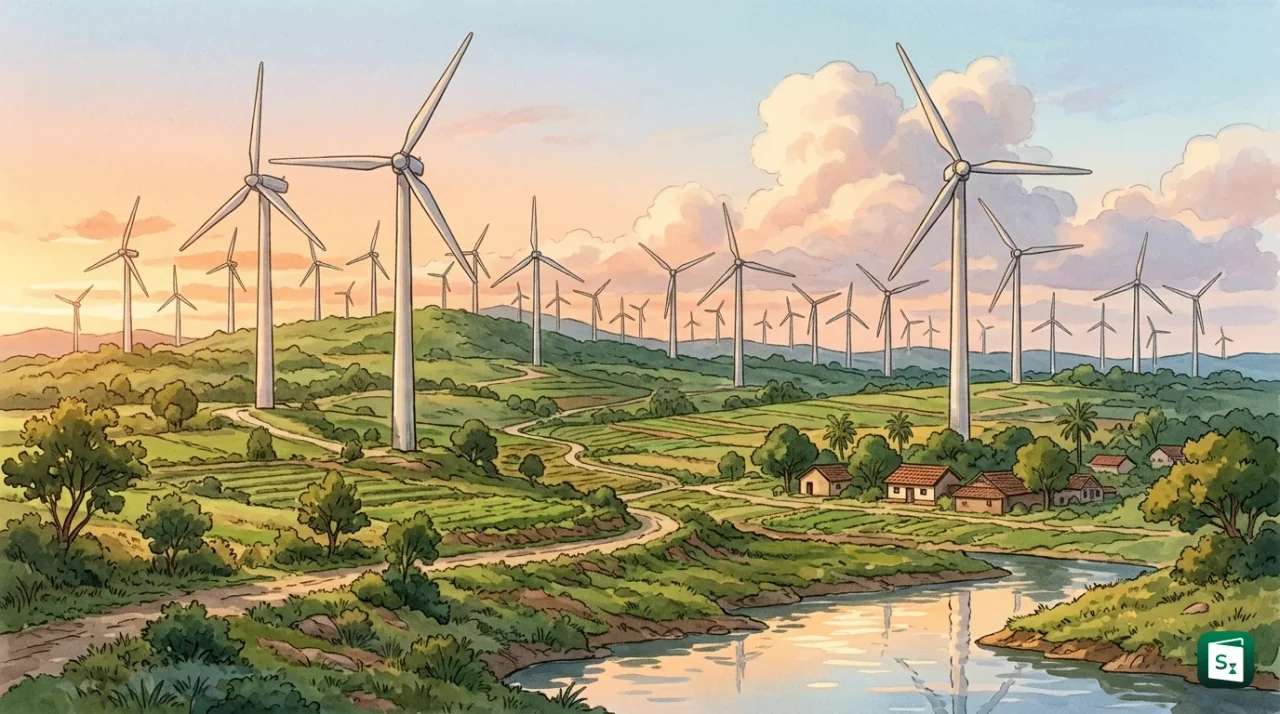
Amazon announced on 17 November 2026 that it will invest an additional $7 billion in renewable energy projects in India by 2030. This is over and above $4 billion already contracted through Power Purchase Agreements, taking its total commitment to $11 billion. The plan includes four new wind and solar projects with 934 MW capacity, including a 234 MW wind farm in Karnataka, its largest contracted wind project in Asia.
What Is Renewable Energy and Why Is It Important for India?
Renewable energy is power generated from natural sources that refill themselves, mainly solar, wind, hydro, bioenergy and small hydro. In India it reduces dependence on coal and imported oil, cuts air pollution and carbon emissions, and supports energy security for a fast growing economy with rising electricity demand.
The Ministry of New and Renewable Energy (MNRE) is the nodal central ministry for renewable energy in India. It sets targets, frames policies and supports capacity growth through schemes for solar parks, wind development, rooftop solar and green hydrogen.
India has expanded capacity at speed in recent years. As of 31 July 2026, India had about 308 GW of non-fossil fuel based installed capacity, which was about 55 percent of total installed power capacity of around 560 GW. India ranks third globally in renewable energy installed capacity. Solar is the largest part with about 175 GW by October 2026, while wind capacity stood at about 59.20 GW.
| Source | How It Works | Key Feature in India |
|---|---|---|
| Solar energy | Electricity from sunlight using solar panels | Largest renewable source, about 175 GW installed |
| Wind energy | Electricity from moving air using turbines | Fourth largest wind capacity in the world, about 59.20 GW |
| Hydro power | Electricity from flowing water | Provides steady power and helps balance solar and wind |
| Bioenergy | Electricity from farm waste, biomass and waste to energy | About 11.75 GW capacity, useful for rural supply |
Renewable energy can lower long term power costs once plants are built, because sunlight and wind have no fuel cost. It also helps India move toward its climate goals without slowing industrial growth and job creation.
What Has Amazon Announced for Renewable Energy Investment in India by 2030?
Amazon announced that it will invest an additional $7 billion in renewable energy projects in India by 2030. This amount is separate from $4 billion that Amazon has already contracted in the country. Together, the existing and planned investments add up to $11 billion.
With this scale, Amazon has become one of the largest corporate buyers of carbon free energy in India. Corporate buying means a private company agrees to purchase clean power directly from wind and solar developers, instead of buying only standard grid supply.
Amazon said the new investment will help add more wind and solar capacity to the grid, support modern energy infrastructure and create jobs. Kara Hurst, Chief Sustainability Officer at Amazon, said the investment reflects long term planning with industry partners and will support energy security and long term renewable energy goals.
Pralhad Joshi, Union Minister for New and Renewable Energy, welcomed the move. He said such investments support clean energy goals, strengthen energy security and show growing global confidence in India as a destination for long term green investment.
Amazon links the India plan to its global electricity goal. The company now aims to cut the carbon intensity of electricity used in its operations by 65 percent by 2030 from a 2019 baseline. Carbon intensity means emissions per unit of electricity used.
The target covers power generated on site and purchased electricity, and follows the International Energy Agency (IEA) Net Zero by 2050 pathway. It is a step toward the Climate Pledge, co-founded by Amazon and Global Optimism in 2019, to reach net zero carbon across operations by 2040.
Four New Wind and Solar Projects in Karnataka, Madhya Pradesh and Rajasthan
Amazon announced four new utility scale wind and solar projects with a combined capacity of 934 MW. Utility scale means large plants that feed power into the grid, not small rooftop units. The four projects are part of the existing $4 billion contracted portfolio, not extra capacity over it.
| Project Location | Capacity | Type | Developer |
|---|---|---|---|
| Bijapur in Karnataka | 234 MW | Wind | Sunsure Energy |
| Tumkur in Karnataka | 200 MW | Solar and wind hybrid | Sunsure Energy |
| Mandsaur in Madhya Pradesh | 300 MW | Solar | Waaree |
| Dinkar in Rajasthan | 200 MW | Solar | ReNew |
The 234 MW wind farm in Bijapur, also called Vijayapura, is the largest wind project Amazon has contracted in Asia to date. Sunsure Energy is developing it as part of a larger 300 MW interstate transmission system connected project, with commissioning targeted for September 2027. The 200 MW hybrid project in Tumkur, also called Tumakuru, is part of a 300 MW project with commissioning targeted for June 2028.
Once all contracted projects are operational, Amazon expects its India renewable portfolio to cross 2 GW in capacity. The company estimates this clean power will equal the annual electricity needs of more than 3.5 million Indian households.
Amazon now has 57 projects in India for clean power. This includes 14 utility scale wind and solar projects that add new carbon free power to the grid, and 43 on site solar installations on its own buildings and facilities. Globally, Amazon has invested in more than 700 carbon free energy projects with over 40 GW capacity, enough to power more than 12.1 million homes in the United States once complete.
What Is a Power Purchase Agreement in Renewable Energy?
A Power Purchase Agreement is a long term contract in which a buyer agrees to purchase electricity from a specific power plant at a fixed price for many years. In renewable energy in India, companies like Amazon use corporate PPAs to buy wind and solar power directly from developers.
Under a corporate Power Purchase Agreement (PPA), the developer builds, owns and maintains the wind or solar plant. The company agrees to buy a set quantity of power for a fixed period, often 10 to 25 years. The price, delivery schedule, payment terms and penalties for short supply are written into the contract.
This model helps both sides. The developer gets a steady payment stream, which makes it easier to raise loans and build large plants. The buyer gets predictable power costs and proof of clean energy use for its climate targets. In India, such power is often moved through the grid using open access rules, where the buyer pays network charges to receive power generated elsewhere.
How Amazon Investment Supports India 500 GW Target and Climate Goals
India has set a target of 500 GW of non-fossil fuel based installed electricity capacity by 2030. Non-fossil includes solar, wind, hydro, nuclear and other clean sources. India had already reached 50 percent non-fossil share in installed capacity in 2025, five years early. Officials now say the 500 GW target may be met before 2030, after adding 56 GW in the previous year.
Large corporate investments help close the funding gap. The government estimates India needs about $220 billion to add the remaining capacity to reach 500 GW. Amazon planned $11 billion pipeline is one part of this flow, alongside domestic and foreign direct investment.
The power from projects like the Karnataka wind farm adds clean units to the national grid. India generated 477.79 billion units from renewable sources in 2025-26, up from 190.96 billion units in 2014-15. The renewable share in total electricity generation rose to about 25.97 percent in 2025-26. More wind and solar supply helps meet rising peak demand, which touched 270 GW in 2026, with renewables meeting about 40 percent of peak needs.
Challenges remain in land availability, transmission lines and grid management because solar and wind output changes with weather. The government is expanding the Green Energy Corridor and interstate transmission system, setting up Renewable Energy Management Centres for forecasting, and promoting battery storage, pumped storage and the National Green Hydrogen Mission. India aims for net zero emissions by 2070, while Amazon aims for net zero by 2040 for its own operations. Corporate PPAs therefore support both national energy security and company level emission cuts.
Key Takeaways
- Amazon announced an additional $7 billion investment in renewable energy in India by 2030, taking its total commitment to $11 billion including $4 billion already contracted.
- Amazon announced four new projects totalling 934 MW in Karnataka, Madhya Pradesh and Rajasthan through long term Power Purchase Agreements.
- The 234 MW wind farm in Bijapur, Karnataka, developed by Sunsure Energy, is the largest wind project contracted by Amazon in Asia to date.
- Once operational, Amazon contracted portfolio in India will exceed 2 GW and supply power equal to the needs of more than 3.5 million households.
- India targets 500 GW of non-fossil capacity by 2030 and net zero by 2070, while Amazon targets a 65 percent cut in electricity carbon intensity by 2030 and net zero by 2040 under the Climate Pledge.