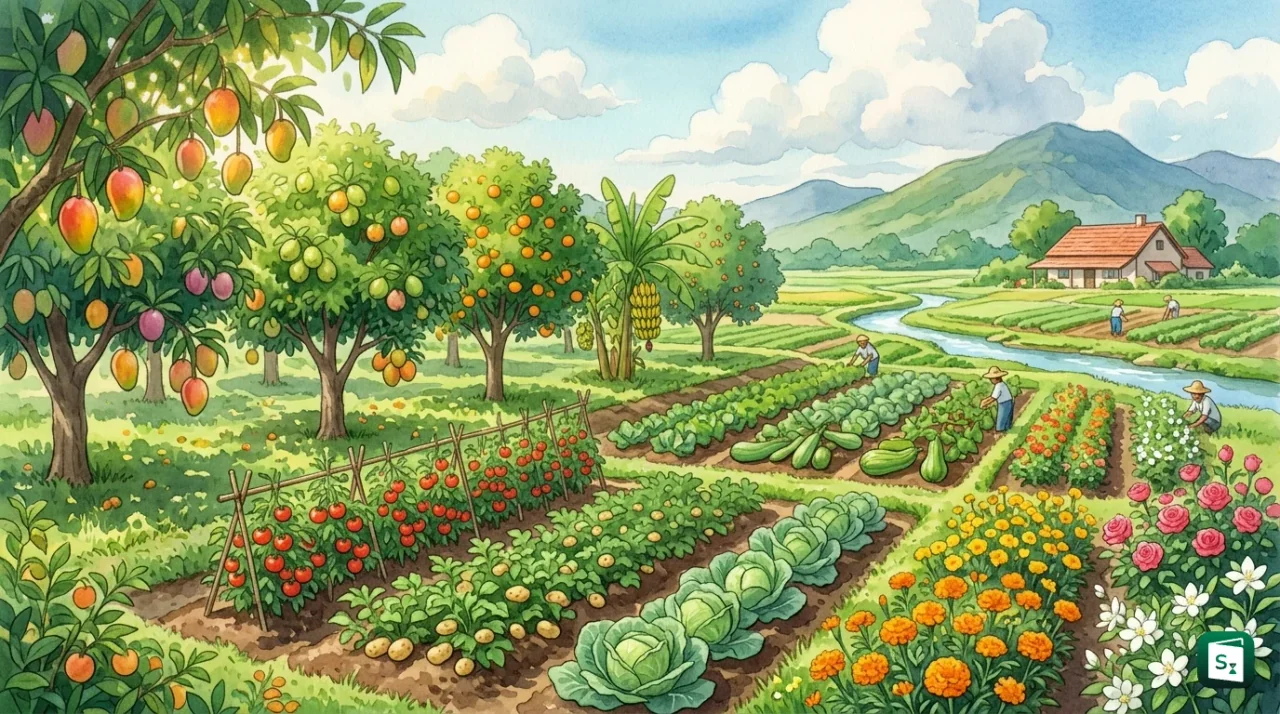
The Union Minister for Agriculture and Farmers Welfare, Shivraj Singh Chouhan, released the Third Advance Estimate of horticultural crops for 2025-26 on 17 November 2026. The estimate places total horticulture production in India at 3,869.15 lakh tonnes, higher by 161.77 lakh tonnes or 4.36 percent over the 3,707.38 lakh tonnes recorded in 2024-25. The striking feature is that output rose to a record even though the area under horticulture fell to 297.21 lakh hectares.
What Is Horticulture and How Is It Different From Agriculture?
Horticulture is the science and practice of growing high value garden crops for food, medicine and decoration. The word comes from the Latin words hortus, meaning garden, and cultura, meaning cultivation. Horticultural crops include fruits, vegetables, flowers, spices, plantation crops such as coconut, cashew, arecanut and cocoa, and aromatic and medicinal plants.
Horticulture differs from field agriculture in method and value. Field agriculture grows cereals such as wheat and rice on large areas with extensive methods. Horticulture uses intensive care on smaller plots, with close planting, irrigation, pruning, grading, packing, cold storage and quick transport, because most fruits, vegetables and flowers are perishable. The reward for this effort is higher income per hectare, which is why one hectare shifted from cereals to fruits or vegetables can raise annual farm income sharply.
The subject has clear branches. Pomology deals with fruit crops such as mango, banana, guava, apple and papaya. Olericulture deals with vegetable crops such as potato, onion, tomato, brinjal and cabbage. Floriculture covers flowers such as rose, marigold, jasmine and carnation for commercial sale and for decoration. Plantation crops, spices and condiments, and medicinal and aromatic plants form the other major branches. M. H. Marigowda is widely regarded as the father of Indian horticulture.
Horticulture holds a large place in the Indian economy. India is the second largest producer of fruits and vegetables in the world after China, and the largest producer, consumer and exporter of spices. Horticulture occupies only about 13 to 14 percent of cropped area but contributes about one third of the value of agricultural output. The rapid growth of this sector between 1991 and 2003 is called the Golden Revolution, a period when planned investment made fruits, vegetables, flowers and related crops a stable source of income, nutrition and rural jobs.
What the Third Advance Estimate for 2025-26 Shows
The Department of Agriculture and Farmers Welfare compiled the Third Advance Estimate from reports sent by states, union territories and other government agencies. The headline figure is 3,869.15 lakh tonnes, which equals about 386.9 million tonnes. The increase of 161.77 lakh tonnes over 2024-25 works out to 4.36 percent.
The total area under horticulture in 2025-26 is estimated at 297.21 lakh hectares, lower than 301.36 lakh hectares in 2024-25. The fall of about 4.15 lakh hectares means production grew while land shrank, which points to higher productivity.
The table below compares the final figures for 2024-25 with the Third Advance Estimate for 2025-26.
| Crop group | 2024-25 production in lakh tonnes | 2025-26 Third Estimate in lakh tonnes | Change |
|---|---|---|---|
| Total horticulture | 3,707.38 | 3,869.15 | Up 4.36 percent |
| Fruits | 1,176.49 | 1,230.66 | Up 4.60 percent |
| Vegetables | 2,177.97 | 2,272.68 | Up 4.35 percent |
| Flowers | 42.65 | 48.82 | Up 14.45 percent |
| Plantation crops | 169.81 | 182.64 | Up 7.56 percent |
| Aromatic and medicinal plants | 9.01 | 9.28 | Up about 3 percent |
| Spices | 129.93 | 123.54 | Lower than last year |
The Third Estimate is also sharply higher than the Second Advance Estimate released in June 2026, which had placed 2025-26 output at 3,777.76 lakh tonnes. The upward revision in five months reflects better harvest reports received later in the season.
How Fruits, Vegetables and Flowers Performed in 2025-26
Fruits, vegetables and flowers together account for most of the growth in the latest estimate. Each group has a distinct story.
Fruit production rises on banana, mango and apple
Fruit production is estimated at 1,230.66 lakh tonnes in 2025-26, an increase of 54.18 lakh tonnes over 2024-25. The rise of 4.60 percent is linked to better output of banana, mango, papaya, apple, pomegranate and jackfruit. India already ranks first in the world in banana, mango, papaya, pomegranate and sapota. Better planting material, expansion of orchards in suitable zones and favourable weather in major fruit belts supported the gain.
Vegetable production led by potato and tomato
Vegetable production is estimated at 2,272.68 lakh tonnes, up by 94.71 lakh tonnes or 4.35 percent. The area under vegetables increased from 117.91 lakh hectares to 119.31 lakh hectares, so vegetables were the main group where both area and output moved up together.
Growth came from potato, tomato, brinjal, bottle gourd, cucumber, cabbage, beans and peas. Potato production is placed at 655.70 lakh tonnes, up 11.95 percent from 585.71 lakh tonnes in 2024-25. Tomato production is placed at 214.11 lakh tonnes, up from 205.99 lakh tonnes. Onion production is estimated at 288.96 lakh tonnes. These three crops matter for daily food supply and price stability, so their performance is watched closely.
Flower production records the fastest growth
Flower production shows the fastest rate of growth among the major groups. Output is estimated at 48.82 lakh tonnes, up from 42.65 lakh tonnes, a rise of about 14.45 percent. The area under flower cultivation increased to 4.10 lakh hectares. The group includes both loose flowers such as marigold and jasmine and cut flowers such as rose and carnation. Rising demand for decoration, religious use and urban markets, along with protected cultivation in polyhouses, has lifted floriculture in recent years.
Plantation crops, spices and medicinal plants
Production of plantation crops, which include arecanut, coconut, cashew, betel leaves and cocoa, is estimated at 182.64 lakh tonnes, up 7.56 percent. Both area and production rose in this group.
Production of aromatic and medicinal plants such as lemongrass, mentha, tulsi and ashwagandha is estimated at 9.28 lakh tonnes, up from 9.01 lakh tonnes.
Spices present a mixed picture. The area under spices is placed at 47.56 lakh hectares and production at 123.54 lakh tonnes, supported by turmeric, garlic, curry leaves and cardamom, according to data from the Directorate of Arecanut and Spices Development. The production figure for 2025-26 is lower than the 2024-25 final figure of 129.93 lakh tonnes, so spices did not add to the overall increase in this advance estimate.
Why Production Rose Even as Cultivated Area Fell
Higher output from less land reflects better yield per hectare. A rough average for all horticulture works out to about 13 tonnes per hectare in 2025-26, against about 12.3 tonnes in 2024-25. The gain came from more use of quality planting material, micro irrigation, protected cultivation and post harvest care, along with a shift toward high value crops.
Public programmes support this shift. The Mission for Integrated Development of Horticulture (MIDH), a centrally sponsored scheme in operation since 2014-15, promotes holistic growth of horticulture in all states and union territories. It has added about 15.66 lakh hectares under horticulture crops and supports quality seeds and planting material, micro irrigation, cold chains and market links. Its sub schemes include Centres of Excellence, the Horticulture Cluster Development Programme, the Clean Plant Programme for disease free planting material, and post entry quarantine facilities.
The National Horticulture Board (NHB), set up in 1984 as an autonomous body under the Ministry of Agriculture and Farmers Welfare and headquartered at Gurugram, promotes commercial horticulture, cold storage and technology transfer. It now works as part of MIDH. Together, these institutions help farmers reduce losses, store perishable produce for longer, and sell graded produce at better prices.
Diversification itself raises income. Farmers are moving from cereals alone toward fruits, vegetables, flowers, spices, plantation crops and medicinal plants. These crops give higher market value per unit of land, improve nutrition supply, and create work in grading, packing, processing and transport. For small farmers, even a small orchard or vegetable plot can add a steady cash flow across the year.
How Advance Estimates Are Prepared and Revised
Horticulture figures in India are released in stages because harvests finish at different times in different states. The Department of Agriculture and Farmers Welfare issues a First, Second and Third Advance Estimate during the crop year, and a Final Estimate after all state data are verified. Each advance estimate uses the reports available at that time.
That is why numbers move between releases. The First Advance Estimate for 2025-26, released in March 2026, placed output at 3,708.46 lakh tonnes. The Second Estimate in June 2026 raised it to 3,777.76 lakh tonnes. The Third Estimate in November 2026 raised it further to 3,869.15 lakh tonnes. The 2024-25 cycle shows the same pattern. Its third estimate was about 369 million tonnes, while the final figure settled at 370.74 million tonnes. The current figure for 2025-26 should therefore be read as the best available estimate, not the final total.
Key Takeaways
- The Third Advance Estimate for 2025-26 places total horticulture production at 3,869.15 lakh tonnes, up 4.36 percent over 3,707.38 lakh tonnes in 2024-25.
- Fruit production is estimated at 1,230.66 lakh tonnes and vegetable production at 2,272.68 lakh tonnes, with potato at 655.70 lakh tonnes leading the vegetable gain.
- Flower production rose by about 14.45 percent to 48.82 lakh tonnes, the fastest growth rate among major horticulture groups.
- Total horticulture area fell to 297.21 lakh hectares in 2025-26, so the record output reflects higher productivity rather than larger area.
- The National Horticulture Board was set up in 1984 at Gurugram, while the Mission for Integrated Development of Horticulture has operated since 2014-15 to support the sector.