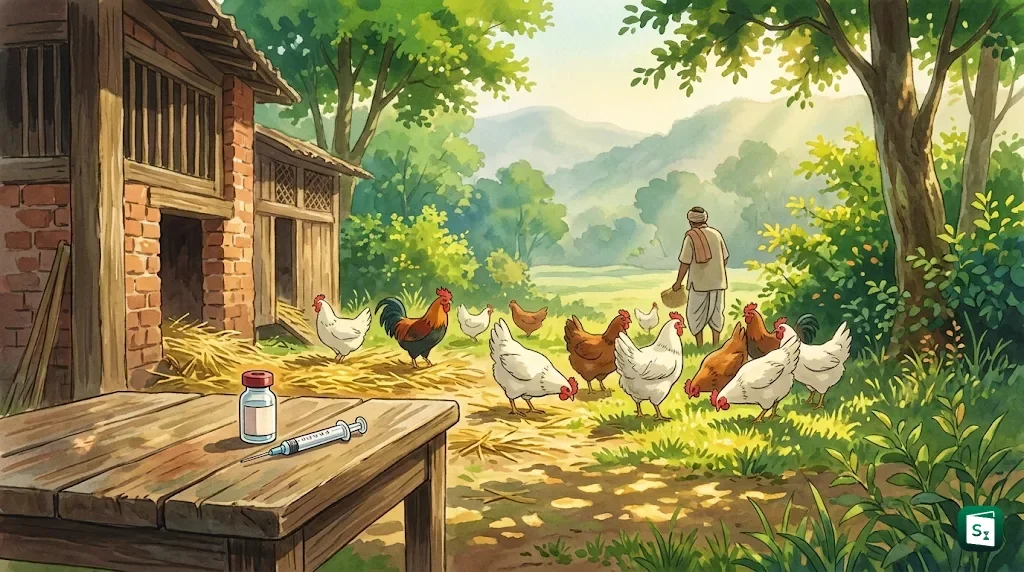
Union Agriculture Minister Shivraj Singh Chouhan dedicated India’s first indigenous H5N1 bird flu vaccine for chickens on 20 November 2026 at ICAR-NIHSAD in Bhopal. The inactivated vaccine targets H5N1 Clade 2.3.2.1a and costs only ₹1 to ₹2 per dose. The Minister also announced a ₹300 crore Biosafety Level-4 laboratory at the institute to strengthen high risk pathogen research.
What Is Bird Flu and What Is H5N1?
Avian influenza, commonly called bird flu, is a highly infectious respiratory disease of birds caused by influenza A viruses. H5N1 is a subtype of this virus, named after two proteins on its surface, hemagglutinin 5 and neuraminidase 1. The new Indian vaccine targets a genetic subgroup of this subtype called Clade 2.3.2.1a, which has caused most bird flu outbreaks in Indian chickens since 2011.
Influenza A viruses that infect birds fall into two groups based on how sick they make chickens. Low Pathogenic Avian Influenza (LPAI) causes mild signs such as ruffled feathers, a small drop in egg production and slight breathing difficulty. Highly Pathogenic Avian Influenza (HPAI) causes sudden and severe disease, with death rates that can reach nearly 100 percent in chickens within 48 hours.
| Term | What It Means |
|---|---|
| Avian influenza | Flu infection of birds caused by influenza A viruses, with wild water birds as natural hosts |
| H5N1 | A subtype defined by H5 and N1 surface proteins, known for severe disease in poultry |
| HPAI | Highly pathogenic form that kills a very large share of infected chickens and spreads fast |
| Clade 2.3.2.1a | A genetic branch of H5N1 now dominant in poultry in India and Bangladesh |
Signs of HPAI in chickens include sudden deaths, stoppage of egg laying, soft shelled eggs, swelling of the head, blue colour of comb and wattles, greenish diarrhoea, laboured breathing and nervous signs such as twisted neck and poor coordination. Ducks and geese may show fewer signs but can still carry and shed the virus through droppings and respiratory secretions.
Why India Needed Its Own H5N1 Vaccine
India reported its first bird flu outbreak in February 2006 at Navapur in Maharashtra. Since then the country has recorded more than 500 outbreaks of H5N1 and H5N8 combined. Between 2006 and 2021 alone, India recorded 341 outbreaks across 24 states, with 284 linked to H5N1 and 57 to H5N8.
The losses have been heavy. The 2006 outbreak killed about 10 lakh chickens and led to culling of lakhs more birds. It caused direct and indirect losses estimated at ₹2,200 crore to ₹3,000 crore. Across all outbreaks, more than 9 million birds have been culled to stop the spread. Estimates cited by the Indian Council of Agricultural Research (ICAR) warn that a major outbreak could place more than 20 percent of the national poultry flock at risk and shave up to 1.5 percent off GDP growth.
The threat is large because poultry is a major rural industry. The 20th Livestock Census of 2019 counted 851.81 million poultry birds in India, about 18 percent of the world total. Commercial farms hold 534.74 million birds while backyard units hold 317.07 million birds. India is the second largest egg producer with 138.38 billion eggs in 2022-23 and the fifth largest poultry meat producer with 4.995 million tonnes.
| Poultry Fact | Figure |
|---|---|
| Total poultry population in 2019 | 851.81 million birds |
| Share of Tamil Nadu, Andhra Pradesh, Telangana, West Bengal, Maharashtra, Karnataka, Assam, Haryana, Kerala and Odisha | About 78 percent of total flock |
| Egg production in 2022-23 | 138.38 billion eggs |
| Poultry meat production in 2022-23 | 4.995 million tonnes |
The new vaccine fills a clear gap. Flu viruses change constantly, so a vaccine must match the strain present in local birds. Clade 2.3.2.1a has caused most H5N1 outbreaks in Indian chickens since 2011. No specific commercial vaccine was available against this clade anywhere in the world. India followed a detect and cull policy, with killing of birds within a 1 km infected zone and strict surveillance up to 10 km. Vaccination against H5 and H7 was not permitted. A matched vaccine now gives the country a preventive tool in addition to culling, movement bans and disinfection.
How the New Indigenous Chicken Vaccine Works
The NIHSAD vaccine is an inactivated vaccine. An inactivated vaccine uses disease virus that has been killed with chemicals or heat, so it cannot cause infection but still trains the immune system to recognise the virus. Such vaccines are valued for safety in poultry and often need a booster dose to build full protection.
ICAR-NIHSAD states that the vaccine passed safety, efficacy and potency tests as per the guidelines of the World Organisation for Animal Health (WOAH), the global body that sets standards for animal disease control. WOAH is headquartered in Paris and has 183 member countries. Efficacy was tested in specific pathogen free layer and grower chickens in controlled challenge trials.
Layers are chickens raised for egg production. Growers are young birds being raised toward laying age or breeding. Breeders are parent birds used to produce chicks. The trials focused on layers and growers, with the technology seen as useful for breeders as well.
Trial results reported by the institute show 100 percent protection against the targeted clade during the 24 week observation period after the booster dose. The dose schedule used in trials was an initial dose followed by a booster after 21 days. Protection lasted for six months. In contact trials, vaccinated chickens were housed with unvaccinated birds and then exposed to the virus. The vaccinated birds did not pass the virus to their unvaccinated contacts. The institute also reported reduced shedding of virus into the environment.
The vaccine is priced at ₹1 to ₹2 per dose. The low price is meant to keep preventive vaccination within reach of small poultry keepers as well as large farms. The technology will be transferred through Agrinnovate India Ltd for commercial production. Agrinnovate India was set up in 2011 under the Department of Agricultural Research and Education as the commercial arm of ICAR to license ICAR technologies to industry. The time for market availability will depend on licensing and approvals handled with the Department of Animal Husbandry and Dairying. The vaccine is not yet available in retail shops.
Who Developed the Vaccine at ICAR NIHSAD Bhopal?
The vaccine was developed by a team of eight scientists led by Principal Scientist Dr S Nagarajan. The team included Dr Manoj Kumar, Dr C Tosh, Dr H V Murugkar, Dr Aniket Sanyal, Dr Senthil Kumar D, Dr Naveen Kumar and Dr Yogisharadhya R. Work started in September 2025 and the vaccine was ready by August 2026, followed by internal validation.
The scientists worked through weekends and holidays under strict biocontainment rules. They followed shower in and shower out procedures, used about 120 litres of water per person for decontamination bathing and kept no pet animals at home during the research period to avoid carrying infection outside.
The host institute is the National Institute of High Security Animal Diseases (NIHSAD) at Anand Nagar in Bhopal. NIHSAD functions under the Indian Council of Agricultural Research (ICAR). ICAR was set up on 16 July 1929 as the Imperial Council of Agricultural Research and is headquartered in New Delhi. It works under the Department of Agricultural Research and Education of the Ministry of Agriculture and Farmers Welfare and coordinates farm research and education across the country.
NIHSAD began as the High Security Animal Disease Laboratory, which became operational in 1998 and was dedicated to the nation on 23 June 2000. It was earlier a regional station of the Indian Veterinary Research Institute at Izatnagar. On 8 August 2014 it became an independent ICAR institute. The institute is the national reference laboratory for avian influenza and Newcastle disease. It has processed more than 13 lakh samples from livestock and poultry. In June 2025 the World Organisation for Animal Health and the Food and Agriculture Organization designated NIHSAD as a Category A Rinderpest Holding Facility, making India one of six countries entrusted with secure storage of rinderpest virus material. The Food and Agriculture Organization is headquartered in Rome.
How the ₹300 Crore BSL-4 Laboratory Will Strengthen Research
A Biosafety Level-4 (BSL-4) laboratory is the highest level of biocontainment for work on the most dangerous pathogens. Such labs operate under negative air pressure, filter all exhaust air through High Efficiency Particulate Air filters and require full body suits, controlled entry and complete decontamination of all solid and liquid waste. NIHSAD currently operates at BSL-3 plus level, with separate laboratory and animal wings, gradient negative pressure from minus 50 to minus 200 pascals and shower out systems.
Union Minister Shivraj Singh Chouhan announced the new BSL-4 facility at NIHSAD at an estimated cost of ₹300 crore. The lab is meant to allow safe study of high risk animal pathogens such as Nipah virus, Crimean Congo Haemorrhagic Fever virus and novel arenaviruses, for which vaccines or treatment are limited. It will support early detection, diagnostics, vaccine work and rapid outbreak response.
| Facility | Status |
|---|---|
| National Institute of Virology, Pune | Only functional civilian BSL-4 lab in India at present |
| Defence Research and Development Organisation lab, Gwalior | BSL-4 lab set up in late 2024 for defence needs |
| Gujarat State Biotechnology Mission lab, Gandhinagar | BSL-4 plus animal BSL-4 facility under construction at about ₹362 crore |
| ICAR-NIHSAD, Bhopal | Currently BSL-3 plus, now approved for upgrade to BSL-4 at ₹300 crore |
The Bhopal upgrade will add animal BSL-4 capacity, which is critical for testing vaccines in livestock and poultry. It will reduce the need to send high risk animal samples to human health labs and will build a dedicated national asset for animal origin infections under a One Health approach. One Health is the idea that human health, animal health and environmental health are linked and must be addressed together.
How Bird Flu Spreads and Can It Reach Humans?
Bird flu spreads among birds through direct contact with infected birds, droppings, respiratory secretions and contaminated feed, water, equipment and clothing. Wild water birds carry the virus along migratory routes and can pass it to domestic poultry. Within a flock the virus moves fast through shared drinking water, close housing and air over short distances. Illegal movement of live birds, dressed carcasses and eggs from infected hens can carry infection across regions.
Bird flu rarely spreads to humans. Human infection occurs mainly after close and unprotected contact with infected live or dead birds, or with virus contaminated surroundings such as live bird markets. Workers involved in culling, plucking and handling of sick poultry face higher risk. There is no evidence of sustained spread from one person to another in India or globally.
Bird flu is dangerous to humans when infection occurs. H5N1 can cause severe disease in people. Reported symptoms include high fever above 38 degrees Celsius, cough, sore throat, muscle aches, eye redness and irritation, diarrhoea and breathing difficulty that can progress to pneumonia. Since 2003 close to 900 human infections have been recorded worldwide, with more than half proving fatal. In 2025 two fatal infections linked to Clade 2.3.2.1a were reported from India, along with detection of the same clade in tigers, leopards, jungle cats and domestic cats.
Properly cooked poultry meat and eggs are considered safe because heat destroys the virus. Raw or partly cooked poultry products from outbreak areas and consumption of birds that died suddenly carry high risk. Control in India rests on early reporting to veterinary officers, laboratory confirmation at NIHSAD Bhopal, culling in the infected zone, bans on poultry movement, closure of poultry shops in the surveillance zone, cleaning and disinfection, and compensation to farmers for culled birds. Vaccinating chickens can lower virus levels in poultry and the environment and thus reduce human exposure, but it must be paired with farm biosecurity, routine testing and rapid outbreak action.
Key Takeaways
- Union Minister Shivraj Singh Chouhan dedicated India’s first indigenous H5N1 Clade 2.3.2.1a chicken vaccine to the nation on 20 November 2026 at ICAR-NIHSAD Bhopal.
- The inactivated vaccine costs ₹1 to ₹2 per dose and showed 100 percent protection for 24 weeks after a booster given after 21 days in trials.
- The vaccine was developed by eight scientists led by Dr S Nagarajan and will be transferred for production through Agrinnovate India Ltd.
- India has recorded more than 500 bird flu outbreaks since 2006, with the first outbreak at Navapur in Maharashtra.
- A new BSL-4 laboratory worth ₹300 crore will be built at ICAR-NIHSAD, which became an independent ICAR institute on 8 August 2014.