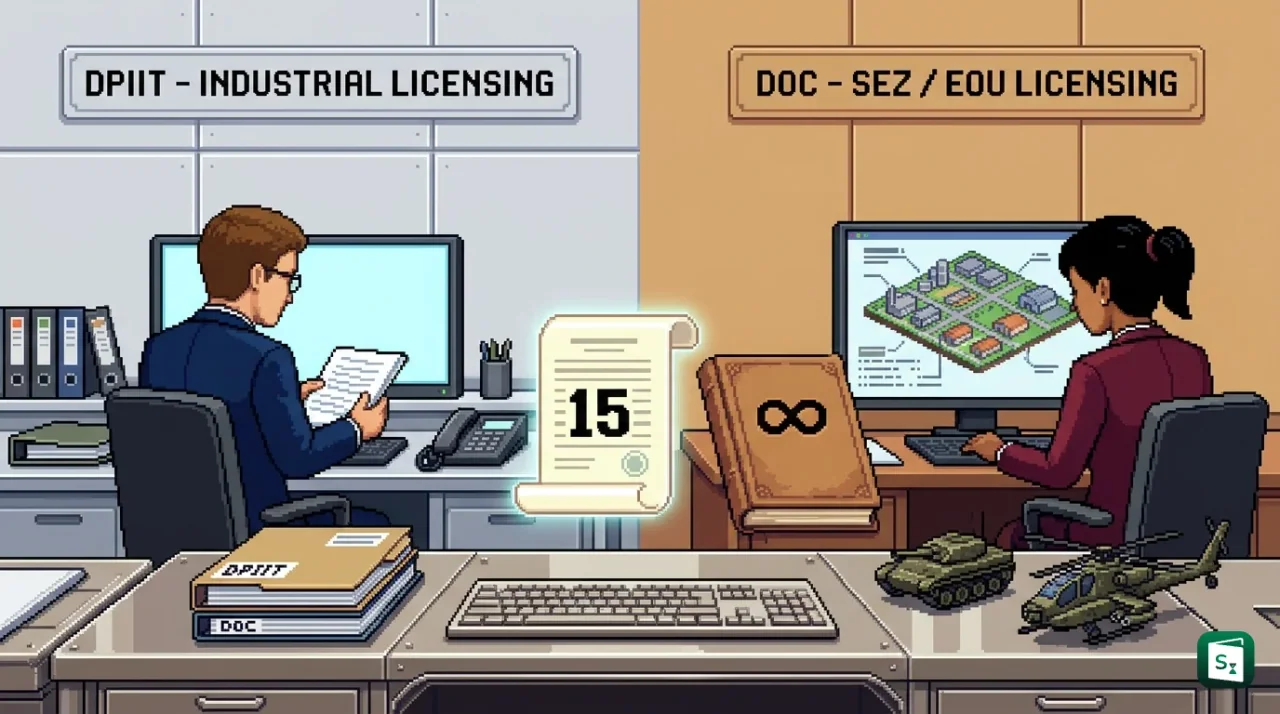
The Ministry of Commerce and Industry has clarified that the Department for Promotion of Industry and Internal Trade (DPIIT) and the Department of Commerce are the competent authorities to issue industrial licences for defence manufacturing under the Industries (Development and Regulation) Act, 1951. DPIIT will handle units located outside Special Economic Zones (SEZs), while the Department of Commerce will handle units inside SEZs and Export Oriented Units (EOUs). The clarification settles who a company must approach based on where its factory is located, at a time when interest in defence manufacturing in India is rising sharply.
What Is Industrial Licensing Under the IDR Act of 1951?
Industrial licensing is official permission from the central government to set up or expand a factory in certain sensitive sectors. The Industries (Development and Regulation) Act, 1951, often called the IDR Act, provides the legal base for this system. Parliament passed the Act in 1951 to regulate industrial growth through registration and licensing of scheduled industries listed in its First Schedule.
Section 11 of the Act requires a licence to set up a new industrial unit in a scheduled industry. Section 11A extends this rule to manufacture of a new article by an existing unit, and Section 13 covers large expansion of capacity or change of location. After the economic reforms of 1991, licensing was removed for most industries. Today only four categories still need compulsory industrial licensing in India. These are electronic aerospace and defence equipment, industrial explosives, specified hazardous chemicals, and cigars and cigarettes.
Defence is one of the few sectors where the licence rule continues. The government opened defence production to private Indian companies in May 2001. Since then, any company that wants to make a listed defence item must first obtain an industrial licence.
What Is DPIIT and What Does It Do?
DPIIT stands for the Department for Promotion of Industry and Internal Trade. It works under the Ministry of Commerce and Industry in New Delhi. The department was first set up in 1995 and took its present shape in 2000 after a merger with the Department of Industrial Development. It was earlier called the Department of Industrial Policy and Promotion. The government renamed it as DPIIT in January 2019 and gave it added charge of internal trade, retail trade, welfare of traders, startups and ease of doing business.
DPIIT is the nodal body for industrial policy, foreign direct investment policy, intellectual property rights and administration of the IDR Act. It grants industrial licences and receives Industrial Entrepreneur Memoranda from exempt industries. It also runs the National Single Window System (NSWS), the online portal where companies file defence licence applications. For defence cases, DPIIT moves the proposal for comments to the Ministry of Defence, the Ministry of External Affairs and other security agencies before approval.
How Is Defence Licensing Divided Between DPIIT and the Department of Commerce?
The latest clarification divides work by location of the factory. DPIIT issues industrial licences under the IDR Act for manufacturing units located outside SEZs. The Department of Commerce issues licences for units located inside SEZs and for EOUs.
An SEZ is a duty free enclave that is treated as foreign territory for trade and customs purposes. Parliament created this system through the Special Economic Zones Act, 2005. Units inside an SEZ enjoy tax and customs benefits and must earn positive net foreign exchange over five years. An EOU, or Export Oriented Unit, is a separate scheme under the Foreign Trade Policy. An EOU can be set up anywhere in India, but it must export its entire production except for permitted domestic sales and must also earn positive net foreign exchange. EOUs need a minimum investment of ₹1 crore in plant and machinery.
Defence manufacturing has a second track for weapons. The Arms Act, 1959, which is administered by the Ministry of Home Affairs, controls the manufacture, sale and possession of arms and ammunition. The detailed process is laid down in the Arms Rules, 2016. The Home Ministry has delegated powers for larger military systems to DPIIT under this law. In practice, DPIIT handles licences for tanks, armoured fighting vehicles, defence aircraft, warships and allied heavy systems listed in Annexure II of Press Note 1 of 2019. The Home Ministry retains direct control over small arms and ammunition of lower calibre.
Which Defence Products Need a Licence and Which Do Not?
The exact list of items that need a licence comes from DPIIT Press Note 1 of 2019, issued on 1 January 2019. It replaced an older 2014 list and shortened the items under control. The list was finalised by the Department of Defence Production under the Ministry of Defence.
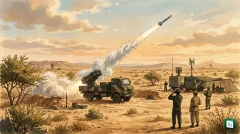
Annexure I of the press note lists the defence products that need an industrial licence under the IDR Act. The list includes military aircraft including helicopters, unmanned aerial vehicles, warships of all kinds, tanks and armoured vehicles, missiles, and military electronics such as electronic warfare systems, jamming equipment, secure communication gear and fire control systems.
Annexure II lists the arms and ammunition that need a licence for manufacture or proof testing under the Arms Act. This covers guns, howitzers, ammunition, bombs and related energetic materials.
A later clarification, Press Note 2 of 2019, eases the burden further. It states that no industrial licence or arms licence is needed to make parts, components or accessories unless the item is named in these annexures. A company must therefore check its product against the notified list before it applies.
How Long Is a Defence Licence Valid?
The two laws give very different validity periods because defence projects have long building and trial cycles.
A licence under the IDR Act is valid for 15 years from the date of issue. The holder must start commercial production within this period. The government can extend the licence by 3 years, taking the maximum to 18 years. If production has not started even after 18 years, the licence lapses automatically. This 15 year rule came through Press Note 1 of 2023, dated 21 July 2023. It replaced the earlier 3 year rule for all industrial licences to improve ease of doing business. Defence items had already moved to 15 years in 2015 through Press Note 10 of that year because defence contracts need long preparation time.
A licence for arms manufacture under the Arms Rules has lifetime validity for the life of the company. This change came through an amendment to the Arms Rules in October 2017. The lifetime licence comes with a strict start up condition. The company must set up the factory, hire staff, develop prototypes, test them and complete trial runs within 7 years from the date of grant. The licensing authority can extend this building period by 3 more years on written request. If the company fails to set up the facility in time, the licence can face suspension or revocation.
| Feature | Licence Under IDR Act 1951 | Licence Under Arms Act 1959 |
|---|---|---|
| Legal base | IDR Act and Press Note 1 of 2023 | Arms Act and Arms Rules, 2016 as amended in 2017 |
| What it covers | Defence products in Annexure I of Press Note 1 of 2019 | Arms and ammunition for manufacture or proof test in Annexure II |
| Issuing route | DPIIT for units outside SEZs, Department of Commerce for SEZs and EOUs | DPIIT under powers delegated by Home Ministry for listed heavy systems, Home Ministry for small arms |
| Validity | 15 years, extendable by 3 years to 18 years | Lifetime of the company |
| Start production condition | Start commercial production within licence period, else licence lapses | Build factory and complete trials within 7 years, extendable by 3 years, else suspension or revocation |
Why This Clarity Matters for Defence Manufacturing in India
India has set a clear goal of making more defence equipment at home and selling it abroad. Defence production reached a record ₹1,50,590 crore in 2024-25, up 18 percent over the previous year and more than three times the level of 2014-15. Defence exports touched a record ₹23,622 crore in the same year, up from only ₹686 crore in 2013-14. India now sells defence equipment to more than 100 countries. The government has set targets of ₹3 lakh crore in annual production and ₹50,000 crore in annual exports by 2029.
Private companies now play a larger role in this growth. They contributed about 23 percent of total production in 2024-25, up from 21 percent a year earlier. More than 700 industrial licences have been issued to over 430 companies. Five Positive Indigenisation Lists covering more than 5,500 items guide the armed forces to buy locally made systems such as Tejas aircraft, Arjun tanks, artillery guns, radars and helicopters.
A clear licensing address helps this system. Export focused units inside SEZs and EOUs now know they must approach the Department of Commerce. Other factories know they must approach DPIIT. The longer 15 year window under the IDR Act and lifetime validity under the Arms Act give companies time to build plants, test weapons and complete long trials without repeated renewals.
Key Takeaways
- DPIIT issues defence industrial licences for units outside SEZs, while the Department of Commerce issues licences for units inside SEZs and for EOUs under the IDR Act.
- The Industries (Development and Regulation) Act, 1951 is the legal base for industrial licences, with Section 11 covering new units in scheduled industries.
- DPIIT stands for the Department for Promotion of Industry and Internal Trade, which was renamed from DIPP in January 2019 and works under the Ministry of Commerce and Industry.
- An industrial licence under the IDR Act is valid for 15 years, extendable by 3 years to 18 years, while an arms manufacturing licence has lifetime validity subject to factory setup within 7 years.
- Defence production hit a record ₹1,50,590 crore in 2024-25 and defence exports reached ₹23,622 crore, with targets of ₹3 lakh crore in production and ₹50,000 crore in exports by 2029.