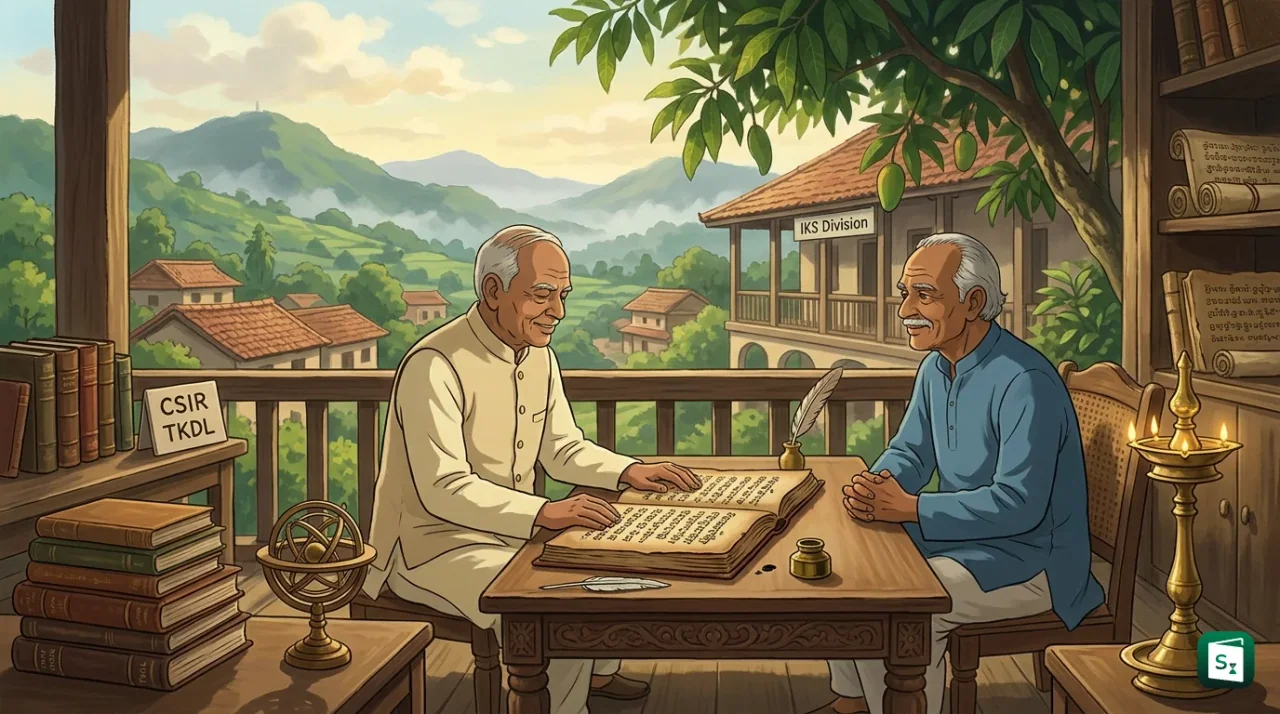
The CSIR Traditional Knowledge Digital Library Unit and the Indian Knowledge Systems Division of the Ministry of Education signed a Memorandum of Understanding in New Delhi on 19 November 2026. The pact seeks closer cooperation on traditional knowledge, intellectual property rights, rights of traditional knowledge holders and the Traditional Knowledge Digital Library. It builds on an earlier MoU of 29 June 2023 and on 11 joint workshops held across 14 states and Union Territories.
What Did the CSIR TKDL Unit and IKS Division Agree To?
The CSIR Traditional Knowledge Digital Library Unit and the Indian Knowledge Systems Division signed the pact in New Delhi on 19 November 2026. Prof Ganti S. Murthy, National Coordinator of the IKS Division and Professor at the Indian Institute of Technology Indore, signed for the Division. Dr Viswajanani J. Sattigeri, Scientist H and Head of the CSIR TKDL Unit, signed for CSIR. Dr Raghurama Bhatta, Controller of Administration of the IKS Division, and senior officials from both sides were present.
The MoU covers joint work on traditional knowledge, intellectual property rights (IPR), rights of traditional knowledge holders and the Traditional Knowledge Digital Library (TKDL). Traditional knowledge here means skills, practices and medicinal formulations passed down through generations within Indian communities. IPR means legal rights such as patents, copyrights and geographical indications that give creators control over the use of their work.
The agreement extends an earlier MoU signed on 29 June 2023. That signing took place in the presence of Dr Jitendra Singh, Minister of State (Independent Charge) for Science and Technology and Earth Sciences, and Dr N. Kalaiselvi, Director General of CSIR and Secretary of the Department of Scientific and Industrial Research. Under that earlier pact, the two bodies held 11 workshops on traditional knowledge, IPR and rights of people over traditional knowledge. Participants included students, research scholars, faculty members, scientists, Army personnel, yoga trainers and project associates from Tamil Nadu, Karnataka, Maharashtra, Uttar Pradesh, West Bengal, Delhi, Punjab, Jammu and Kashmir, Kerala, Gujarat, Andhra Pradesh, Puducherry, Rajasthan and Chhattisgarh.
The new MoU widens this work to education and training programmes, seminars, webinars, conferences, exhibitions and joint publications. The stated aim is to spread awareness about Indian traditional knowledge and to support its responsible use in research and innovation.
What Is the Traditional Knowledge Digital Library?
The Traditional Knowledge Digital Library, or TKDL, is a digital database of Indian traditional medicine. It was set up in 2001 jointly by the Council of Scientific and Industrial Research (CSIR) and the Ministry of Ayurveda, Yoga and Naturopathy, Unani, Siddha, Sowa Rigpa and Homoeopathy, now called the Ministry of AYUSH. The CSIR implements the project through its TKDL Unit. TKDL is widely described as the first prior art database of its kind in the world.
Prior art means knowledge that is already public before a patent claim is filed. Patent offices check prior art to decide if a claimed invention is really new. TKDL was created because much of India’s medicinal knowledge existed only in classical texts written in Sanskrit, Hindi, Arabic, Persian, Urdu, Tamil, Bhoti and other local dialects. Patent examiners abroad could not read or search these texts. This gap allowed wrong patents to be filed on uses already known in India.
TKDL bridges that gap. Experts in traditional medicine, patent examiners, IT specialists and scientists convert text from open classical sources into structured records. Each record uses the Traditional Knowledge Resource Classification (TKRC), an innovative classification system built for this purpose, along with modern medical terms. The records are then made available in five international languages.
| Feature of TKDL | Detail |
|---|---|
| Full form | Traditional Knowledge Digital Library |
| Established | 2001 |
| Set up by | CSIR with Ministry of AYUSH |
| Implemented by | CSIR TKDL Unit |
| Systems covered | Ayurveda, Unani, Siddha, Sowa Rigpa and Yoga |
| Content size | More than 5.2 lakh formulations and practices |
| Source languages | Sanskrit, Hindi, Arabic, Persian, Urdu, Tamil, Bhoti and others |
| Search languages | English, French, German, Japanese and Spanish |
Access to the full database is given only to patent offices under non disclosure access agreements. At present 14 patent offices, including the European Patent Office, the United States Patent and Trademark Office, the Japan Patent Office and the Indian Patent Office, can use TKDL for search and examination. Examiners may cite the content to reject a claim but may not share the database with third parties. In 2022 the Union Cabinet approved widening access to TKDL beyond patent offices to researchers and other users.
How TKDL Stops Biopiracy and Wrong Patents
Biopiracy means taking biological resources or community knowledge without permission and claiming exclusive rights over it. India faced this problem in the 1990s. In 1995 a US patent was granted on the wound healing use of turmeric. In 1994 a European patent was granted on the antifungal use of neem oil. Both uses were long known in India. CSIR led the challenge to the turmeric patent with old Sanskrit texts and a 1953 journal paper, and the patent was revoked in 1997. The neem patent was opposed by Indian farmers and activists and was finally revoked in 2005. These cases took years and cost large sums.
TKDL offers a preventive check. Its global watch system tracks new patent filings linked to Indian medicinal systems. The TKDL Unit files third party observations and pre grant oppositions with prior art proof. This evidence has led to rejection, amendment or withdrawal in several hundred applications. Recent official counts place the figure between 239 and 375 cases, depending on the cut off year. The effect is faster and cheaper than fighting a granted patent in court.
What Is the Indian Knowledge System?
The Indian Knowledge System, often shortened to IKS, refers to the broad body of knowledge built in India over centuries through observation, experiment and practice. It covers fields such as mathematics, astronomy, metallurgy, medicine, architecture, agriculture, law, governance, linguistics, arts and philosophy. This knowledge has been passed down through classical texts, oral traditions and craft practices in many Indian languages.
The Indian Knowledge Systems Division, or IKS Division, is the agency that promotes this field within the education system. The Ministry of Education set up the Division in October 2020 at the All India Council for Technical Education (AICTE) in New Delhi. Its vision is to support interdisciplinary research on all aspects of IKS and to bring that knowledge into modern teaching and social use. The work links directly to the National Education Policy (NEP) 2020, which calls for greater use of Indian knowledge traditions in curricula.
The Division funds IKS centres in universities and institutes, research projects, internships for students, faculty training, text mining and documentation work and an IKS Wiki in Indian languages. Its stated working ideas are Parampara, meaning respect for the unbroken lineage of knowledge, Drishti, meaning the distinct Indian view of problems, and Laukik Prayojana, meaning practical use for present needs.
| Fact about IKS Division | Detail |
|---|---|
| Full form | Indian Knowledge Systems Division |
| Nodal ministry | Ministry of Education |
| Established | October 2020 |
| Housed at | AICTE, New Delhi |
| Policy anchor | NEP 2020 |
| Core work | Research funding, IKS centres, internships, documentation and outreach |
What Is CSIR and How Does Its TKDL Unit Work?
CSIR stands for the Council of Scientific and Industrial Research. It is India’s largest public research organisation for science and industry. CSIR was set up as an autonomous body in September 1942. It is headed by a Director General, a post held by Dr N. Kalaiselvi at the time of the 2026 MoU. The headquarters is Anusandhan Bhawan on Rafi Marg in New Delhi.
CSIR runs a network of 37 national laboratories, 39 outreach centres, one Innovation Complex and three special units across India. Well known labs include the National Chemical Laboratory in Pune, the National Physical Laboratory in New Delhi, the Central Drug Research Institute in Lucknow and the National Aerospace Laboratories in Bengaluru. The CSIR TKDL Unit is one of the three special units. It manages the database, updates records from classical texts, monitors global patent filings and files legal observations to stop wrong claims.
The Unit works closely with the Ministry of AYUSH, the Controller General of Patents, Designs and Trade Marks, the National Informatics Centre and traditional medicine councils. Its classification and translation work allows a patent examiner in Munich, Tokyo or Washington to read a verse from an Ayurvedic text as a clear prior art record in German, Japanese or English.
Why Protection of Traditional Knowledge Holders Matters
Traditional knowledge belongs to communities and lineages, not to a single inventor. Standard patent law protects new inventions for a fixed term. It does not fit knowledge that is old, shared and passed on orally. This mismatch creates two risks. Outsiders may patent community knowledge as their own. Communities may also receive no credit or income when their knowledge leads to a commercial product.
Indian law tries to close this gap. Section 3(p) of the Patents Act, 1970 states that an invention which in effect is traditional knowledge is not patentable. A mere mix of known properties of known traditional parts is also not patentable. The Biological Diversity Act, 2002 adds a second filter. Anyone using biological resources from India for an invention needs approval from the National Biodiversity Authority before patent sealing and before commercial use. Applicants must also disclose the source and place of origin of biological material. A geographical indication, or GI tag, offers another tool by linking a product to its region and makers.
The 2026 MoU speaks directly to these issues. Prof Murthy stressed stronger guidance on patents, copyrights and geographical indications for Indian Knowledge Systems. He also called for clearer attribution rules so holders are named and for suitable legal tools to protect Indian traditional knowledge. Dr Sattigeri stressed fair benefit sharing with holders and keeping the heritage useful for present needs and future generations. Both sides linked the work to NEP 2020, to self reliance rooted in Bharatiya Gnana Parampara and to the national goal of Viksit Bharat 2047. For research, the link is practical. Scholars in the IKS network read Sanskrit, Tamil and other classical sources. Their work can improve documentation. TKDL records can in turn help those scholars test ideas, avoid repeat claims and build products that respect prior holders.
Key Takeaways
- The CSIR TKDL Unit and the IKS Division of the Ministry of Education signed an MoU in New Delhi on 19 November 2026 on traditional knowledge and intellectual property rights.
- The Traditional Knowledge Digital Library was set up in 2001 by CSIR with the Ministry of AYUSH and holds more than 5.2 lakh formulations from Ayurveda, Unani, Siddha, Sowa Rigpa and Yoga.
- TKDL records are searchable in five languages, English, French, German, Japanese and Spanish, and are shared with 14 patent offices under non disclosure agreements.
- The IKS Division was established in October 2020 under the Ministry of Education at AICTE in New Delhi to link Indian Knowledge Systems with modern education under NEP 2020.
- CSIR, set up in September 1942 and headquartered at Anusandhan Bhawan in New Delhi, runs 37 national laboratories, while Section 3(p) of the Patents Act, 1970 bars patents on traditional knowledge.