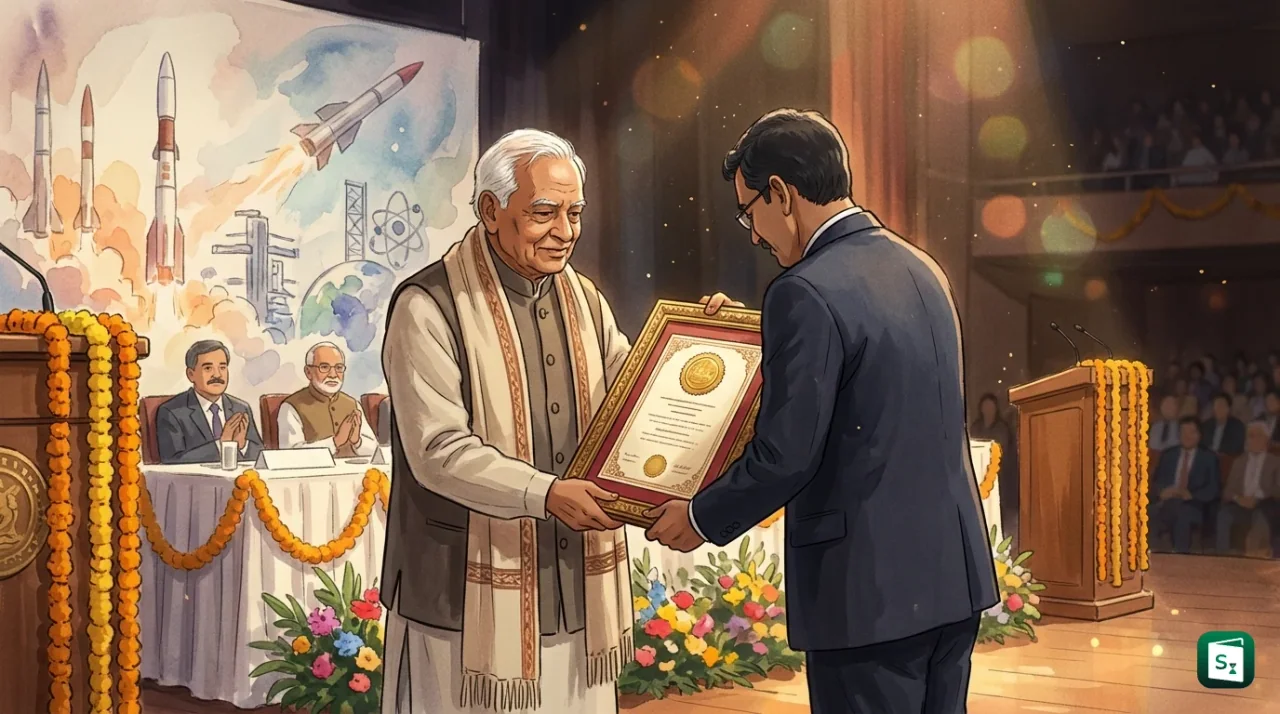
Defence Research and Development Organisation scientist Prakash Chand Jain received the Dr Murli Manohar Joshi Award in the Science and Technology category in New Delhi on 22 November 2026. Former Union Minister Murli Manohar Joshi presented the honour for Jain’s work on the structural design of missile systems. The award spotlights the engineering behind lighter, stronger Indian missiles developed in Hyderabad.
Who Is Murli Manohar Joshi?
Murli Manohar Joshi is an Indian physicist, educationist and senior Bharatiya Janata Party leader born on 5 January 1934 in Delhi. He is 92 years old in 2026 and his family hails from Almora in the Kumaon region of present day Uttarakhand. Joshi earned his MSc in Physics and PhD in spectroscopy from the University of Allahabad and later served as Professor and Head of the Physics Department there until January 1994.
Joshi joined the Rashtriya Swayamsevak Sangh (RSS) in 1944 and became one of the founding members of the Bharatiya Janata Party (BJP) in 1980 after his years in the Bharatiya Jana Sangh and the Janata Party. He served as BJP president from 1991 to 1993 and led the Ekta Yatra from Kanyakumari to Srinagar, which culminated in the hoisting of the national flag at Lal Chowk on 26 January 1992. He was elected to the Lok Sabha from Almora in 1977, from Allahabad in 1996, 1998 and 1999, from Varanasi in 2009 and from Kanpur in 2014, and served in the Rajya Sabha from 1992 to 1996.
His previous ministerial offices include Union Home Minister from 16 May to 1 June 1996 in the 13-day Atal Bihari Vajpayee government, and Union Minister for Human Resource Development, Science and Technology and Ocean Development from 1998 to 2004. The Government of India conferred the Padma Vibhushan, the second highest civilian honour, on him in 2017.
What Is the Dr Murli Manohar Joshi Award?
The Dr Murli Manohar Joshi Award is an honour instituted by the Federation for World Academics (FWA) to recognise sustained contributions to education, science and public life. The FWA is a network of academics and institutions that organises national conclaves, teacher honours and research collaboration programmes from New Delhi. An independent honorary council based in New Delhi administers the selection, and researchers, engineers, scientists and innovators from across the world are eligible.
The 2026 edition was presented at the ninth FWA Annual Conclave held at the India International Centre on Max Mueller Marg in New Delhi on 22 November 2026. The 2026 awards cover six categories, which are Higher Education, Arts and Culture, Science and Technology, Energy Sovereignty, Sustainable Consumption and Public Service. Honourees receive a citation, a medallion and an honorarium, and nominations for the 2026 cycle closed on 31 October 2026.
The Science and Technology category rewards research breakthroughs, technological innovation and work that addresses industrial and societal needs. It is distinct from the government run national science honours and from the internal DRDO awards such as Scientist of the Year and Young Scientist awards, which are limited to defence laboratory staff.
Why Was DRDO Scientist PC Jain Selected?
The 2026 Science and Technology honour went to Dr Prakash Chand Jain, an Outstanding Scientist at the Defence Research and Development Laboratory (DRDL) in Hyderabad. DRDL is part of the Dr A P J Abdul Kalam Missile Complex, which also houses the Research Centre Imarat and the Advanced Systems Laboratory and designs missiles that can be launched from land, sea, air and underwater platforms. Jain, who holds the rank of Scientist H and serves as a Group Director at DRDL, was cited for his contributions to the structural design of missile systems and for strengthening defence research capability over three decades.
Jain trained as a mechanical engineer at Shri Govindram Seksaria Institute of Technology and Science (SGSITS) Indore, and later studied at the Indian Institute of Technology (IIT) Roorkee and IIT Bombay. He was a BOYSCAST Fellow of the Department of Science and Technology at Pennsylvania State University in the United States, a fellowship that supports young Indian scientists for advanced research abroad. He also completed an advanced leadership programme at George Washington University. Jain is an elected Fellow of the American Society of Mechanical Engineers (ASME) and an Associate Fellow of the American Institute of Aeronautics and Astronautics (AIAA). His earlier honours include several DRDO awards, the Dr Biren Roy Space Science Award and the Homi J Bhabha Memorial Award.
His research covers structural dynamics, vibration analysis and aerospace structures, supported by research papers, patents and technology transfers to industry. Reports on his work note that the airframes of the BrahMos supersonic cruise missile and the Akash surface to air missile deployed during Operation Sindoor were designed and developed by Jain and his team.
How Lighter Airframes Strengthen Missiles
An airframe is the outer body and load carrying frame of a missile. Jain specialises in structural optimisation, which means shaping that frame to use less material while keeping it strong enough to survive launch forces, vibration and high speed flight.
A lighter airframe allows a missile to fly farther on the same fuel, carry sensors or guidance units more easily and remain stable during manoeuvres. For systems such as BrahMos, which flies at nearly three times the speed of sound, and Akash, which must intercept fast aircraft and drones, small savings in weight translate into better range, accuracy and reliability.
Where Does This Award Stand Among Science Awards in India?
India has a layered system of science awards. The highest national honour for science is now the Rashtriya Vigyan Puraskar (RVP), instituted by the Government of India and first presented by the President at Rashtrapati Bhavan in August 2024. The Dr Murli Manohar Joshi Award is a private academic honour instituted by the FWA, so it does not carry the same official status, but it adds to a growing set of recognitions for applied research with clear industrial use.
The RVP has four categories that cover lifetime work, distinguished service, young talent and team effort.
| Award Category | Full Name | Who It Honours |
|---|---|---|
| Vigyan Ratna | Vigyan Ratna | Lifetime achievement in any field of science and technology |
| Vigyan Shri | Vigyan Shri | Distinguished contributions in any field of science and technology |
| Vigyan Yuva Shanti Swarup Bhatnagar | Vigyan Yuva Shanti Swarup Bhatnagar | Young scientists up to 45 years with exceptional contributions |
| Vigyan Team | Vigyan Team | Team of three or more scientists for collaborative work |
Before the RVP, the best known science prize was the Shanti Swarup Bhatnagar Prize, given annually since 1958 by the Council of Scientific and Industrial Research (CSIR) for work in seven disciplines including biological, chemical, engineering, mathematical, medical, physical and earth sciences. That prize, named after CSIR founder director Shanti Swarup Bhatnagar, was open to Indian scientists up to 45 years of age and is now continued in the form of the Vigyan Yuva Shanti Swarup Bhatnagar component of the RVP.
Other important recognitions include the DRDO national level honours such as the Scientist of the Year Award, Young Scientist Award, Technology Leadership Award and Agni Award for Excellence in Self Reliance, along with the Dr Kothari Defence Science Award and the Dr Kalam Defence Technology Award for defence research. Prizes from academies and societies, such as the Indian National Science Academy awards, the Dr Biren Roy Space Science Award and the Homi J Bhabha Memorial Award, recognise subject specific excellence. For students and early career researchers, the Vigyan Yuva track and DRDO Young Scientist awards serve as the main national pathway for young scientist in India recognition.
Key Takeaways
- Prakash Chand Jain of DRDL Hyderabad received the Dr Murli Manohar Joshi Award in Science and Technology on 22 November 2026 in New Delhi.
- The award was presented by Murli Manohar Joshi and instituted by the Federation for World Academics for sustained work in science and technology.
- Jain is an Outstanding Scientist at DRDL in the Dr A P J Abdul Kalam Missile Complex known for lightweight missile airframe design for BrahMos and Akash.
- Murli Manohar Joshi, born on 5 January 1934, served as BJP president from 1991 to 1993 and as Union HRD and Science and Technology Minister from 1998 to 2004.
- India’s highest science honour is the Rashtriya Vigyan Puraskar, whose top Vigyan Ratna recognises lifetime achievement in science and technology.