The Chennai based nonprofit Resource Group for Education and Advocacy for Community Health (REACH) won the Kochon Prize 2026 for tuberculosis control. The prize was presented on 5 November 2026 at the Stop TB Partnership Board meeting in Indonesia. REACH is the first Indian civil society organisation to receive this global honour.
What Is the Kochon Prize?
The Kochon Prize is an annual international award for outstanding work to prevent, treat and control tuberculosis (TB), an infectious lung disease caused by bacteria. The Stop TB Partnership and the Kochon Foundation of the Republic of Korea jointly established the prize in 2005, and it was first given in 2006. The prize includes a medal and a cash award of $65,000, which makes it the largest global prize devoted only to TB.
The Kochon Foundation is a nonprofit body based in Seoul. It was set up in 1973 by Chong-Kun Lee, whose pen name was Kochon. Lee founded the Chong Kun Dang Pharmaceutical Corporation and worked to make low cost antibiotics and anti TB drugs available in Korea. The prize honours his memory.
The Stop TB Partnership is a global alliance hosted by the United Nations Office for Project Services, with its secretariat in Geneva, Switzerland. It selects a fresh theme each year and invites nominations from across the world. A global expert panel then picks the winners. The award is usually presented at the Partnership Board meeting or at the Union World Conference on Lung Health.
Past winners from India show the range of the prize. L. S. Chauhan, who headed the national TB programme, won in 2006. The Indian Council of Medical Research (ICMR), the top public body for medical research in India, won in 2017. Molbio Diagnostics, a private diagnostics company known for its portable Truenat test platform, won in 2024.
Who Shared the Kochon Prize 2026 With REACH?
The Kochon Prize 2026 was the 20th edition of the award. The Stop TB Partnership and the Kochon Foundation presented it on 5 November 2026 in Bali, Indonesia, during the Partnership Board meeting. About 300 health officials from many countries attended the event.
The 2026 theme was improving early TB diagnosis and treatment results by linking TB services with other health services. Three organisations shared the prize under this theme. They were chosen from more than 100 nominations from around the world.
| Winner | Country | Work recognised in 2026 |
|---|---|---|
| REACH | India | Linked private hospitals and pharmacies to the public TB system, screened about 15 lakh people and found about 3,000 TB cases |
| Centre for Health Solutions (CHS) | Kenya | Used artificial intelligence based chest X-ray and mobile testing units to serve about 1,65,000 people in remote areas and found 1,876 new TB cases |
| Marshall Islands TB Control Program | Marshall Islands | Ran joint screening for TB, diabetes and leprosy in Majuro, screened about 20,000 people, found 314 active TB cases and reached a 95.9% treatment success rate |
REACH won for joining TB care with private clinics and patient support. CHS won for taking modern diagnosis to areas with few doctors. The Marshall Islands programme won for a community wide model that tested whole neighbourhoods and followed each patient closely until treatment ended.
The 2026 ceremony also included the delayed 19th edition, which honoured work on domestic funding for TB. The DOPASI Foundation of Pakistan and Stop TB Partnership Nigeria shared that prize. DOPASI helped form a parliamentary caucus on TB and helped secure more than 8.1 billion Pakistani rupees for the TB response. The Nigeria team mobilised private firms to donate about 2.4 billion naira and diagnostic equipment worth $1.2 million.
Who Is REACH and What Work Won It the Award?
REACH stands for Resource Group for Education and Advocacy for Community Health. It is a nonprofit body based in Royapettah, Chennai, in Tamil Nadu. It was set up in 1999, when the Revised National TB Control Programme was expanding in Tamil Nadu. It is led by women. Nalini Krishnan is its chairperson and co founder, and Ramya Ananthakrishnan is its director.
REACH works closely with the National TB Elimination Programme (NTEP) at national, state and district levels. Its core idea is simple. Treatment must centre on the person, not only on the disease. Many patients stop medicines because of stigma, loss of income, poor nutrition, mental stress or family pressure. REACH tries to solve these linked problems together.
Four strands of its work stood out for the 2026 prize:
- Private sector linkage. REACH partnered with more than 180 private hospitals, doctors, laboratories and pharmacies. Private doctors see a large share of TB patients in India. REACH helped them test patients early and link them to free public treatment.
- Large scale screening. Through this network, REACH helped screen about 15 lakh people and detect about 3,000 TB cases that may otherwise have been missed.
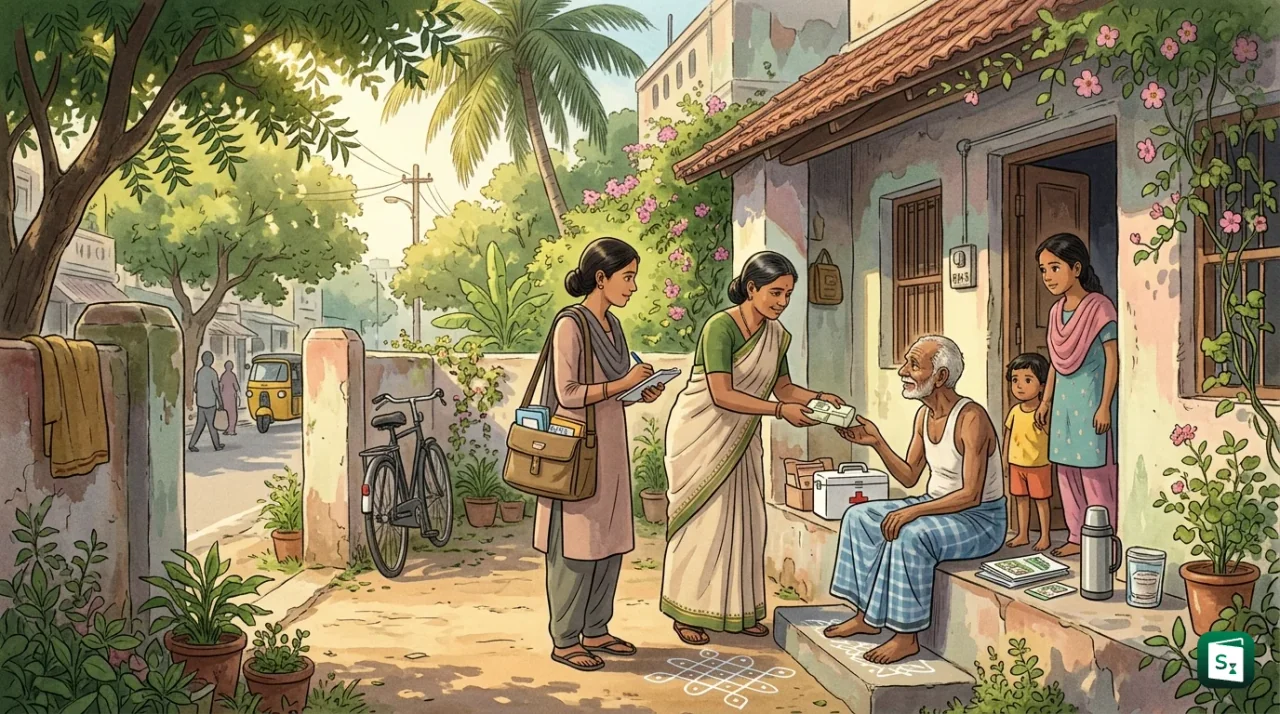
- Survivor led support. REACH trains TB survivors as TB Champions and TB Nanbans. Nanban is the Tamil word for friend. These volunteers counsel patients, visit homes, explain side effects and nutrition, and build trust. Through this network, REACH supported more than four lakh patients with treatment guidance and counselling.
- Integrated care. Since 2018, REACH has also worked on non communicable diseases such as diabetes. It runs nodal Nakshatra centres in Chennai for direct care. It links TB patients to checks for diabetes, nutrition support and mental health help.
Soumya Swaminathan, former chief scientist of the World Health Organization, nominated REACH for the prize. She noted that REACH combines field compassion with strong science and a clear grasp of public health in India.
How India Fights TB: From Control Programme to Elimination Mission
India carries the largest TB burden in the world. India accounts for about 25% of global TB cases. The fight against TB has passed through three main phases.
| Programme | Period | Key features |
|---|---|---|
| National TB Programme (NTP) | Launched in 1962 | District TB centres, BCG vaccination, X-ray based diagnosis and standard drugs |
| Revised National TB Control Programme (RNTCP) | Launched in 1997, full country cover by 2006 | Directly Observed Treatment Short course, sputum microscopy at designated centres, drug resistant TB care from 2006, case based Nikshay portal from 2012, daily fixed dose drugs from 2016 |
| National TB Elimination Programme (NTEP) | Renamed from RNTCP on 1 January 2020 | Goal to end TB in India by 2025, five years before the global 2030 target under the Sustainable Development Goals |
The revised programme is now known as NTEP. The national TB control programme was adopted in 1962. The revised version started in 1997. The current elimination programme dates to 2020.
NTEP follows the National Strategic Plan 2017 to 2025. Its work rests on four pillars, Detect, Treat, Prevent and Build. Detect means early testing, including molecular tests. Treat means prompt and full treatment with quality drugs. Prevent means contact tracing and preventive treatment for household contacts, children and people living with HIV. Build means stronger labs, data systems and health staff.
The latest field push is the TB Mukt Bharat Abhiyan. The central government launched an intensive 100 day campaign on 7 December 2024. It ended on World TB Day, 24 March 2025, and then expanded across the country. Health teams held more than 13.4 lakh Nikshay Shivirs, or community screening camps. They screened about 12.97 crore vulnerable people and found more than 7.19 lakh TB patients, including about 2.85 lakh people with no clear symptoms. Newer tools included handheld X-ray units with artificial intelligence support and wider use of nucleic acid amplification tests.
Results show steady progress, though the 2025 elimination target was missed. As per the World Health Organization Global TB Report 2025, TB incidence in India fell by 21%, from 237 cases per lakh population in 2015 to 187 in 2024. TB deaths fell by 25%, from 28 to 21 per lakh in the same period. Treatment coverage rose from 53% to 92%. India notified 26.18 lakh TB patients in 2024 and reached a 90% treatment success rate, above the global average of 88%.
Why People Centred and Integrated Care Matters for TB Elimination
TB treatment lasts many months. Patients often face wage loss, travel costs, side effects and social stigma. About 60% of people with TB symptoms do not seek care quickly. Nearly half of notified patients are undernourished. Diabetes, HIV, smoking and alcohol use raise risk further. A drug prescription alone cannot solve these problems.
That is why the 2026 Kochon theme stressed integration. When TB screening joins diabetes checks, nutrition help and mental health support, more cases are found early and more patients finish treatment. REACH showed this in cities by linking private clinics, pharmacies and survivor counsellors to the public system. The Marshall Islands and Kenya showed the same idea in island and rural settings.
For India, the lesson is direct. More than 30% of notified TB cases now come from private providers. Community workers and TB Champions bridge the gap between clinics and homes. Nutrition transfers under Nikshay Poshan Yojana and community adoption under the Nikshay Mitra initiative add social support to medical care. The REACH award puts global focus on this blend of science, community trust and health system linkage as the path to a TB free India.
Key Takeaways
- Chennai based REACH won the Kochon Prize 2026 and became the first Indian civil society organisation to receive the award.
- The prize was presented on 5 November 2026 in Bali, Indonesia, by the Stop TB Partnership and the Kochon Foundation.
- The 2026 prize was shared by REACH (India), the Centre for Health Solutions (Kenya) and the Marshall Islands TB Control Program for integrated TB diagnosis and care.
- The Kochon Prize was jointly set up in 2005 and first given in 2006, and it carries a cash award of $65,000.
- The Revised National TB Control Programme (1997) was renamed as the National TB Elimination Programme on 1 January 2020, with a goal to end TB in India by 2025.