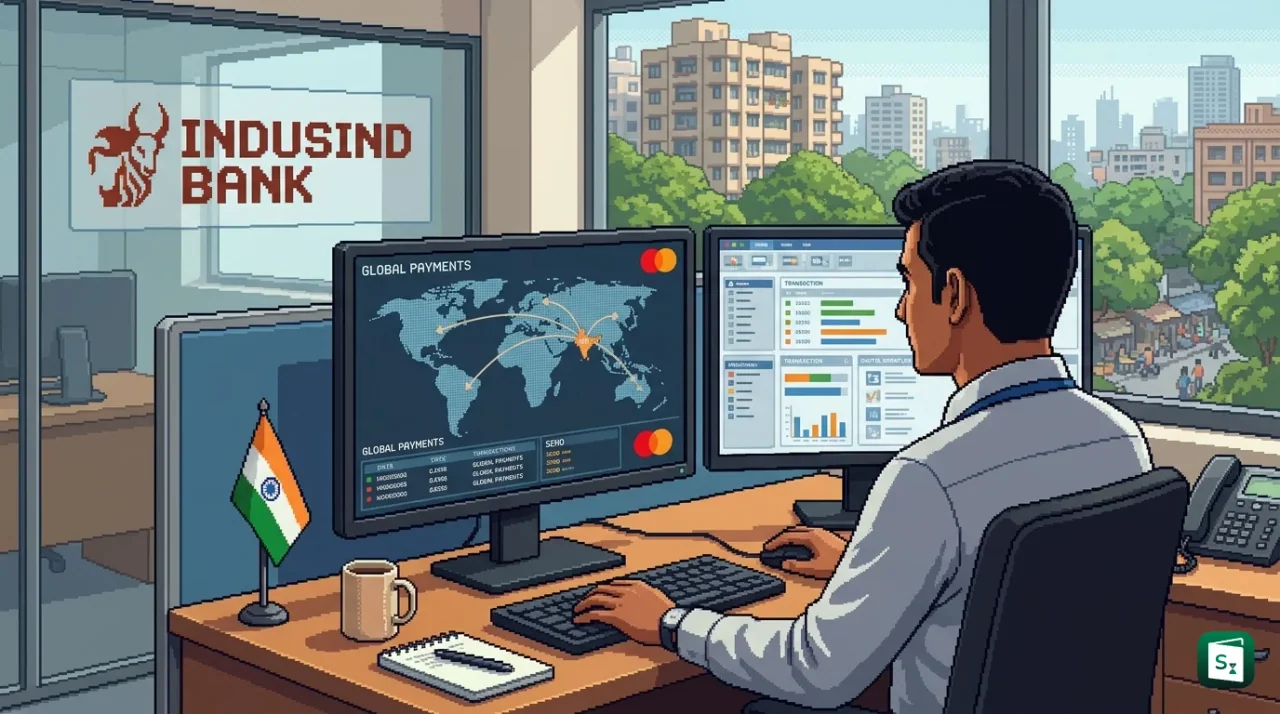
IndusInd Bank announced a collaboration with Mastercard on 17 November 2026 to simplify outbound cross border payments from India through Mastercard Move. The tie-up will start with person-to-person remittances and education related payments to the United States, the United Kingdom, Europe, Canada and Australia. It aims to make transfers faster with clearer exchange rates and end-to-end tracking, with support for small and medium enterprises planned next.
What Is Mastercard Move?
Mastercard Move is Mastercard’s portfolio of global money movement capabilities. It allows banks, financial institutions, companies and governments to send and receive money across borders through bank accounts, cards, digital wallets and cash pickup points. The network reaches more than 200 countries and territories in over 150 currencies, covering about 17 billion endpoints and nearly 95 percent of the world’s banked population.
Mastercard, founded in 1966 and headquartered in Purchase, New York, built Move to combine its card rails and non-card rails in one system. The portfolio includes Mastercard Send for domestic and card based transfers and Mastercard Cross-Border Services for international transfers. A bank can connect once to Mastercard Move instead of building separate links with banks in every destination market.
For users, the platform promises practical features. It shows the exchange rate upfront with no hidden charges. It allows tracking of payment status in many corridors. It offers choice of payout method, subject to what is available in the receiving country.
How Cross Border Payments Work From India?
Cross border payments from India are transfers where money in rupees is converted into foreign currency and paid to a person or institution abroad. The Indian bank checks the purpose under foreign exchange law, converts the funds through an authorised dealer and routes the payment through a global network for payout into the receiver’s account, card, wallet or cash pickup point.
An outbound remittance means an outflow of foreign exchange from India. In this deal, the focus is on non-trade current account remittances. These are payments that are not linked to import or export of goods. Examples include money sent to family abroad and fees paid to a foreign university.
The traditional route is slow because money often passes through several correspondent banks. Each bank can add a fee and processing time. The exchange rate may also be unclear until the end. This raises cost and makes tracking difficult.
Mastercard Move tries to reduce these frictions with a single connection. IndusInd Bank sends the payment instruction into the Mastercard network with the exchange rate disclosed upfront. Mastercard then moves the funds through its own links to the destination and provides end-to-end visibility on status and delivery time in covered corridors.
What IndusInd Bank and Mastercard Agreed On
IndusInd Bank and Mastercard disclosed the collaboration on 17 November 2026 through a joint press release and a stock exchange filing. The arrangement covers outbound remittances from India using Mastercard Move. In the first phase, it will support person-to-person transfers and education related payments. IndusInd Bank plans to extend the same platform to payments by small and medium enterprises at a later stage.
The initial corridors are the United States, the United Kingdom, Europe, Canada and Australia. These are among the largest destinations for Indian students and families. The bank said the service would offer faster processing, greater transparency and full tracking of the payment journey.
IndusInd Bank is a private sector bank headquartered in Mumbai. It was established in April 1994 and promoted by the Hinduja Group. It began operations after inauguration by then Finance Minister Manmohan Singh and is regulated by the Reserve Bank of India (RBI). The bank already handles international payments for education, travel, business and other overseas needs. The Mastercard tie-up builds on that base by giving the bank access to a ready global payout network instead of creating separate connections for each market.
RBI Rules for Cross Border Payments From India
All cross border payments from India must follow the Foreign Exchange Management Act (FEMA), 1999. FEMA is the law that controls foreign exchange transactions to support orderly development of the external sector. The RBI issues directions under this law for banks and payment companies.
For individuals, the main route is the Liberalised Remittance Scheme (LRS). The scheme allows all resident individuals, including minors, to remit up to $250,000 per financial year for permitted current or capital account purposes. It was introduced on 4 February 2004 with a limit of $25,000 and reached the present limit on 26 May 2015. Remitters must route funds through an authorised dealer bank with a Permanent Account Number (PAN) and Form A2 declaration.
Permitted purposes under LRS include private visits, gifts, employment, emigration, maintenance of close relatives, business trips, medical treatment and studies abroad. The scheme is not available to companies, partnership firms, Hindu Undivided Families and trusts. There is no cap on the number of transactions, but total remittances in a year must stay within the limit.
For companies that process such payments, the RBI created a separate category called Payment Aggregator Cross Border (PA-CB). The consolidated Master Direction of 15 September 2025 treats PA-CB firms as entities that collect payments from Indian customers for e-commerce and other current account transactions and settle them abroad, or vice versa. Key norms are summarised below.
| Norm | What the RBI Requires |
|---|---|
| Authorisation | Non-bank firms need RBI authorisation to operate as a PA-CB. Banks do not need separate authorisation for this business. |
| Capital | Minimum net worth of ₹15 crore at application, rising to ₹25 crore by the end of the third financial year. |
| Transaction cap | Maximum ₹25 lakh per import or export transaction processed by a PA-CB. |
| Fund segregation | Inward and outward funds must be kept separate. No netting is allowed. Funds sit in designated collection accounts with an authorised dealer bank. |
| Foreign exchange | A PA-CB can buy or sell foreign currency only through an authorised dealer. |
This framework matters for the IndusInd Bank deal because the bank, as an authorised dealer, remains responsible for FEMA checks even when the payment travels on the Mastercard network. The global push behind such reforms is the G20 roadmap for cross border payments, which calls for faster, cheaper, more transparent and more inclusive international transfers.
Mastercard Move vs Visa Direct and SWIFT
India’s banks can use several global rails for outward transfers. Two card based systems and one interbank messaging system are most often compared.
| Feature | Mastercard Move | Visa Direct | SWIFT |
|---|---|---|---|
| Type | Portfolio of money movement capabilities, including Mastercard Send and Cross-Border Services | Push payments platform that sends funds directly to eligible cards, accounts and wallets | Messaging network that carries payment instructions between banks, mostly through correspondent banks |
| Reach | More than 200 countries and territories, over 150 currencies | Global coverage across cards, accounts and wallets, subject to market availability | Connects more than 11,000 financial institutions in over 200 countries and territories |
| Payout options | Bank account, card, wallet and cash pickup, based on corridor | Card, account and wallet, based on corridor | Account to account credit through the banking chain |
| Integration | Single connection to Mastercard’s network | Single connection to Visa’s network | Banks need correspondent relationships or standard interfaces like SWIFT gpi for tracking |
| Typical use in India | Person-to-person transfers, tuition fees, business payouts, disbursements | Similar person-to-person, marketplace payouts and emergency disbursements | Trade payments, high value corporate transfers and bank to bank settlement |
The practical difference is control over the chain. SWIFT moves information securely, but the money still passes through intermediary banks. Card based platforms move both the instruction and the funds path through their own links, which can improve speed and tracking in retail corridors. Banks often use more than one rail to cover different currencies and customer needs.
Why Outbound Remittances From India Matter
India is better known for money received from abroad, but money sent out is now large and policy sensitive. The World Bank estimated personal remittances sent from India at $12.1 billion in 2025. More than 1.2 million Indian students were enrolled in higher education abroad in 2025. Tuition fees and living costs create repeated, time bound transfers for families.
RBI data shows a shift in this flow. Outward remittances under LRS for studies abroad fell to $2.91 billion in 2024-25, down about 16 percent from the previous year. Families are using more scholarships, loans taken abroad and careful choice of destinations. Travel, investment in foreign securities and maintenance of relatives now form a larger share of LRS outflows.
Cost is the central concern. The World Bank put the global average cost of sending remittances at 6.62 percent of the amount in July to September 2024. Studies on Indian education transfers find traditional banking markups of 3 to 3.5 percent on exchange rates. For a family sending ₹30 lakh in a year, that gap can equal several months of living expenses.
Faster settlement and upfront rate disclosure therefore have direct value. Clear tracking helps parents meet university deadlines. Transparent pricing helps small firms plan supplier payments. Lower friction also supports the RBI’s wider work on linking fast payment systems, such as the linkage of India’s Unified Payments Interface (UPI) with Singapore’s PayNow system for person-to-person transfers.
Key Takeaways
- IndusInd Bank tied up with Mastercard on 17 November 2026 to route outbound cross border payments from India through Mastercard Move, starting with person-to-person and education remittances.
- The first corridors are the United States, United Kingdom, Europe, Canada and Australia, with support for small and medium enterprises planned later.
- Mastercard Move reaches more than 200 countries and territories in over 150 currencies, covering about 17 billion endpoints.
- IndusInd Bank was established in April 1994 in Mumbai and is promoted by the Hinduja Group.
- Resident individuals can remit up to $250,000 per financial year under the RBI’s Liberalised Remittance Scheme, while a PA-CB can process up to ₹25 lakh per cross border transaction.