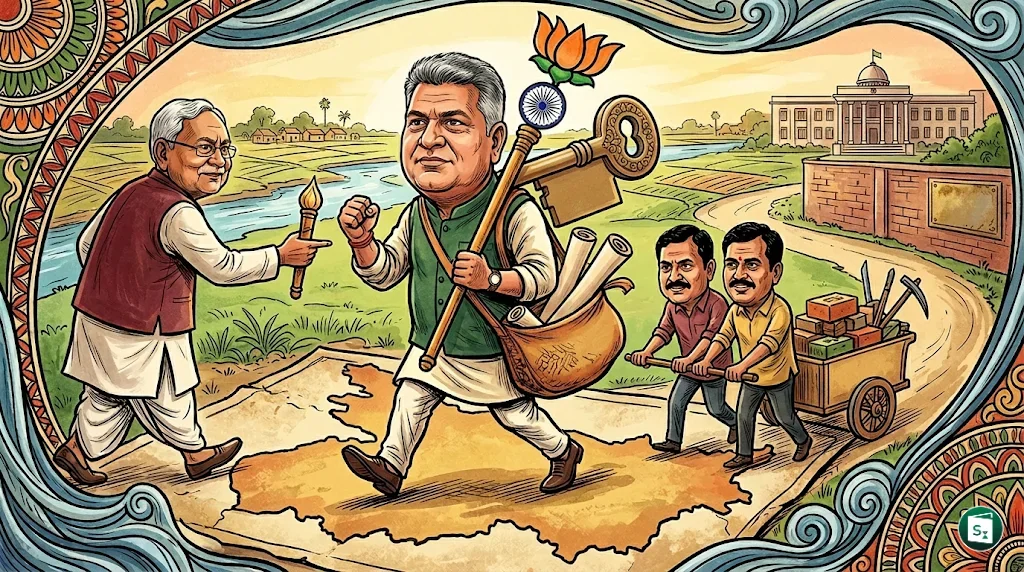
Samrat Choudhary was sworn in as the 24th Chief Minister of Bihar on April 22, 2026, marking a historic shift as the first leader from the Bharatiya Janata Party (BJP) to head the state government. He succeeds Nitish Kumar, who stepped down from the post to transition into a new role in the Indian Parliament. The ceremony, held at the Raj Bhavan in Patna, also saw the appointment of senior leaders from the Janata Dal (United) as Deputy Chief Ministers.
A Historic Shift: The First BJP Chief Minister of Bihar
The appointment of Samrat Choudhary as the Chief Minister represents a watershed moment in Bihar’s political history. Since the state’s formation, the Bharatiya Janata Party has primarily served as a junior partner in various coalitions or as the principal opposition. By assuming the top executive post, the party has now solidified its position as the leading force in the ruling alliance with the Janata Dal (United), or JD(U).
This transition followed the resignation of Nitish Kumar, who had led the state for nearly two decades across multiple terms. Kumar’s decision to transition to the Rajya Sabha, the upper house of the Indian Parliament, necessitated a leadership change within the National Democratic Alliance (NDA). This move is widely viewed as a strategic realignment aimed at restructuring the state administration while maintaining the stability of the coalition government.
The New Leadership Team: Deputy Chief Ministers
Alongside the Chief Minister, two veteran leaders were sworn in as Deputy Chief Ministers to assist in the state’s governance. Vijay Kumar Choudhary and Bijendra Prasad Yadav, both senior figures from the JD(U), bring decades of political and administrative expertise to the new cabinet. Their appointments underscore the collaborative nature of the current ruling alliance, maintaining a balance between the two primary coalition partners.
Vijay Kumar Choudhary has a distinguished career, having served as the Speaker of the Bihar Legislative Assembly and holding critical portfolios like Finance and Water Resources in previous governments. Bijendra Prasad Yadav, often referred to as the patriarch of the JD(U), has been a consistent presence in the state cabinet, specifically leading the Energy department. This leadership team is expected to focus on continuing the developmental agenda of the state while navigating the complexities of coalition politics.
Profile of Samrat Choudhary: A Political Journey
Born on November 16, 1968, Samrat Choudhary hails from a family with deep political roots in Bihar. His father, Shakuni Choudhary, was a prominent leader and a six-time legislator, while his mother, Parvati Devi, also served as a member of the state legislature. This background provided him with early exposure to the state’s intricate political landscape, particularly the aspirations of the Other Backward Class (OBC) communities.
Choudhary’s career has spanned across major political platforms in the state, including the Rashtriya Janata Dal (RJD) and the JD(U). Since joining the BJP in 2017, he has seen a rapid ascent within the party ranks. He has held several key positions, including the President of the BJP’s Bihar state unit and the Leader of the Opposition in the Bihar Legislative Council. His experience as the Deputy Chief Minister in the previous administration further prepared him for the responsibility of leading the state government.
Constitutional Framework: The Appointment Process
The appointment of a Chief Minister in any Indian state is governed by the provisions of Article 164 of the Constitution of India. Following the formal resignation of the outgoing incumbent, the Governor of Bihar, Lt. Gen. Syed Ata Hasnain (Retd.), invited the leader of the majority coalition to form the government. The Governor administered the oath of office and secrecy to the new Chief Minister and the Deputy Chief Ministers at a ceremony held in the capital.
Under the parliamentary system, the Council of Ministers remains collectively responsible to the Bihar Legislative Assembly, which consists of 243 elected members. Bihar is one of the few states in India with a bicameral legislature, meaning it also has a Legislative Council or Vidhan Parishad. According to constitutional mandates, if a person who is not a member of the state legislature is appointed as a minister, they must be elected to either house within a period of six months to continue in office.
Historical Context of Bihar’s Leadership
Bihar has a storied political history, with the office of the Chief Minister being held by various transformative figures since independence. Sri Krishna Sinha, often remembered as the architect of modern Bihar, served as the state’s first Chief Minister from 1946 to 1961. Following his era, the state’s political landscape transitioned through phases of Congress dominance, socialist movements, and eventually the rise of regional powers in the 1990s.
The most recent decades were largely characterized by the leadership of Nitish Kumar, whose tenure was focused on governance reforms and social engineering. The appointment of Samrat Choudhary marks a significant departure from this era, as it is the first time the BJP has claimed the chief ministerial position in its own right in Bihar.
| Chief Minister | Political Party | Significance |
|---|---|---|
| Sri Krishna Sinha | Indian National Congress | First Chief Minister of Bihar (1946–1961) |
| Lalu Prasad Yadav | Rashtriya Janata Dal | Established a massive base among OBC and minority communities |
| Rabri Devi | Rashtriya Janata Dal | First woman to serve as the Chief Minister of Bihar |
| Nitish Kumar | Janata Dal (United) | Longest-serving Chief Minister with a focus on ‘Sushasan’ (Good Governance) |
| Samrat Choudhary | Bharatiya Janata Party | First BJP leader to be appointed as the Chief Minister of Bihar (2026) |
Key Takeaways
- Samrat Choudhary was sworn in as the 24th Chief Minister of Bihar on April 22, 2026, succeeding Nitish Kumar.
- He holds the distinction of being the first leader from the Bharatiya Janata Party (BJP) to serve as the Chief Minister of the state.
- The Governor of Bihar, Lt. Gen. Syed Ata Hasnain (Retd.), administered the oath of office at a ceremony held in Patna.
- Vijay Kumar Choudhary and Bijendra Prasad Yadav were appointed as the Deputy Chief Ministers in the new cabinet.
- The appointment process for the Chief Minister and the Council of Ministers is governed by Article 164 of the Constitution of India.
- Bihar’s legislature is bicameral, consisting of a Legislative Assembly with 243 seats and a Legislative Council with 75 seats.