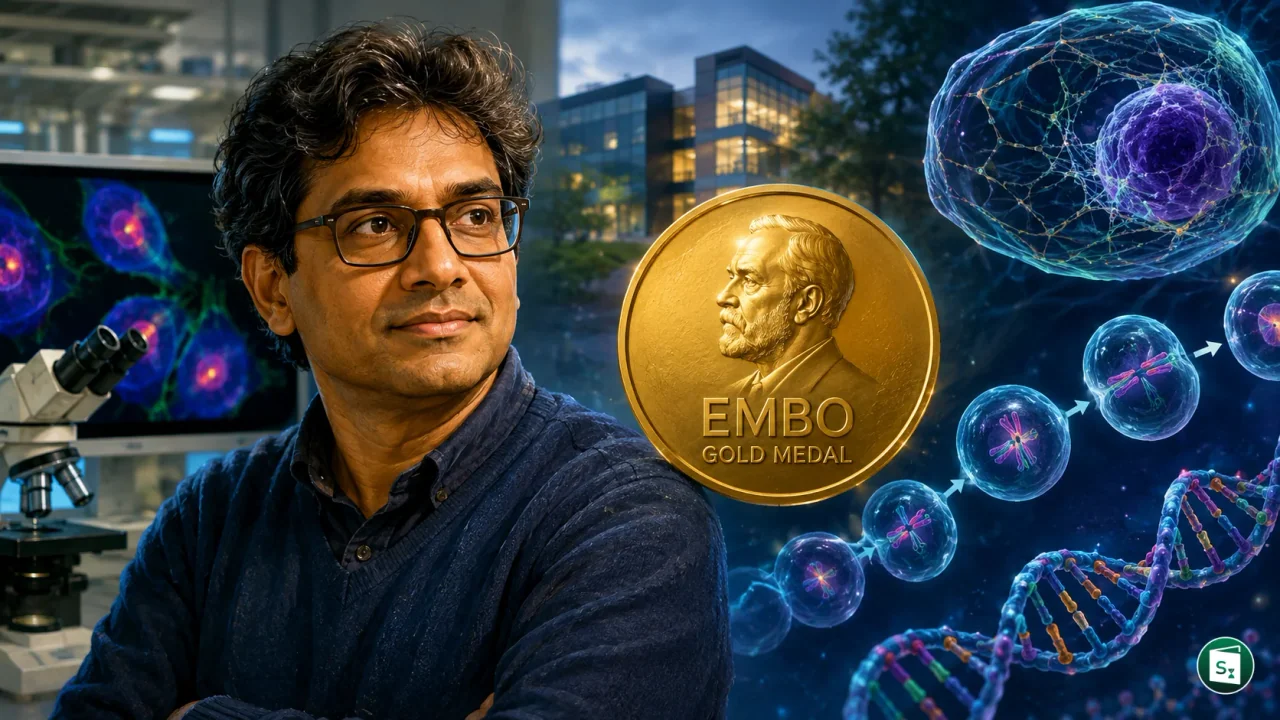
Gautam Dey, an Indian-origin scientist at the European Molecular Biology Laboratory in Germany, has been awarded the prestigious EMBO Gold Medal for 2026. He received the honour for his pioneering research into the evolutionary origins of how cells organize their nuclei and manage cell division. Dey shares the award with Omaya Dudin from the University of Geneva, marking a significant recognition of collaborative excellence and innovation in the life sciences.
Recognition for Evolutionary Cell Biology
The EMBO Gold Medal is awarded annually to young scientists for their outstanding contributions to the life sciences in Europe. In 2026, the European Molecular Biology Organization (EMBO) chose to honour Gautam Dey and Omaya Dudin for their collaborative efforts in the field of evolutionary cell biology. This emerging discipline combines traditional cell biology with evolutionary theory to understand how the complex machinery of life evolved over billions of years.
Gautam Dey serves as a Group Leader at the European Molecular Biology Laboratory (EMBL) in Heidelberg, Germany. His work has been instrumental in shifting the focus of cell biology from just studying human or yeast cells to exploring a broader diversity of life forms. By comparing different species, his research group seeks to identify the fundamental principles that govern how cells function and replicate.
Understanding the Origins of the Cell Nucleus
A central focus of Gautam Dey’s research is eukaryogenesis, the evolutionary process that led to the emergence of the first complex eukaryotic cells. Unlike simpler bacteria, eukaryotic cells possess a well-defined nucleus that houses their genetic material. Understanding how this structure formed and how it is managed during cell division is a major challenge in modern biology.
The research group led by Dey investigates mitosis, the process by which a cell divides into two identical daughter cells. While human cells typically break down their nuclear envelope during mitosis, many other organisms follow different strategies. For instance, yeast and certain fungi undergo “closed mitosis” where the nuclear envelope remains intact. By studying these diverse strategies across the tree of life, Dey aims to uncover the universal rules that govern cellular architecture and its stability during reproduction.
The Quest for Multicellularity: Omaya Dudin’s Work
Gautam Dey shares the 2026 medal with Omaya Dudin, an Assistant Professor at the University of Geneva. While Dey focuses on the nucleus, Dudin’s research explores the evolution of multicellularity. He studies how single-celled organisms, specifically those from the Ichthyosporean group, transitioned into complex multicellular animals.
The collaboration between Dey and Dudin is a highlight of the 2026 award. Together, they lead a massive project to build a Global Atlas of Microbial Eukaryotic Cell Architecture. This initiative uses advanced imaging techniques like expansion microscopy to physically enlarge biological samples. This allows researchers to see the intricate details of cellular structures using standard light microscopes, providing a high-resolution map of life’s diversity.
About the EMBO Gold Medal
Established in 1986, the EMBO Gold Medal is one of the most prestigious accolades for early-career researchers in the life sciences. It is awarded by the European Molecular Biology Organization (EMBO) to scientists who have made significant contributions while working in Europe or in an EMBO Associate Member State. Recipients of the award receive a gold medal and a bursary of €10,000.
| Aspect | Details |
|---|---|
| Award Name | EMBO Gold Medal |
| Established Year | 1986 |
| Presented By | European Molecular Biology Organization (EMBO) |
| Prize Money | €10,000 |
| Headquarters | Heidelberg, Germany |
| Eligibility | Early-career scientists under 40 years of age |
The EMBO itself was founded in 1964 with the mission to promote excellence in molecular biology. It now comprises more than 2,000 leading scientists who participate in the organization’s activities, including publishing journals and organizing international conferences.
India’s Partnership with EMBO and EMBL
India has a deep and growing relationship with the European molecular biology community. In February 2016, India became an Associate Member State of the European Molecular Biology Conference (EMBC), which is the intergovernmental funding body for EMBO. This agreement was spearheaded by the Department of Biotechnology (DBT) under the Ministry of Science and Technology.
Through this partnership, researchers working in India can apply for prestigious EMBO fellowships and participate in the Young Investigator Programme. This collaboration has allowed for a greater exchange of scientific knowledge and has opened doors for Indian scientists to access high-end research infrastructure in Europe. The EMBL, founded in 1974, also works closely with Indian institutes through data services and collaborative research projects, further strengthening India’s position in the global life sciences landscape.
Key Takeaways
- Gautam Dey, an Indian-origin scientist at EMBL Heidelberg, has been awarded the EMBO Gold Medal 2026.
- He shares the prestigious award with Omaya Dudin from the University of Geneva for their collaborative research in evolutionary cell biology.
- The research focuses on eukaryogenesis and the evolutionary origins of nuclear organization and cell division.
- The EMBO Gold Medal was established in 1986 and includes a gold medal and a €10,000 bursary for the recipients.
- India has been an Associate Member State of the European Molecular Biology Conference (EMBC) since 2016.
- The European Molecular Biology Organization (EMBO) is headquartered in Heidelberg, Germany, and was founded in 1964.