The global community observed World Oceans Day on June 8, 2026, under the theme Reimagine: Beyond the world we know, a new relationship with our ocean. This year’s observance marks a pivotal moment as the landmark High Seas Treaty officially entered into force, providing a legal framework to protect 30 percent of the world’s oceans by 2030. For India, the day highlights the country’s strategic shift toward a sustainable blue economy and the upcoming launch of its ambitious manned deep-sea mission, Samudrayaan.
What is World Oceans Day?
World Oceans Day is an international day that takes place annually on June 8. The concept was first proposed by the Government of Canada at the 1992 Earth Summit in Rio de Janeiro, Brazil. However, it was only in 2008 that the United Nations General Assembly officially recognized the day through Resolution 63/111, with the first official UN observance occurring in 2009.
The primary purpose of the day is to inform the public of the impact of human actions on the ocean and to develop a worldwide movement of citizens for the ocean. Oceans cover over 70 percent of the planet and produce at least 50 percent of the Earth’s oxygen. They are also home to most of the Earth’s biodiversity and are the main source of protein for more than a billion people around the world. Furthermore, oceans absorb about 30 percent of carbon dioxide produced by humans, buffering the impacts of global warming.
The observance is closely linked to Sustainable Development Goal 14 (SDG 14), which aims to conserve and sustainably use the oceans, seas, and marine resources for sustainable development. As the world navigates the UN Decade of Ocean Science for Sustainable Development (2021-2030), the focus in 2026 has shifted toward delivering science-based solutions to reverse the decline in ocean health.
Theme 2026: Reimagine Our Relationship with the Ocean
The theme for World Oceans Day 2026 is Reimagine: Beyond the world we know, a new relationship with our ocean. This theme calls for a fundamental shift in the human perspective toward the marine environment. It emphasizes moving away from a model of extraction and exploitation toward one of active stewardship and restoration.
The 2026 campaign specifically aligns with the global 30x30 goal, an international commitment to protect at least 30 percent of the world’s land and ocean by the year 2030. This goal is a central pillar of the Kunming-Montreal Global Biodiversity Framework. By “reimagining” this relationship, the global community aims to integrate indigenous knowledge with modern marine science to create a more resilient blue planet.
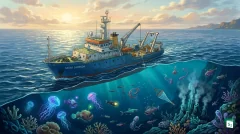
This year’s focus also highlights the unseen parts of the ocean, particularly the deep sea. As technology advances, humanity is beginning to understand that the health of the deep ocean is inextricably linked to the climate and life on the surface. Reimagining this relationship involves recognizing the ocean not just as a resource, but as a critical life-support system that requires urgent protection from threats like overfishing, plastic pollution, and seabed mining.
Global Milestones in 2026: The BBNJ Agreement and WOA III
The year 2026 marks a historic turning point in international ocean governance. In early 2026, the Biodiversity Beyond National Jurisdiction (BBNJ) Agreement, often called the High Seas Treaty, officially entered into force. This landmark treaty provides the first legal framework for establishing Marine Protected Areas (MPAs) in international waters, which cover nearly two-thirds of the world’s oceans. India signed this treaty in 2024, signaling its commitment to global marine conservation.
Coinciding with World Oceans Day on June 8, 2026, the United Nations launched the Third World Ocean Assessment (WOA III). This report provides a sobering scientific update on the state of the marine environment. Key findings from WOA III include:
| Parameter | Current Status (as of 2026) |
|---|---|
| Sea-level Rise | 4.3 mm per year (rate has doubled in a decade) |
| Heat Absorption | Over 90% of excess global warming heat |
| Ocean Floor Mapping | Approximately 30% mapped to high resolution |
| BBNJ Status | Entered into force in January 2026 |
Additionally, the 11th Our Ocean Conference (OOC11) was held in Mombasa, Kenya, from June 16 to 18, 2026. This was the first time the prestigious conference was hosted on African soil. Under the theme Our Ocean, Our Heritage, Our Future, the summit focused on mobilizing finance for the sustainable blue economy and implementing the Nice Ocean Action Plan, which includes over 800 voluntary commitments for ocean conservation.
India’s Maritime Vision: From SAGAR to MAHASAGAR
India has rapidly evolved its maritime strategy to meet the challenges of the 21st century. Building on the SAGAR (Security and Growth for All in the Region) vision launched in 2015, India introduced the MAHASAGAR doctrine in 2025. MAHASAGAR, which stands for Mutual and Holistic Advancement for Security and Growth Across Regions, expands India’s strategic reach to the broader Global South, focusing on maritime security, trade, and capacity building.
The Deep Ocean Mission and Samudrayaan
A key highlight of India’s maritime ambition is the Deep Ocean Mission (DOM), a multi-ministerial program led by the Ministry of Earth Sciences (MoES). The mission’s flagship project is Samudrayaan, India’s first manned mission to explore the deep ocean.
The Samudrayaan mission utilizes the indigenously developed submersible MATSYA 6000, which is designed to carry three personnel to a depth of 6,000 meters. By June 2026, the mission has successfully completed shallow-water trials and is on track for its full-scale deep-sea launch by the end of the year. This achievement will place India in an elite club of nations (including the US, Russia, France, Japan, and China) that possess manned deep-sea exploration capabilities.
Strengthening the Blue Economy
The Union Budget 2026-27 further cemented the Blue Economy as a national priority. The fisheries sector received its highest-ever allocation of ₹2,761.80 crore, aimed at boosting deep-sea fishing and supporting the Viksit Bharat 2047 roadmap. Key policy updates in 2026 include:
- Duty-Free High Seas Catch: The government introduced duty-free treatment for fish caught by Indian vessels in the Exclusive Economic Zone (EEZ) to incentivize deep-sea operations.
- ICGS Samudra Pratap: A specialized pollution control vessel commissioned in January 2026 to enhance environmental response in the EEZ.
- Fisheries Rules 2025: The Sustainable Harnessing of Fisheries in the EEZ Rules became fully operational in 2026, providing a legal framework for sustainable resource management.
The Way Forward: Towards 2030 and Beyond
As the world reaches the halfway point of the UN Decade of Ocean Science for Sustainable Development (2021-2030), the focus is shifting toward the implementation of the Vision 2030 roadmap. The next major milestone will be the 2027 Ocean Decade Conference in Rio de Janeiro, Brazil, which will serve as a mid-term review to adjust global strategies for the final years of the decade.
For India, the path forward involves the integration of its maritime security doctrines with its economic goals. The successful execution of the Samudrayaan mission will not only provide scientific insights into deep-sea biodiversity but also unlock the potential of polymetallic nodules, which are critical for the global transition to green energy. Furthermore, India’s leadership in the International Solar Alliance and its growing role in the Indian Ocean Rim Association (IORA) will be vital in ensuring that ocean conservation remains a central part of the Global South’s development agenda.
Key Takeaways
- World Oceans Day is observed annually on June 8, with the 2026 theme being Reimagine: Beyond the world we know, a new relationship with our ocean.
- The landmark High Seas Treaty (BBNJ Agreement) officially entered into force in early 2026, providing a legal mechanism to protect international waters.
- The Third World Ocean Assessment (WOA III), released in June 2026, revealed that sea levels are rising at a doubled rate of 4.3 mm per year.
- India’s manned deep-ocean mission, Samudrayaan, is scheduled for its final launch by the end of 2026 using the indigenous submersible MATSYA 6000.
- The MAHASAGAR doctrine, launched in 2025, serves as India’s expanded maritime vision for holistic security and growth across the Global South.
- India’s Union Budget 2026-27 provided a record allocation of ₹2,761.80 crore for the fisheries sector to strengthen the national Blue Economy.