Acting President Delcy Eloína Gómez of Venezuela arrived in India on June 16, 2026, for a high-level visit aimed at deepening bilateral energy and economic cooperation. During her visit, she held extensive talks with Prime Minister Narendra Modi and toured the world’s largest refining facility in Jamnagar, Gujarat. This engagement marks a critical step in stabilizing India’s crude oil supply chain while revitalizing a long-standing partnership with the energy-rich South American nation.
Strengthening India-Venezuela Energy Ties
The primary focus of the bilateral talks at Hyderabad House was the formalization of a long-term energy partnership. India, the world’s third-largest oil consumer, has increasingly looked toward Venezuela to diversify its energy basket. Venezuela holds the world’s largest proven oil reserves, estimated at over 300 billion barrels, primarily located in the Orinoco Belt.
As of mid-2026, Venezuela has emerged as India’s third-largest crude oil supplier, with imports averaging approximately 427,000 barrels per day (bpd). This surge follows a significant liberalization of trade protocols in early 2026, allowing Indian state-run and private refiners to sign direct term contracts. The two leaders discussed expanding this cooperation into upstream exploration, where ONGC Videsh (OVL) already holds significant interests.
Venezuela’s state-owned oil company is Petróleos de Venezuela, S.A. (PDVSA). The country is a founding member of OPEC (Organization of the Petroleum Exporting Countries), which was established in 1960 and is headquartered in Vienna, Austria.
Strategic Visit to Jamnagar: The World’s Largest Refinery
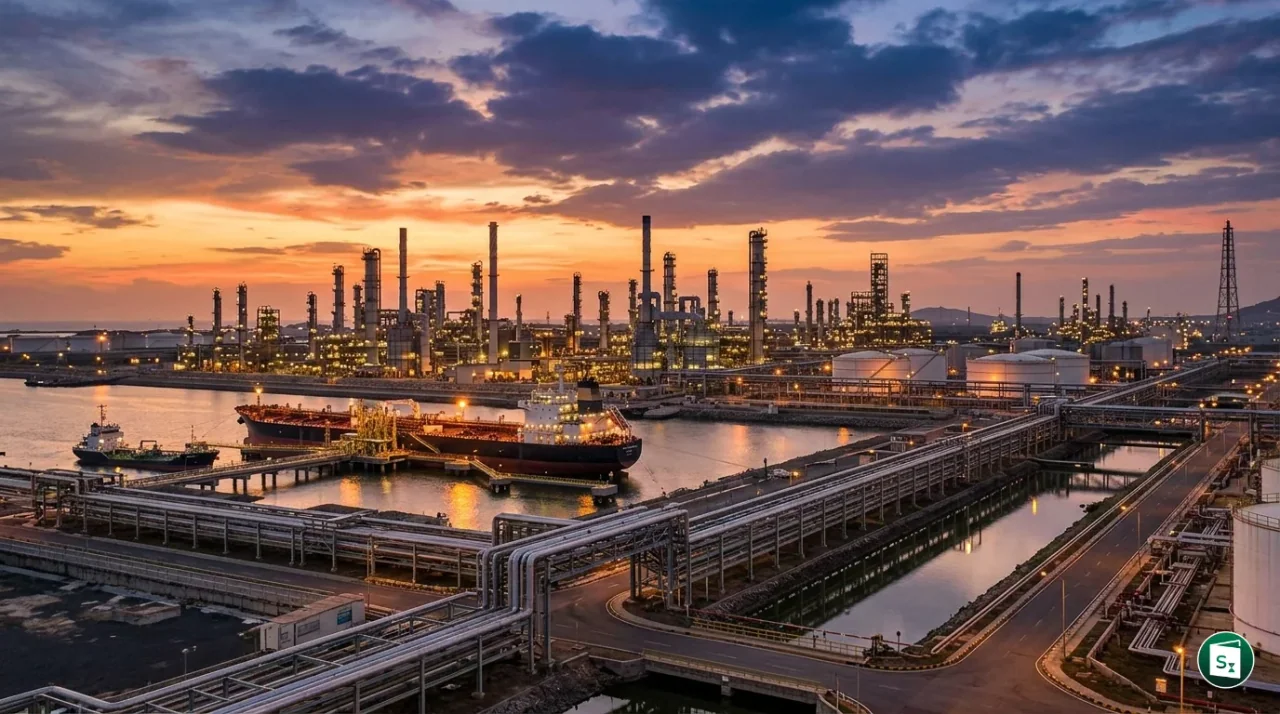
A cornerstone of the visit was the Acting President’s tour of the Jamnagar refinery in Gujarat. Owned by Reliance Industries Limited (RIL), this facility is the world’s largest single-point oil refining complex. The visit underscores the technical synergy between the two nations. Venezuelan crude is typically “heavy” and “sour,” meaning it has a high density and sulfur content, which requires sophisticated refining processes.
The Jamnagar complex is one of the few facilities globally equipped with the complex “coking” units and secondary processing capabilities needed to refine Venezuelan Merey blend crude into high-value products like diesel and jet fuel. By securing consistent volumes from Venezuela, Reliance can optimize its refining margins while providing Venezuela with a stable market for its heavy oil exports.
| Feature | Jamnagar Refinery Details |
|---|---|
| Owner | Reliance Industries Limited (RIL) |
| Location | Jamnagar, Gujarat, India |
| Type | Single-point crude oil refinery |
| Specialization | Heavy and sour crude processing |
| Capacity | Approximately 1.24 million bpd |
Diplomatic Engagements and the “Oil-for-Debt” Mechanism
Beyond energy, the visit involved deep diplomatic engagement. Acting President Gómez met with External Affairs Minister Dr. S. Jaishankar to discuss broader regional issues and the expansion of trade in sectors like pharmaceuticals and agriculture. A major breakthrough was the discussion on the “Oil-for-Debt” mechanism.
As of early 2026, ONGC Videsh (OVL), the overseas arm of India’s ONGC, has approximately $600 million in stuck dividends from its stakes in the San Cristobal and Carabobo-1 projects. The two nations are finalizing a deal where Venezuela will pay these outstanding dues by supplying additional crude oil to Indian refineries. This mechanism ensures that Indian state-run companies can recoup their investments while Venezuela stabilizes its debt obligations through its primary natural resource.
India and Venezuela established diplomatic relations in 1959. The capital of Venezuela is Caracas, and its official currency is the Bolívar. The country’s primary oil-producing region, the Orinoco Belt, is named after the Orinoco River, which is one of the longest rivers in South America.
Beyond Oil: Digital Infrastructure and Critical Minerals
The 2026 visit also signaled a diversification of ties into technology and mining. India and Venezuela are exploring cooperation in Digital Public Infrastructure (DPI), with India offering to share its successful models like UPI and Aadhar to help Venezuela modernize its financial and public delivery systems.
In the mining sector, the two countries are discussing joint exploration of critical minerals, including lithium and coltan. Venezuela’s extensive mineral wealth could support India’s National Electric Mobility Mission, which aims to secure supply chains for EV battery manufacturing. This broadens the bilateral relationship from a traditional buyer-seller energy model to a multi-dimensional strategic partnership.
India’s Indian Technical and Economic Cooperation (ITEC) program, established in 1964, continues to be a primary vehicle for capacity building between the two nations, providing scholarships and training to Venezuelan professionals in various fields.
Key Takeaways
- Venezuela’s Acting President Delcy Eloína Gómez visited India on June 16, 2026, to strengthen bilateral energy and economic ties.
- Venezuela is currently India’s third-largest crude oil supplier, with imports reaching 427,000 barrels per day in mid-2026.
- The Jamnagar refinery in Gujarat, owned by Reliance Industries (RIL), is the world’s largest single-point oil refining facility and processes Venezuelan heavy crude.
- India and Venezuela are finalizing an “Oil-for-Debt” mechanism to settle $600 million in stuck dividends owed to ONGC Videsh (OVL).
- Venezuela holds the world’s largest proven oil reserves, primarily in the Orinoco Belt region.
- The two nations are exploring new cooperation in Digital Public Infrastructure (DPI) and critical minerals like lithium for EV battery production.