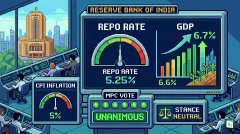
India’s wholesale inflation accelerated to 9.68% in May 2026, marking a sharp rise from the 8.26% recorded in the previous month. This data release coincides with the Ministry of Commerce and Industry transitioning to a revised Wholesale Price Index (WPI) series with 2022-23 as the new base year. The surge was primarily driven by a massive spike in global energy costs, with fuel and power inflation crossing the 30% mark.
The Shift to the 2022-23 Base Year Series
The Ministry of Commerce and Industry, through the Office of the Economic Adviser under the Department for Promotion of Industry and Internal Trade (DPIIT), has officially transitioned to the 2022-23 base year for the WPI. This replaces the previous 2011-12 series, which had become outdated in reflecting India’s modern industrial structure. The revised series features an expanded commodity basket, increasing from 697 to 957 items, to better capture emerging sectors and changing production patterns.
A major methodological shift in the new series is the use of Gross Value of Output (GVO) for determining item weights, replacing the older net traded value approach. This change ensures that the index reflects the total value of domestic production more accurately. Additionally, for the first time, the series integrates green energy sources such as solar, wind, and nuclear power into the electricity group. This move aligns the inflation tracking mechanism with India’s ongoing transition toward renewable energy.
Breaking Down the May 2026 Inflation Data
The headline WPI inflation rate of 9.68% was significantly influenced by the re-weighted groups in the new series. The following table summarizes the key sector-wise inflation rates for May 2026:
| Sector | Inflation Rate (%) |
|---|---|
| Fuel and Power | 30.33% |
| Manufactured Products | 7.48% |
| Food Articles | 3.60% |
| Crude Petroleum | 61.51% |
| Overall WPI | 9.68% |
The Dominance of Fuel and Power Inflation
The Fuel and Power group emerged as the single largest contributor to the wholesale price surge. Within this group, Crude Petroleum recorded a staggering inflation rate of 61.51%. This spike is attributed to volatile global energy markets and supply chain disruptions in key oil-producing regions. Under the new series, Crude Petroleum and Natural Gas have been moved to the Fuel and Power category from Primary Articles to consolidate all primary energy inputs. This reorganization allows for a more focused monitoring of energy costs, which act as a critical input for the entire industrial sector.
Performance of Food and Manufactured Products
In contrast to the extreme volatility in energy, Food inflation remained relatively stable at 3.60%. This indicates a localized decoupling of food prices from the broader industrial inflation trend. Meanwhile, Manufactured Products, which carry the highest weightage in the WPI basket, saw an inflation rate of 7.48%. This suggests that high energy and raw material costs are beginning to translate into higher factory-gate prices. Industries such as chemicals, basic metals, and textiles have been particularly affected by the rise in input prices.
The Roadmap to the Producer Price Index (PPI)
Alongside the revised WPI series, the government has introduced a new framework for the Producer Price Index (PPI). The PPI is the international standard for measuring inflation at the factory gate, as recommended by organizations like the International Monetary Fund (IMF). Unlike the WPI, which includes some trade and transport margins, the PPI is designed to measure the “pure” change in prices received by domestic producers for their output, excluding indirect taxes and trade margins.
The Ministry of Commerce and Industry has announced a five-year transition period during which both WPI and PPI will be published simultaneously. This parallel run will allow businesses and policymakers to adjust their price escalation clauses and long-term contracts to the new framework. After this transition, the WPI will be phased out in favor of the PPI. This shift represents a significant move toward global best practices in economic data reporting, providing a clearer picture of industrial price pressures without the noise of taxes and distribution costs.
Analyzing the Widening WPI-CPI Divergence
A significant observation in the May 2026 data is the widening divergence between wholesale and retail inflation. While the WPI inflation surged to 9.68%, the Consumer Price Index (CPI), which measures retail inflation, remained relatively contained at 3.93%. This gap indicates that while producers are facing intense cost pressures at the factory gate, especially from energy inputs, these costs have not yet been fully passed on to the final consumers.
This divergence has critical implications for the Indian economy. For the industrial sector, a high WPI combined with a lower CPI often leads to a margin squeeze, where corporate profits are hit because producers cannot raise retail prices fast enough to cover rising input costs. From a policy perspective, the Reserve Bank of India (RBI) primarily focuses on CPI inflation for its inflation-targeting mandate of 4% plus or minus 2%. However, a persistently high WPI acts as a lead indicator for future retail inflation, as sustained wholesale price pressures eventually seep into the retail market. Monitoring this gap is essential for understanding the underlying health of the manufacturing sector and anticipating future shifts in monetary policy.
Key Takeaways
- India’s Wholesale Price Index (WPI) inflation rose to 9.68% in May 2026, driven by a sharp spike in energy costs.
- The Ministry of Commerce and Industry has revised the WPI base year from 2011-12 to 2022-23, expanding the commodity basket to 957 items.
- Fuel and Power inflation stood at 30.33%, with Crude Petroleum prices surging by 61.51% during the month.
- For the first time, green energy sources such as solar, wind, and nuclear power have been included in the WPI basket.
- The government has launched a Producer Price Index (PPI) framework, which will eventually replace the WPI after a five-year transition period.
- The divergence between WPI (9.68%) and CPI (3.93%) indicates significant input cost pressure on producers that has not yet fully reached the retail level.