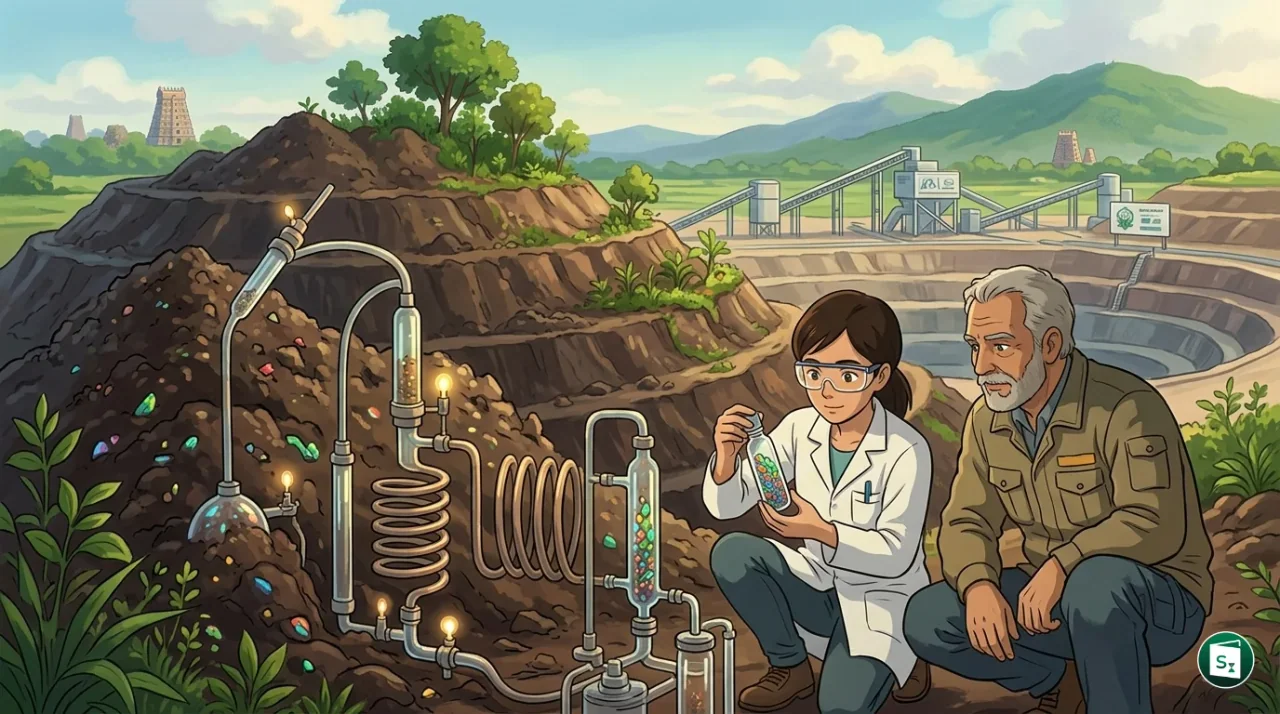
NLC India Limited and the CSIR-Central Electrochemical Research Institute (CSIR-CECRI) signed a Memorandum of Understanding on June 16, 2026, to pioneer the extraction of Rare Earth Elements and critical minerals from mining waste. This partnership targets the recovery of strategic resources from overburden and tailings at the Neyveli lignite mines in Tamil Nadu. The initiative marks a significant step toward securing India’s domestic supply chain for minerals essential to the green energy transition and national defense.
A Strategic Alliance for Mineral Self-Reliance
The agreement was formalized at Neyveli by senior officials from both organizations in the presence of NLC India Chairman and Managing Director, Prasanna Kumar Motupalli. This collaboration is designed to develop economically viable and sustainable technologies for the beneficiation of critical minerals from secondary sources. While the initial research is centered on the Neyveli lignite mines, the partnership intends to expand these technological applications across other mining and exploration projects managed by NLC India.
The primary focus of this research involves characterising the chemical composition of mining overburden (the layer of earth removed to access coal or lignite) and tailings (the materials left over after mineral processing). By identifying the specific concentrations of various elements, the two institutions aim to create a scalable model for mineral recovery that bypasses the environmental and regulatory hurdles often associated with traditional greenfield mining.
Transforming Mining Waste into Strategic Wealth
The concept of Waste to Wealth is central to this partnership, aiming to convert massive volumes of mining byproducts into high-value strategic assets. Lignite mining operations generate significant quantities of overburden, which have traditionally been treated as environmental liabilities. However, recent geological studies have indicated that the Neyveli lignite basin, a sedimentary sequence from the Tertiary period, contains elevated concentrations of Rare Earth Elements.
NLC India is already moving toward industrial-scale testing with a ₹600 crore pilot project to extract minerals from fly ash in collaboration with the Bhabha Atomic Research Centre (BARC). The new partnership with CSIR-CECRI complements this by focusing on different types of waste materials. The institute in Karaikudi will deploy specialized electrochemical separation methods to isolate trace minerals. These electrochemical techniques are preferred for their high selectivity and lower environmental footprint compared to conventional chemical leaching processes.
Rare Earth Elements: The ‘Vitamins’ of Modern Industry
Rare Earth Elements (REEs) are a group of 17 chemical elements, including the 15 lanthanides plus scandium and yttrium. Often described as the “vitamins” of modern technology, they are indispensable for high-performance applications despite being used in relatively small quantities. They are critical for the manufacturing of permanent magnets used in electric vehicle motors, wind turbines, and precision-guided munitions for the defense sector.
India currently possesses the third-largest REE reserves in the world, primarily in the monazite-rich beach sands of coastal states. However, the country remains heavily dependent on imports for finished rare earth products, particularly from China. By targeting secondary resources like mining waste, India seeks to break this dependency and ensure a stable supply for its Net Zero 2070 goals and the FAME scheme for electric mobility.
Supporting India’s National Critical Mineral Mission
This partnership aligns with the National Critical Mineral Mission (NCMM), which was launched by the Union Cabinet in 2025 with a total outlay of ₹16,300 crore. The mission was established to secure the supply chain for 30 critical minerals identified by the Ministry of Mines in 2023. These minerals are deemed essential for India’s economic growth, national security, and the transition to a low-carbon economy.
| Key Aspect of NCMM | Details |
|---|---|
| Primary Goal | Ensuring supply security for 30 critical and strategic minerals. |
| Secondary Sourcing | Promoting recycling and extraction from mining waste (Waste-to-Wealth). |
| Overseas Acquisition | Facilitating mineral asset purchases abroad via KABIL. |
| Financial Support | Incentives for domestic exploration and processing technologies. |
Institutional Profile: NLC India and CSIR-CECRI
NLC India Limited (NLCIL), formerly known as Neyveli Lignite Corporation, is a Navratna Public Sector Undertaking (PSU) operating under the administrative control of the Ministry of Coal. Established in 1956, it is headquartered in Neyveli, Tamil Nadu. While its core business has historically been lignite mining and thermal power generation, NLCIL is rapidly diversifying into renewable energy and critical mineral exploration to support India’s energy transition.
The CSIR-Central Electrochemical Research Institute (CECRI) is a premier research laboratory under the Council of Scientific and Industrial Research (CSIR). Founded in 1948 and located in Karaikudi, Tamil Nadu, it is the largest electrochemical research establishment in South Asia. CSIR-CECRI has been a pioneer in developing indigenous technologies, including India’s first indigenous Lithium-ion cells, and it continues to lead research in advanced energy storage and mineral processing.
Key Takeaways
- NLC India and CSIR-CECRI signed an MoU on June 16, 2026, for the extraction of Rare Earth Elements (REEs) from mining waste.
- The project focuses on utilizing overburden and tailings from the Neyveli lignite mines in Tamil Nadu as a secondary source of minerals.
- This initiative is a critical component of India’s National Critical Mineral Mission (NCMM), which targets supply security for 30 identified minerals.
- CSIR-CECRI, headquartered in Karaikudi, will provide technical expertise in electrochemical separation for mineral recovery.
- NLC India Limited is a Navratna PSU under the Ministry of Coal, established in 1956.
- The partnership aims to reduce India’s import dependency on REEs, which are vital for Electric Vehicles, wind energy, and defense systems.