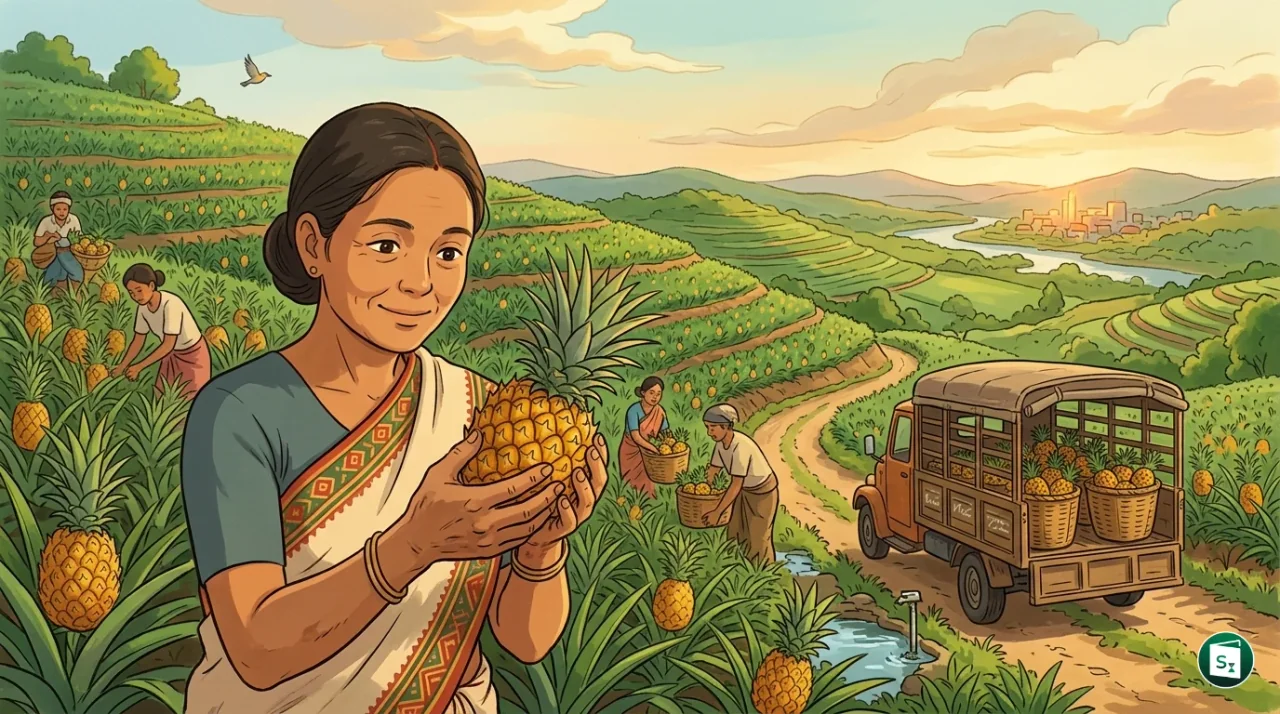
Union Minister for the Development of North Eastern Region Jyotiraditya Scindia and Tripura Chief Minister Dr. Manik Saha launched the Tripura Mission Queen Pineapple at Sanchar Bhawan in New Delhi. The ₹236 crore convergence-led project aims to upgrade cultivation practices, establish post-harvest infrastructure, and strengthen the value chain of the state’s famous fruit. This landmark initiative is designed to boost farmer incomes and establish the Geographical Indication tagged fruit as a premium global brand.
What Is the Tripura Mission Queen Pineapple?
The Tripura Mission Queen Pineapple is a comprehensive development project with a total outlay of ₹236 crore. Operating as a three-year roadmap spanning from financial year 2026 to financial year 2028, the mission focuses on transitioning the state’s famous Queen Pineapple from a regional crop into a globally competitive brand. The Ministry of Development of North Eastern Region (MDoNER), which was established in September 2001 and elevated to a full ministry in 2004, is driving this central initiative in close collaboration with the state government of Tripura.
The primary target beneficiaries of this mission are the smallholder pineapple farmers and local tribal communities in Tripura. Historically, Tripura ranks among the top five pineapple-producing states in India, second only to Assam in the northeastern region. The Queen Pineapple was awarded the Geographical Indication (GI) tag in 2015 and declared the official State Fruit of Tripura in 2018. Despite producing over 178,000 metric tons of pineapple annually across approximately 12,500 hectares, the state’s growers have faced challenges due to poor market linkages and inadequate processing capacity. The mission aims to address these structural issues by enabling farmers to participate directly in the higher segments of the agricultural value chain.
Hub-and-Spoke Infrastructure Model
To bridge the gap between farms and markets, the mission employs a Hub-and-Spoke post-harvest infrastructure network. A major central hub will be built near the Agartala Airport to act as the primary node for consolidation, quality grading, processing, packaging, and dispatch. This hub is strategically located to leverage air connectivity for transporting fresh fruit to domestic and international markets.
Key Components of the Infrastructure
The central hub will connect to eight collection centers, or spokes, across major pineapple-growing clusters. These spokes are located in the districts of West Tripura, Khowai, and Sepahijala.
| Infrastructure Component | Details and Objectives |
|---|---|
| Central Hub | Located near Agartala Airport to handle grading, high-end processing, and export logistics. |
| Spoke Collection Centers | Eight facilities located in West Tripura, Khowai, and Sepahijala districts to aggregate harvest. |
| Cold Chain Logistics | Temperature-controlled storage and refrigerated vehicles to reduce post-harvest losses. |
| Green Infrastructure | Integration of solar-powered storage systems to reduce carbon footprints and operating costs. |
| Digital Systems | Internet of Things (IoT) sensors for farm monitoring and blockchain-based digital traceability for quality assurance. |
| Nalkata Processing Unit | Revival of the historical Nalkata Pineapple Processing Unit to boost local processing capacity. |
| Waste-to-Wealth Units | Facilities for processing waste into value-added products like Bromelain enzyme and Pineapple Leaf Fibre (PALF). |
The inclusion of waste-to-wealth systems is designed to create a circular bio-economy. Extracting Bromelain, a commercially valuable enzyme used in pharmaceuticals, and processing Pineapple Leaf Fibre (PALF) for textiles will provide additional revenue streams for farmer groups.
Convergence-Led Implementation Strategy
The mission adopts a convergence-led approach to avoid fragmentation and maximize the impact of government spending. By integrating schemes and budgets from multiple central ministries and state agencies, the project ensures that infrastructure development, agricultural inputs, training, and export promotion work in unison.
Roles of Central and State Agencies
The Ministry of Development of North Eastern Region acts as the nodal agency to coordinate actions across different entities. Key institutions participate with specific responsibilities:
- Central Ministries: The Ministry of Agriculture and Farmers Welfare, the Ministry of Food Processing Industries, and the Ministry of Micro, Small and Medium Enterprises support cultivation practices, food processing infrastructure, and entrepreneurship. The Ministry of Commerce and Industry facilitates international trade links.
- Export and Trade Facilitators: The Agricultural and Processed Food Products Export Development Authority (APEDA), established in 1986, and the Department for Promotion of Industry and Internal Trade (DPIIT) coordinate trade corridors, certification, and global buyer matches.
- Regional and Tribal Development Bodies: The North Eastern Regional Agricultural Marketing Corporation (NERAMAC), established in 1982 with headquarters in Guwahati, helps in ground-level aggregation and branding. The Tribal Cooperative Marketing Development Federation of India (TRIFED), established in 1987, assists tribal farmers with marketing and capacity building.
- Research Institutions: The Indian Council of Agricultural Research (ICAR) and the Council of Scientific and Industrial Research (CSIR) provide technical expertise on crop disease control, tissue culture, and processing techniques.
Global Promotion of the Queen Pineapple
The cornerstone of the mission is the global positioning of the Queen Pineapple as Tripura’s agricultural brand. Rather than competing in the low-margin commodity market, the mission aims to establish the fruit as a premium product in domestic metro cities and international markets.
Unique Selling Proposition (USP) of the Fruit
The Queen Pineapple is distinguished by several unique physical and sensory characteristics that form its Unique Selling Proposition (USP):
- Physical Features: The fruit is relatively small, with a vibrant golden-yellow color and deep-set eyes.
- Sensory Qualities: It is known for its intense, sweet aroma, high sugar content with pleasant acidity, and a crisp, low-fiber texture. Unlike other common varieties, the core of the Queen Pineapple is soft and edible.
- GI Protection: The Geographical Indication status granted in 2015 ensures that only pineapples grown under specific soil and climate conditions of Tripura can carry the name.
To commercialize these advantages, the mission will implement a systematic marketing plan. The Agricultural and Processed Food Products Export Development Authority (APEDA) will lead campaigns to establish direct export channels to the Middle East, Europe, and Southeast Asia. Furthermore, the integration of blockchain-based digital traceability systems will allow international consumers to scan a QR code to verify the origin and organic certification of the fruit, ensuring brand integrity and premium pricing.
Key Takeaways
- The Tripura Mission Queen Pineapple is a ₹236 crore convergence-led project launched to develop the cultivation and value chain of the fruit over a three-year roadmap spanning financial year 2026 to financial year 2028.
- The mission is driven by the Ministry of Development of North Eastern Region (MDoNER), which was established in September 2001 and became a full-fledged ministry in 2004.
- The Queen Pineapple was awarded the Geographical Indication (GI) tag in 2015 and declared the official State Fruit of Tripura in 2018.
- The project implements a Hub-and-Spoke model featuring a central hub near Agartala Airport and eight collection centers across West Tripura, Khowai, and Sepahijala districts.
- Implementing and collaborating agencies include the North Eastern Regional Agricultural Marketing Corporation (NERAMAC), established in 1982, and the Tribal Cooperative Marketing Development Federation of India (TRIFED), established in 1987.