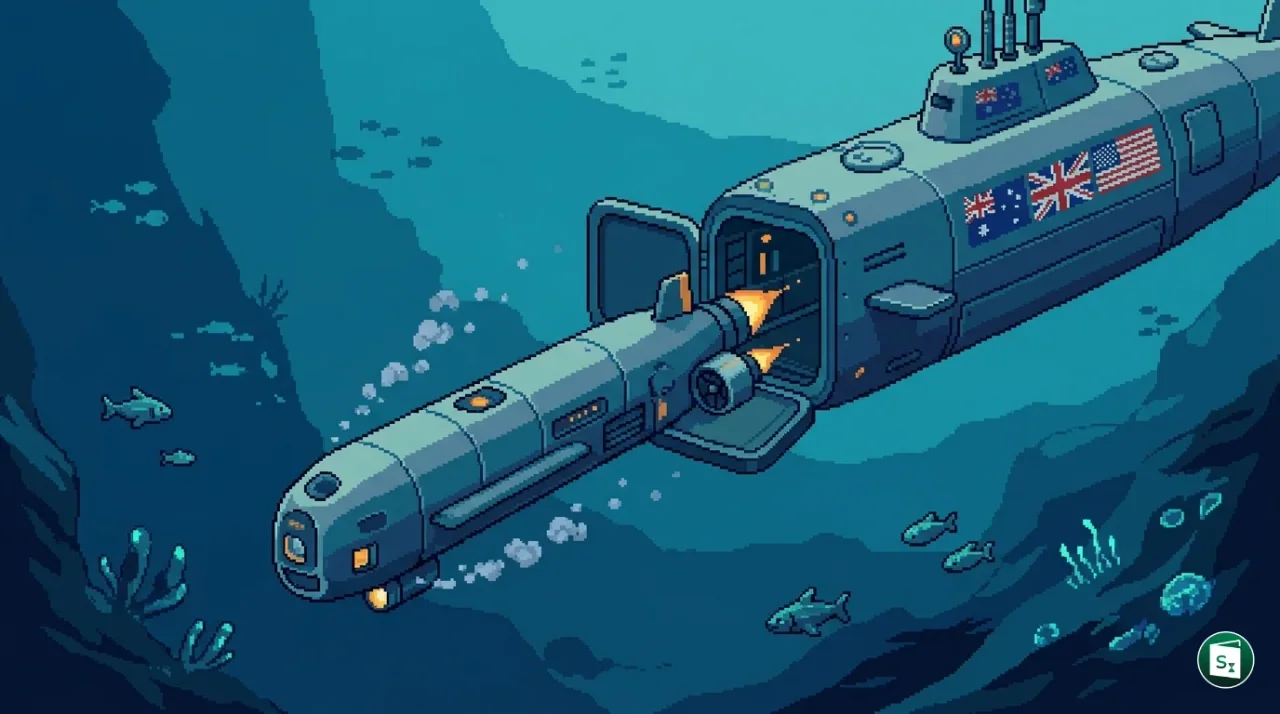
The trilateral security alliance AUKUS, comprising Australia, the United Kingdom, and the United States, has launched a joint underwater drone programme to co-develop advanced Uncrewed Undersea Vehicles (UUVs). Announced under the partnership’s Pillar Two initiative, the project focuses on creating adaptable, multi-mission payloads to strengthen undersea operational capabilities. The partner nations expect the first deliveries of these co-developed maritime technologies to begin by 2027.
What is the AUKUS Pillar Two Undersea Drone Programme?
The AUKUS security partnership was established in September 2021 to address shifting strategic dynamics in the Indo-Pacific region. The partnership is structured around two key pillars. Pillar One focuses on facilitating Australia’s acquisition of conventionally armed, nuclear-powered submarines. Pillar Two is designed to accelerate joint research, development, and integration of advanced defence technologies, including artificial intelligence, quantum computing, hypersonics, cyber security, and undersea warfare capabilities.
The newly announced joint underwater drone programme represents the first major signature project under Pillar Two. Rather than developing entirely new autonomous vessels from scratch, the programme focuses on standardising and co-developing advanced payloads, sensors, and software. This collaborative approach allows the partner nations to integrate common technologies across their respective national fleets, ensuring seamless interoperability in contested waters.
Integrating National UUV Fleets: Ghost Shark, Cetus, and Orca
Each AUKUS partner nation is already developing its own domestic UUV platform. The new joint programme focuses on sharing tech, sensors, and operational concepts to integrate these distinct systems.
Overview of AUKUS UUV Platforms
| Nation | UUV Program | Prime Developer | Focus Area | Key Features |
|---|---|---|---|---|
| Australia | Ghost Shark | Anduril Australia | Long-range intelligence, surveillance, reconnaissance, and strike missions | Rapid development cycle, modular, software-defined, affordable asymmetric design |
| United Kingdom | Project Cetus (XV Excalibur) | MSubs | Anti-submarine warfare, seabed protection, and doctrine testing | Sized to fit standard shipping containers, largest uncrewed submersible in European navies |
| United States | Orca XLUUV | Boeing | Covert payload delivery, mine countermeasures, and long-endurance ocean patrol | Extra-large size (85 feet), hybrid diesel-electric propulsion, high payload capacity |
By focusing on common payloads, such as sonar arrays, communication links, navigation packages, and potential weapon systems, the trilateral partners plan to ensure that a payload developed by one country can be instantly deployed on a UUV built by another. This approach accelerates technological innovation and significantly reduces development costs across the alliance.
Strategic Importance and Objectives of the Programme
The trilateral project serves several critical tactical and strategic purposes in the modern naval arena. Undersea warfare is shifting toward hybrid fleet designs, where crewed warships and submarines operate in tandem with autonomous uncrewed systems. The primary objectives of this joint UUV initiative include:
- Seabed Infrastructure Protection: The vulnerability of critical undersea structures, such as telecommunication cables and energy pipelines, has become a major national security concern. The co-developed UUVs will monitor and safeguard these vulnerable assets.
- Asymmetric Deterrence: Deploying autonomous undersea drones allows the partner nations to project power and conduct surveillance in highly contested or anti-access and area-denial (A2/AD) zones without risking human lives.
- Enhanced Undersea Awareness: By carrying diverse payloads, UUVs can perform persistent intelligence, surveillance, and reconnaissance (ISR) tasks, tracking adversarial submarine movements and mapping ocean geography.
- Multi-mission Flexibility: Modular payloads mean UUVs can be rapidly configured for different operations, such as mine clearance, electronic warfare, or tactical decoy operations, depending on the mission requirements.
Key Takeaways
- The AUKUS security alliance, consisting of Australia, the United Kingdom, and the United States, was established in September 2021.
- The alliance launched a joint uncrewed undersea vehicle (UUV) programme under Pillar Two to co-develop advanced payloads.
- The first deliveries of UUV technology under the joint programme are scheduled to begin by 2027.
- Australia is developing the Ghost Shark UUV in partnership with Anduril Australia.
- The United Kingdom’s experimental UUV, XV Excalibur, is operated by MSubs for doctrine testing.
- The United States Navy is acquiring the Orca XLUUV developed by Boeing.