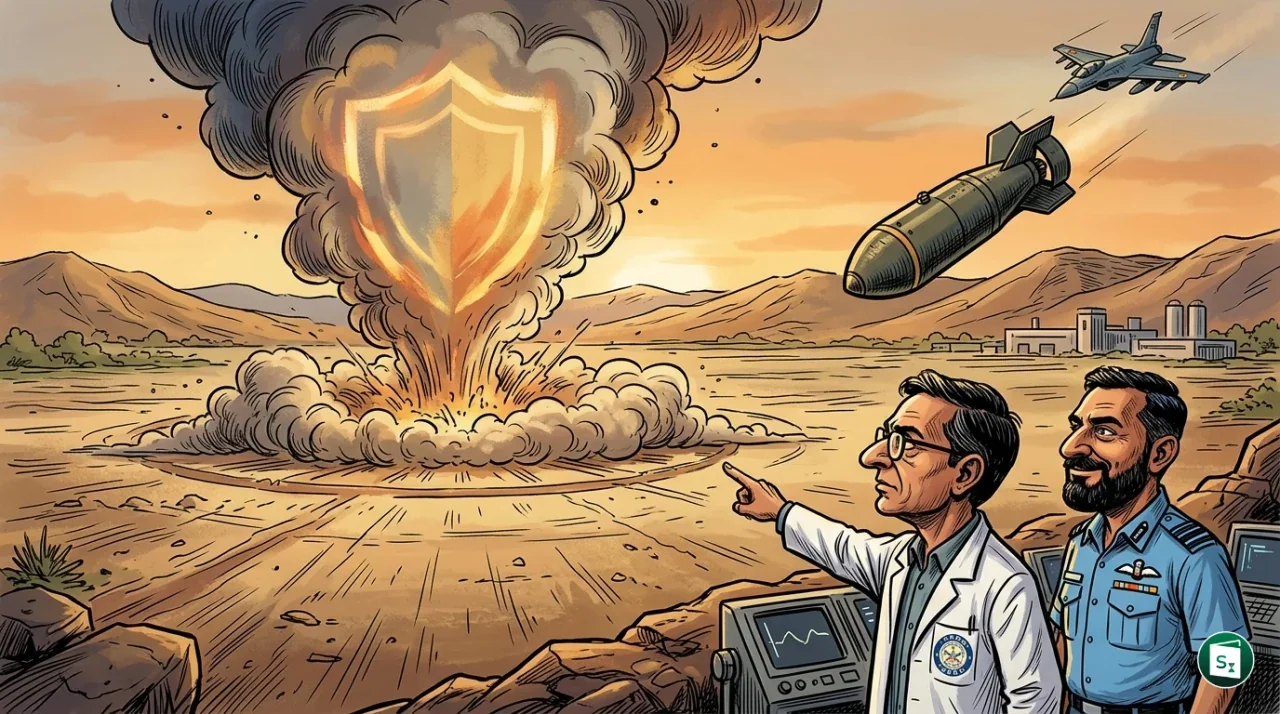
The Defence Research and Development Organisation successfully conducted a trial of a high-calibre conventional bomb at the Terminal Ballistics Research Laboratory range in Ramgarh, Haryana, on June 6, 2026. Supervised by senior officials from the Indian Air Force and defence scientists, the test validated the structural integrity and performance parameters of advanced domestic munitions. This successful detonation marks a significant step forward in strengthening India’s self-reliance in precision aerial strike capabilities.
Successful Test of the High-Calibre Munition
The high-power explosive trial was executed in full compliance with established standard operating procedures to verify the safety, reliability, and terminal effects of the heavy armament. Given the high-intensity blast anticipated from a high-calibre weapon, local authorities implemented rigorous safety measures before the detonation. They established a 2-kilometre sensitive zone around the test range to prevent any accidental casualties or damage.
In addition to securing the immediate perimeter, the administration issued public advisories to residents of nearby villages, including Bhanu and Billa, urging them to remain indoors during the designated testing hours. Safety planners estimated that metal fragments from the bomb casing could scatter up to a distance of 1.5 kilometres from the epicentre of the blast. The successful completion of the trial under these controlled conditions allowed DRDO scientists to collect critical data on blast shockwaves, fragmentation spread, and heat signatures.
Role and Operations of the Terminal Ballistics Research Laboratory
The Terminal Ballistics Research Laboratory (TBRL) is a key facility under the Armaments and Combat Engineering cluster of the DRDO. Headquartered in Chandigarh, TBRL operates a specialized 5,000-acre firing range at Ramgarh in the Panchkula district of Haryana. The laboratory was conceptualized in 1961 to provide modern facilities for armament research in India. It became operational in 1967 and was formally inaugurated in January 1968 to advance the country’s capability in terminal ballistics.
TBRL conducts basic and applied research in high explosives, detonics, and shock waves. Its primary mandate involves assessing the terminal effects of ammunition, evaluating new warhead designs, and testing projectiles. The facility plays an important role in the performance evaluation of warheads for India’s major missile systems, including the Prithvi and Akash. Beyond military applications, TBRL also assists in the development of civilian safety equipment, such as bullet-resistant glass, body armour, and non-lethal riot control ammunition.
High Speed Low Drag Bombs: Enhancing Aerial Firepower
India’s development of high-calibre conventional munitions includes the High Speed Low Drag (HSLD) family of air-dropped bombs. Developed by the DRDO, these general-purpose munitions are designed to reduce aerodynamic drag on carrying aircraft. This design enables high-speed carriage and safe release from supersonic fighter jets.
The HSLD series is compatible with the frontline combat aircraft of the Indian Air Force. These include the Su-30MKI, Jaguar, Mirage 2000, and the indigenous HAL Tejas. These bombs are primarily utilized to target hardened ground installations, railway yards, enemy runways, and bridges.
HSLD Bomb Weight Classes and Warhead Payload
The HSLD munitions are manufactured in different weight classes to meet various mission profiles. They are equipped with advanced explosive fillings like Dentex (composed of RDX, TNT, and aluminium powder) to optimize blast pressure.
| Bomb Variant | Total Weight Class | Approximate Warhead Weight | Primary Target Type |
|---|---|---|---|
| HSLD-100 | 100 kg | 45 kg | Light installations, soft-skinned vehicles |
| HSLD-250 | 250 kg | 103 kg | Command posts, communication centers, bunkers |
| HSLD-450 | 450 kg | 200 kg | Hardened ammunition depots, bridges, runways |
| HSLD-500 | 500 kg | 185 kg | Reinforced concrete bunkers, infrastructure |
Strategic Implications for India’s Defence Capabilities
The successful validation of high-calibre conventional munitions carries significant strategic benefits for India’s defense posture. By developing these weapons domestically, India decreases its dependence on foreign suppliers for heavy aerial armaments. This progress aligns with the national goal of achieving self-reliance in defence manufacturing, ensuring a steady supply of critical munitions during emergencies.
Furthermore, these conventional bombs serve as the foundation for advanced smart weapons. When combined with wing kits and guidance modules, such as the Tactical Advanced Range Augmentation (TARA) system, standard gravity bombs are converted into precision-guided glide weapons. This upgrade provides the Indian Air Force with stand-off capabilities, allowing pilots to strike heavily defended target coordinates from safe distances, thereby minimizing risks to aircraft and crew.
Key Takeaways
- The Defence Research and Development Organisation successfully tested a high-calibre conventional bomb in Haryana on June 6, 2026.
- The trial was conducted at the Ramgarh range of the Terminal Ballistics Research Laboratory, which is located in the Panchkula district of Haryana.
- The test was monitored under strict standard operating procedures and jointly supervised by the Indian Air Force and DRDO scientists.
- The Terminal Ballistics Research Laboratory was conceptualized in 1961, became operational in 1967, and operates under the Armaments and Combat Engineering cluster of DRDO.
- India’s high-calibre air-dropped weapon arsenal includes the High Speed Low Drag (HSLD) series, which features weight classes ranging from 100 kg to 500 kg.
- The HSLD munitions can be converted into stand-off precision weapons using wing kits like the Tactical Advanced Range Augmentation (TARA) system.