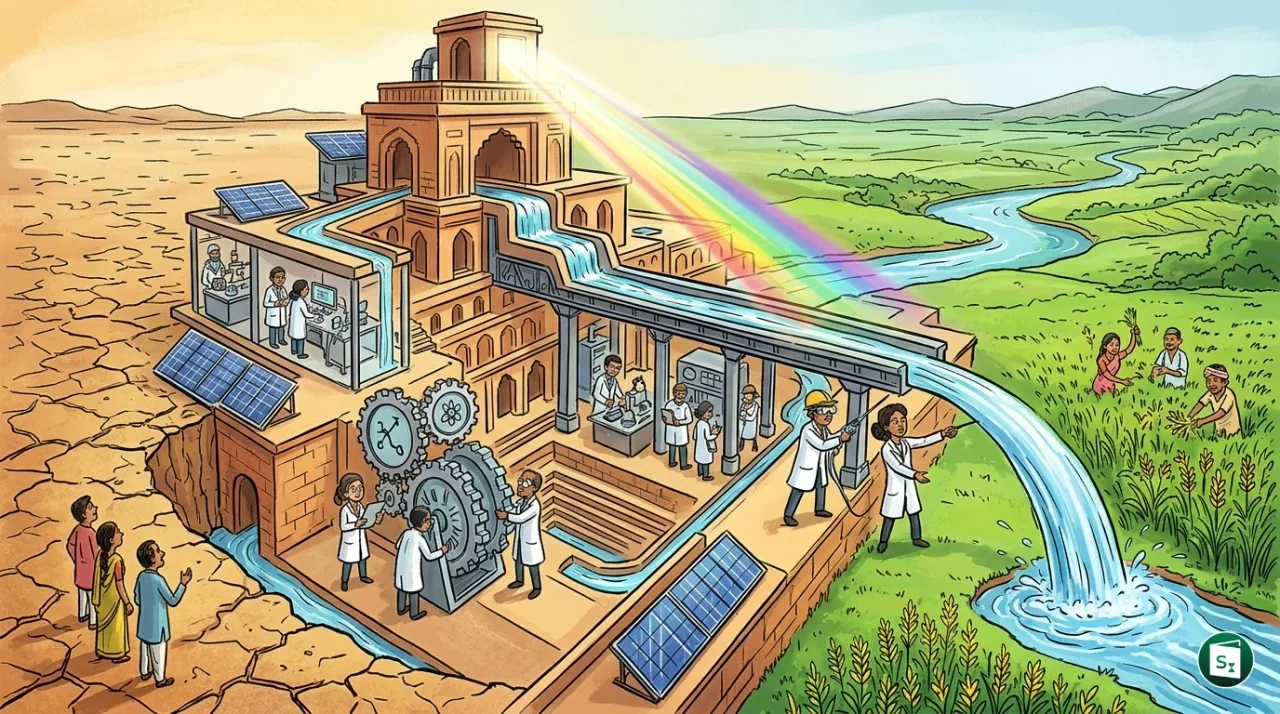
The Ministry of Jal Shakti and the Anusandhan National Research Foundation (ANRF) jointly launched the Missions for Advancement in High-Impact Areas (MAHA) Water Mission on June 1, 2026. Unveiled during a national workshop on water research and development in New Delhi, the initiative features a financial outlay of ₹200 crore to be implemented over five years. The mission aims to strengthen India’s water security by bridging the gap between scientific research and field-ready technological solutions.
Understanding the MAHA Water Mission
The mission provides a structured platform to promote collaborative innovation by connecting academia, research institutes, start-ups, and industrial entities. To drive this collaboration, the program offers research grants of up to ₹20 crore per consortium. Each consortium must bring together diverse stakeholders, including universities, national laboratories, and private enterprises, to translate laboratory-scale research into scalable solutions for the field. This funding model aims to support technology development, prototype validation, and actual field deployment.
This initiative is backed by the administrative and scientific capabilities of its two parent bodies. The Ministry of Jal Shakti was formed in May 2019 by merging the Ministry of Water Resources, River Development and Ganga Rejuvenation with the Ministry of Drinking Water and Sanitation. This merger was designed to integrate water-related planning and execution. On the other hand, the Anusandhan National Research Foundation (ANRF) was established under the Anusandhan National Research Foundation Act, 2023, replacing the erstwhile Science and Engineering Research Board (SERB). The Governing Board of the foundation is presided over by the Prime Minister of India, while its Executive Council is chaired by the Principal Scientific Adviser to the Government of India.
Five Strategic Pillars of the Mission
The mission operates across five strategic pillars designed to tackle critical challenges in the water sector. These focus areas address the entire lifecycle of water, from source mapping and quality preservation to wastewater recycling and climate adaptation.
| Strategic Pillar | Focus Areas |
|---|---|
| Water Resource Assessment | Precision mapping, water budgeting, and sustainable groundwater and surface water management. |
| Drinking Water | Advancing filtration technologies, ensuring safe drinking water supply, and tackling arsenic or fluoride pollution. |
| Water Quality and Ecological Health | Monitoring microplastics and heavy metal contaminants, alongside ecological restoration of polluted water bodies. |
| Water Use Efficiency | Promoting wastewater treatment, circular economy models through recycling, and reducing agricultural water usage. |
| Climate Resilience | Developing climate change adaptation models, flood and drought forecasting tools, and resilient infrastructure. |
Key Collaborations: Jal Shakti Ministry and ISRO Partnership
During the national workshop, the Ministry of Jal Shakti signed a Memorandum of Understanding (MoU) with the Indian Space Research Organisation (ISRO). This agreement aims to integrate advanced space-based applications and satellite technology into India’s water governance framework. The collaborative initiative focuses on building climate resilience and establishing evidence-based decision-making systems for water resources across the country.
The partnership identifies 24 priority research areas for technology deployment. Key focus areas include reservoir monitoring, water-spread assessment, river-flow analysis, and satellite-based flood forecasting. Additionally, the collaboration will utilize satellite imagery to assess water quality and study the distribution of macroplastics in major water bodies. This agreement strengthens a long-standing cooperation between the space agency and the water sector that began in 1982, updating their joint efforts to support the development targets of Viksit Bharat 2047.
Launch of Digital Platforms and Community Initiatives
Alongside the research mission and the space partnership, the workshop marked the rollout of digital tools to foster grassroots participation and industrial innovation. The ministry introduced the Jal Sanchay Jan Bhagidari: Catch the Rain (JSJB:CTR) Portal. This platform allows citizens, local bodies, educational institutions, and industries to document and verify their rainwater harvesting and groundwater recharge efforts. This portal supports the nationwide Catch the Rain campaign, which operates under the tagline Catch the rain, where it falls, when it falls. The ministry also initiated Phase 3 of the campaign, which aims to construct two crore water conservation structures across India between June 2026 and May 2027.
To engage the private sector and entrepreneurial ecosystem, the government announced an open call for proposals on the Bharat Water Innovation Network (Bharat-WIN) Portal. This digital interface connects scientific research, entrepreneurship, and community efforts. Through this call, startups and MSMEs can access funding and support to design, test, and scale innovative solutions for water conservation, purification, and distribution.
The Way Forward
To maximize the impact of the newly launched mission and portals, India must ensure seamless integration between research outputs and local administration. The success of the consortia funded under the mission will depend on how effectively their technologies are adopted by state departments, municipal bodies, and local communities. Linking the academic research of the consortia with the startup solutions from the innovation network will also help accelerate the transition of products from lab testing to mass production.
Furthermore, integrating space-based satellite monitoring from the space agency with real-time ground data from the digital portals will create a comprehensive water management database. This unified data structure will allow policymakers to make informed, predictive decisions regarding groundwater depletion, river flow anomalies, and flood risks. In the long run, combining technological innovation with active community participation will be essential to achieving sustainable water security and meeting national development goals.
Key Takeaways
- The Missions for Advancement in High-Impact Areas (MAHA) Water Mission was launched on June 1, 2026, with a total budget of ₹200 crore to be implemented over five years.
- The initiative is a joint venture of the Ministry of Jal Shakti and the Anusandhan National Research Foundation (ANRF) to support technology-driven water security.
- Multidisciplinary research consortia under the mission are eligible to receive funding support of up to ₹20 crore per project.
- The Anusandhan National Research Foundation (ANRF) was established under the ANRF Act, 2023, replacing the Science and Engineering Research Board (SERB).
- The Ministry of Jal Shakti signed an agreement with ISRO covering 24 priority research areas that deploy satellite technology for water governance.
- The new Jal Sanchay Jan Bhagidari: Catch the Rain (JSJB:CTR) Portal will document community-led rainwater harvesting efforts.