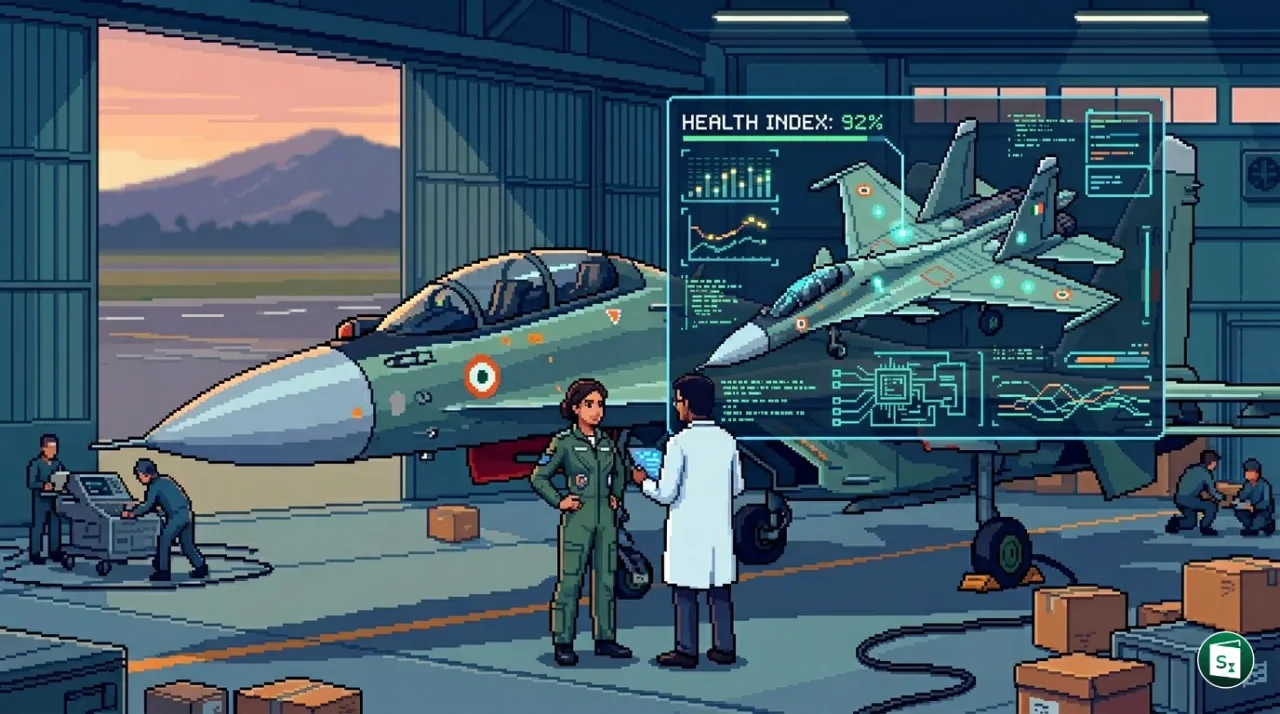
The Indian Air Force has signed three contracts with the Indian Institute of Technology Bombay to indigenously design and deploy artificial intelligence-driven predictive maintenance systems. This collaboration focuses on developing a digital diagnostic health index for the frontline Sukhoi Su-30MKI fighter fleet to anticipate component failures. By integrating advanced data analytics, the partnership seeks to maximize the operational readiness of these multi-role aircraft while reducing maintenance downtime and service costs.
Enhancing Fighter Fleet Reliability Through AI
The three contracts signed between the Indian Air Force (IAF) and the Indian Institute of Technology Bombay (IIT Bombay) mark a transition from reactive to data-driven engineering. The agreements were signed on 27 May 2026 by Air Marshal KAA Sanjeeb, Director General (Aircraft) of the IAF, and Professor Shireesh B. Kedare, Director of IIT Bombay.
Under these agreements, the partners will develop systems for predictive, prognostic, and prescriptive maintenance. Unlike traditional maintenance schedules that rely on fixed flight hours or elapsed time, predictive systems use real-time sensors and historical operational data to identify when a part is likely to fail. This allows engineering crews to replace components before a malfunction occurs in mid-flight, enhancing both pilot safety and mission success rates.
The Role of Digital Twin Models and Health Indexing
A major component of the project is the creation of a Digital Diagnostic Health Index (DDHI) specifically tailored for the Sukhoi Su-30MKI fighter fleet. The Su-30MKI is a twin-engine, long-range, multi-role fighter aircraft designed by Russia’s Sukhoi and manufactured under license in India by Hindustan Aeronautics Limited (HAL). The fleet serves as the backbone of the IAF’s fighter power.
To build the health index, researchers at IIT Bombay will construct AI-driven digital twin models of the aircraft’s engines. A digital twin is a virtual, real-time software replica of a physical system, in this case, the AL-31FP turbofan engine. By feeding flight data, temperature readings, pressure metrics, and vibrational frequencies into the digital twin, the software simulates how the engine is wearing down and calculates a real-time health score. This score helps ground crews decide exactly which engines require immediate attention, avoiding unnecessary inspections of healthy aircraft.
Strategic Importance of Defence Indigenisation
Developing predictive maintenance models within India reduces reliance on foreign original equipment manufacturers for engineering data and technical support. Historically, India has depended on Russian support for major structural and engine overhauls of the Sukhoi fleet. By creating domestic capability to analyze and interpret engine wear, the IAF strengthens its strategic autonomy.
This collaboration aligns with the national goal of Aatmanirbharta in defence, aiming to build a robust domestic military-industrial complex. It leverages academic research from institutions like IIT Bombay to address practical engineering challenges in defence Maintenance, Repair, and Overhaul (MRO). This approach turns academic AI research into field-ready applications, boosting the reliability of high-value national security assets.
Key Takeaways
- The Indian Air Force (IAF) signed three contracts with IIT Bombay on 27 May 2026 to indigenously develop AI-driven predictive maintenance technologies.
- The project focuses on creating a Digital Diagnostic Health Index (DDHI) to monitor the health of the frontline Sukhoi Su-30MKI fighter fleet.
- The predictive maintenance technology utilizes digital twin models of the aircraft’s AL-31FP engines to simulate wear and anticipate component failures.
- The Sukhoi Su-30MKI is a twin-engine multi-role fighter designed by Russia and manufactured under license in India by Hindustan Aeronautics Limited (HAL).
- This collaboration supports the Aatmanirbharta initiative by building domestic expertise in military Maintenance, Repair, and Overhaul (MRO) systems.