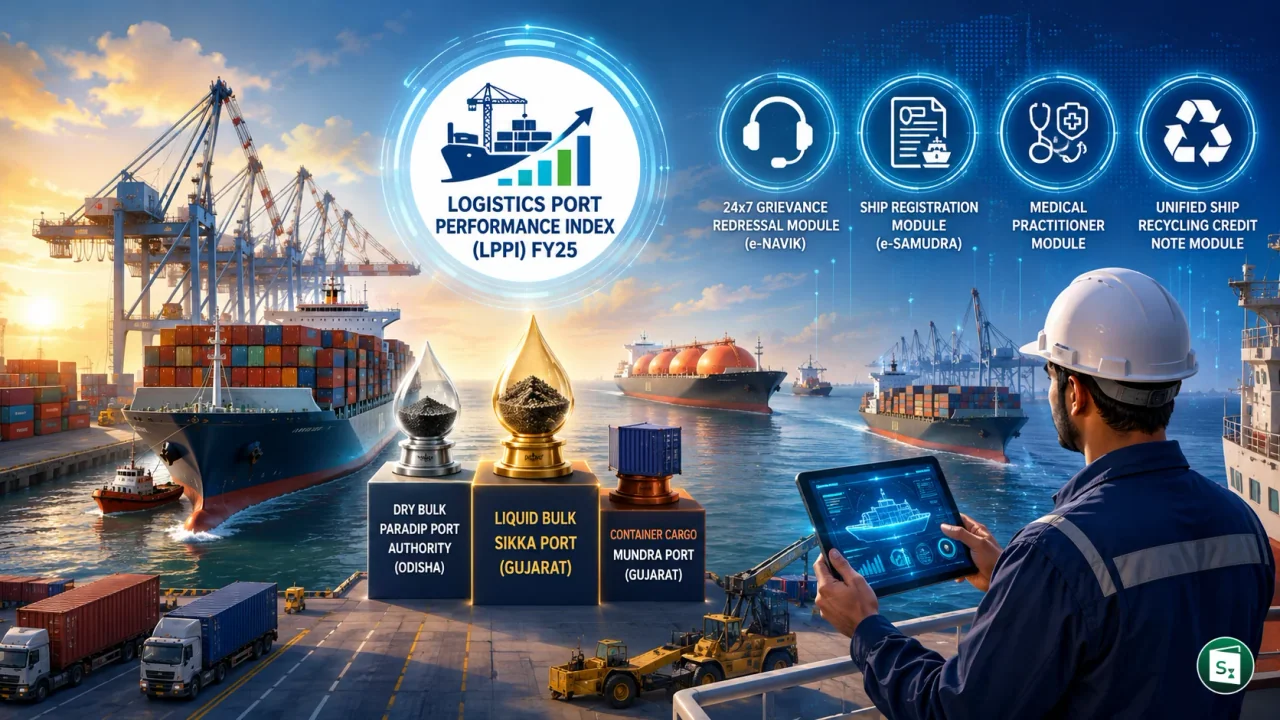
Union Minister Sarbananda Sonowal launched the Logistics Port Performance Index (LPPI) for the fiscal year 2024-25 (FY25) during the 37th Foundation Day celebrations of the Jawaharlal Nehru Port Authority (JNPA) in Mumbai. Developed under the national Sagar Aankalan framework, the new index establishes a standardized benchmark to measure and enhance operational efficiency across key cargo sectors. Simultaneously, the Directorate General of Shipping (DGS) introduced four major digital modules to streamline vessel registration, seafarer grievance redressal, medical certification, and ship recycling.
Understanding the Logistics Port Performance Index (LPPI)
The Logistics Port Performance Index (LPPI) serves as a comprehensive national benchmarking mechanism to evaluate and improve operational performance across India’s maritime gateways. By identifying operational bottlenecks and promoting healthy competition among ports, the index aims to lower overall logistics costs and enhance ease of doing business. The LPPI is designed to align with India’s long-term strategic infrastructure policies, including the PM Gati Shakti National Master Plan, Maritime India Vision 2030, and Maritime Amrit Kaal Vision 2047.
To ensure a comprehensive evaluation, the index assesses port efficiency using key performance indicators. These parameters are structured to analyze operational delays, productivity, and capacity utilization.
| Key Performance Indicator (KPI) | Operational Description |
|---|---|
| Vessel Turnaround Time (TAT) | The total duration a ship spends in a port from its arrival at the limit to its departure. |
| Berth Idle Time | The duration a berth remains vacant or inactive despite demand or scheduled arrivals. |
| Pre-berthing Waiting Time | The time a vessel spends anchored waiting for an available berth to dock. |
| Container Dwell Time | The total duration export, import, or transit containers remain stored inside the port terminal. |
| Ship Berth Day Output | The volume of cargo loaded or discharged from a vessel within a single day of berth occupancy. |
The LPPI utilizes the Technique for Order of Preference by Similarity to Ideal Solution (TOPSIS), a multi-criteria decision-making model, to assign weights and evaluate overall port efficiency. This mathematical approach guarantees a standardized, unbiased, and globally aligned benchmarking process. Additionally, the index balances absolute operational scores with year-on-year growth to ensure that both established mega-ports and developing facilities are evaluated fairly.
Recognizing Top Performers Across Cargo Categories
The LPPI evaluated port performance across three distinct cargo segments: dry bulk, liquid bulk, and container cargo. The index recognized the top-performing ports in each category for their outstanding operational efficiency and throughput management during the fiscal year.
| Cargo Category | Top Performer | Location (State) | Operator Type |
|---|---|---|---|
| Dry Bulk | Paradip Port Authority | Odisha | Major Port (Autonomous Government Body) |
| Liquid Bulk | Sikka Port | Gujarat | Non-Major Port (Private Captive Terminal) |
| Container Cargo | Mundra Port | Gujarat | Non-Major Port (Private Commercial Port) |
Paradip Port Authority
Located on the east coast of India in Odisha, the Paradip Port Authority is a major autonomous port under the union government. The port has built extensive infrastructure to handle dry bulk cargo such as thermal coal, iron ore, and fertilizer raw materials. Its recognition as the top dry bulk port reflects its high ship-berth day output and low vessel turnaround times for large bulk carriers.
Sikka Port
Situated in the Gulf of Kutch, Gujarat, Sikka Port is a non-major captive port governed by the Gujarat Maritime Board and operated by Sikka Ports and Terminals Limited, an arm of Reliance Industries. The port is highly specialized in liquid bulk cargo, serving as the primary logistics gateway for the crude imports and petroleum product exports of the Jamnagar refinery complex. Its performance highlights the efficiency of its marine terminal operations and liquid cargo evacuation systems.
Mundra Port
Also located in Gujarat, Mundra Port is India’s largest private commercial port. Operated by Adani Ports and Special Economic Zone (APSEZ), the port serves as a premier hub for container traffic, handling a significant portion of India’s maritime export and import containers. Its top ranking in the container category is driven by its advanced automated terminal operations, low container dwell times, and seamless rail-road connectivity.
Digitalization of Maritime Governance: The Four Initiatives
To modernise maritime administration, improve ease of doing business, and enhance seafarer welfare, the Directorate General of Shipping (DGS) has introduced four key digital modules. Established in 1949 and headquartered in Mumbai, the DGS is the statutory body under the Ministry of Ports, Shipping and Waterways responsible for administering merchant shipping laws in India.
The newly launched digital modules automate manual verification processes and integrate various services into single-window platforms.
| Digital Module | Portal / Platform | Primary Objective | Key Features |
|---|---|---|---|
| 24x7 Grievance Redressal Module | e-Navik | Seafarer Welfare | Multi-channel complaint submission (portal, WhatsApp, email) and round-the-clock tracking. |
| Ship Registration Module | e-Samudra | Ease of Doing Business | Electronic submission, processing, and issuance of vessel registration certificates. |
| Medical Practitioner Module | e-Samudra | Health Certification | Online registration for medical practitioners and secure digital verification of seafarer health checkups. |
| Unified Ship Recycling Credit Note Module | DGS Unified Portal | Circular Maritime Economy | Transferable credit notes worth 40 percent of scrap value for recycling at certified Indian yards. |
e-Navik Grievance Redressal Module
The 24x7 Grievance Redressal Module on the e-Navik portal provides a dedicated support channel for Indian seafarers working globally. Seafarers can submit issues regarding wages, working conditions, or repatriation. The system accepts complaints via the web portal, email, WhatsApp, and a toll-free helpline, ensuring that assistance is accessible at all times.
e-Samudra Ship Registration Module
The Ship Registration Module on the e-Samudra platform digitizes the entire lifecycle of vessel registration in India. Previously dependent on physical documentation, shipowners can now upload credentials, pay fees, and receive digitized registration certificates online. This change aligns India with global maritime standards and reduces registration delays.
Medical Practitioner Module
Also integrated into the e-Samudra portal, the Medical Practitioner Module digitizes the health certification workflow for seafarers. The system allows DGS-approved medical practitioners to upload health check certificates directly to the national database. This eliminates physical paperwork, simplifies verification for shipping companies, and reduces the risk of fraudulent health certifications.
Unified Ship Recycling Credit Note Module
The Unified Ship Recycling Credit Note Module supports the circular economy by incentivizing green ship recycling in India. Under this module, shipowners who scrap their vessels at Indian shipbreaking yards compliant with the Hong Kong International Convention for the Safe and Environmentally Sound Recycling of Ships receive a digital credit note.
The credit note is equivalent to 40 percent of the scrap value of the recycled vessel. Shipowners can redeem these credits to offset costs when commissioning new vessels at Indian shipyards. The credit notes are transferable, allowing owners to trade them to other domestic shipbuilders, which helps stimulate the domestic shipbuilding sector.
Key Takeaways
- The Logistics Port Performance Index (LPPI) for the fiscal year 2024-25 was launched during the 37th Foundation Day celebrations of the Jawaharlal Nehru Port Authority (JNPA) in Mumbai.
- The LPPI is based on the Sagar Aankalan national benchmarking framework and evaluates port operational efficiency across dry bulk, liquid bulk, and container cargo.
- The index recognized Paradip Port Authority (Odisha) for dry bulk, Sikka Port (Gujarat) for liquid bulk, and Mundra Port (Gujarat) for container cargo as the top-performing ports.
- The Directorate General of Shipping (DGS), established in 1949 and headquartered in Mumbai, introduced four digital modules to improve maritime governance and seafarer welfare.
- The Unified Ship Recycling Credit Note Module offers shipowners a transferable credit note worth 40 percent of the vessel’s scrap value for recycling at compliant Indian yards.