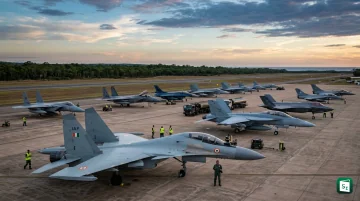
Russian President Vladimir Putin has offered India the advanced Sukhoi Su-57, a fifth-generation stealth aircraft.
He also proposed joint production in India, including full technology transfer and the establishment of manufacturing facilities, during the St. Petersburg International Economic Forum (SPIEF) held in St. Petersburg, Russia.
The Ministry of Defence has signed a contract with the Bengaluru-based Accord Software and Systems Pvt Ltd (ASSPL) for the procurement of 20 Enhanced Capability Global Navigation Satellite System (ECGNSS) Jammers for the Indian Navy.
The contract is worth ₹449 crore and falls under the ‘Buy (Indian-Indigenously Designed, Developed and Manufactured (IDDM))’ category, which mandates at least 75% indigenous content.
India has issued a Letter of Request (LoR) to France for a government-to-government (G2G) deal worth ₹3.25 lakh crore to procure 114 Rafale fighter jets for the Indian Air Force (IAF).
Under this agreement, 94 of these aircraft will be manufactured in India by Dassault Aviation in collaboration with an Indian partner. The first Rafale-M jets are expected to be delivered by 2028.
Major Prabhat Mishra of the Indian Army (IA), belonging to the 22 Kumaon Regiment, has been honoured with the Birrer-Brookes Award for Outstanding Master of Military Arts and Science (MMAS) Thesis and the General Douglas MacArthur Military Leadership Writing Award.
He has also received the Golden Pen Award for scholarly excellence. It is to be noted that he is the first Indian officer to win both the awards simultaneously.
Union Minister Rajnath Singh has approved the establishment of a 250 MW Solar Power Project at the Sitapur Ex-Cantonment area in Uttar Pradesh. This is the first large-scale green energy installation developed on vacant defence land.
The project will feature an integrated Battery Energy Storage System (BESS) to store surplus energy and ensure a stable power supply. NTPC Ltd will implement the project through a competitive bidding process.
The Indian Army has successfully completed operational trials of the Divyastra Mk-1 in Jodhpur, Rajasthan.
The Divyastra Mk-1 is an advanced indigenous AI powered tactical loitering munition system developed by Hoverit. It is designed to strengthen Intelligence, Surveillance, and Reconnaissance (ISR) capabilities along the border regions of India.
The DRDO has successfully tested a high-calibre conventional bomb at the Terminal Ballistics Research Laboratory (TBRL) in Haryana.
The test was conducted following standard operating procedures (SOPs) and was supervised by senior officials from the Indian Air Force (IAF) and DRDO scientists. The trial aimed to validate advanced munitions and strengthen defence capabilities.
The Indian Air Force (IAF) has signed three contracts with the IIT Bombay to indigenously develop AI-driven predictive maintenance technologies.
This initiative includes the development of a digital diagnostic health index for the Sukhoi Su-30MKI fighter aircraft fleet. The Su-30MKI is a twin-engine, multi-role fighter aircraft developed by Sukhoi, Russia, and customised for India by Hindustan Aeronautics Ltd (HAL).
The Government of India has signed an agreement to export BrahMos missiles to Vietnam in a deal valued at ₹6,000 crore ($629 million).
This agreement strengthens bilateral defence and strategic cooperation between the countries. Vietnam is the second overseas buyer of the BrahMos missile system, after the Philippines.
The Defence Research and Development Organisation (DRDO) and the Indian Air Force (IAF) have successfully conducted flight tests of the indigenous RudraM-II Air-to-Surface Missile. The missile was launched from a Sukhoi Su-30MKI fighter aircraft off the Odisha coast.
The RudraM-II is a solid-propelled, high-speed, air-launched system designed for the Suppression of Enemy Air Defences (SEAD). It is capable of neutralising enemy surveillance radars, communication hubs, and tracking stations, with an operational strike range of 300 to 350 km.
The Ministry of Defence (MoD) has issued a Request for Proposal (RFP) for the Advanced Medium Combat Aircraft (AMCA) programme, which is India’s first indigenous fifth-generation stealth fighter aircraft project.
The government-funded programme has an estimated prototype development cost of ₹15,000 crore, covering the development of 5 flying prototypes and 1 structural test aircraft.
For the first time, the MoD has excluded Hindustan Aeronautics Ltd (HAL) from the manufacturing process and invited private sector participation. A 650-acre greenfield manufacturing facility and the Core Integration and Flight Testing Centre of the Aeronautical Development Agency (ADA) are being developed at Puttaparthi, Andhra Pradesh, in collaboration with the selected private partner.
Union Minister Rajnath Singh has inaugurated the private defence manufacturing complex of the NIBE Group in Shirdi, Maharashtra. The project involved an investment of over ₹5,000 crore.
Additionally, the Minister has approved the establishment of four defence corridors in Pune, Nashik, Ahmednagar, and Nagpur to strengthen the indigenous defence manufacturing ecosystem of India.
The Indian Army (IA) has launched ‘Q-FORCE’, an integrated digital application designed to streamline logistics and sustainment management by integrating multiple logistics and inventory platforms across diverse operational terrains.
Additionally, the IA has introduced ‘Kautilya’, an AI-powered command intelligence platform.
General NS Raja Subramani has assumed charge as the Chief of Defence Staff (CDS) of India. He succeeds General Anil Chauhan.
Prior to this appointment, he served as the Military Advisor at the National Security Council Secretariat (NSCS) and is recognized as an expert on security matters concerning Pakistan and China.
The Nibe Group has signed a Joint Venture (JV) with Israel-based Elbit Systems to establish manufacturing facilities for advanced energetic materials and propellants in India.
The JV will manufacture products including Nitro Cellulose, Nitro Glycerine, and various propellant bases like single base, double base, and triple base.
Union Minister Rajnath Singh and Uttar Pradesh CM Yogi Adityanath have inaugurated the ‘Nausena Shaurya Vatika’ in Lucknow. Built at a cost of ₹19 crore, this Open-Air Display Museum is spread over 2 acres and is dedicated to the spirit, valour, and prowess of the Indian Navy.
The museum showcases artefacts and weapon systems from the INS Gomati, which was decommissioned in 2022 after 34 years of service.
Vice Admiral Sanjay Vatsayan has assumed charge as the Flag Officer Commanding-in-Chief (FOC-in-C) of the Western Naval Command (WNC). He succeeds Vice Admiral Krishna Swaminathan.
Union Minister Rajnath Singh held bilateral talks with South Korean Ministers Ahn Gyu-back and Lee Yong-cheol in Seoul. He also chaired the India-ROK Defence Industry Business Roundtable in Seoul to foster bilateral defence cooperation.
During the visit, India and the ROK exchanged an MoU to enhance cooperation in defence cyber security and defence information sharing. Additionally, two agreements were signed between Larsen & Toubro (L&T) and Hanwa Co Ltd to facilitate collaboration between the defence industries of both nations.
India successfully tested the 'Suryastra' Universal Rocket Launcher system at the Integrated Test Range in Chandipur, Odisha, on May 28, 2026.
Developed by Pune-based Nibe Limited in collaboration with Israel's Elbit Systems, the system is India's first indigenous universal multi-caliber rocket launcher. The system demonstrated exceptional precision during the trials, with its tactical and strategic variants hitting targets at ranges of 150 km and 300 km, respectively.
NIBE Ltd (NIBE Ltd) has successfully conducted trials of its Vayu Astra-1 Loitering Munition (LM), which features a 100-km operational range. The trials were conducted at Pokhran in Rajasthan and Joshimath (Malari) in Uttarakhand under the No-Cost, No-Commitment (NCNC) model.
The Vayu Astra-1 is based on an Israeli-designed loitering munition system developed in collaboration with Elbit Systems. Under the NCNC model, NIBE Ltd managed the technology, conducted the demonstrations, and bore all operational and technical validation costs.