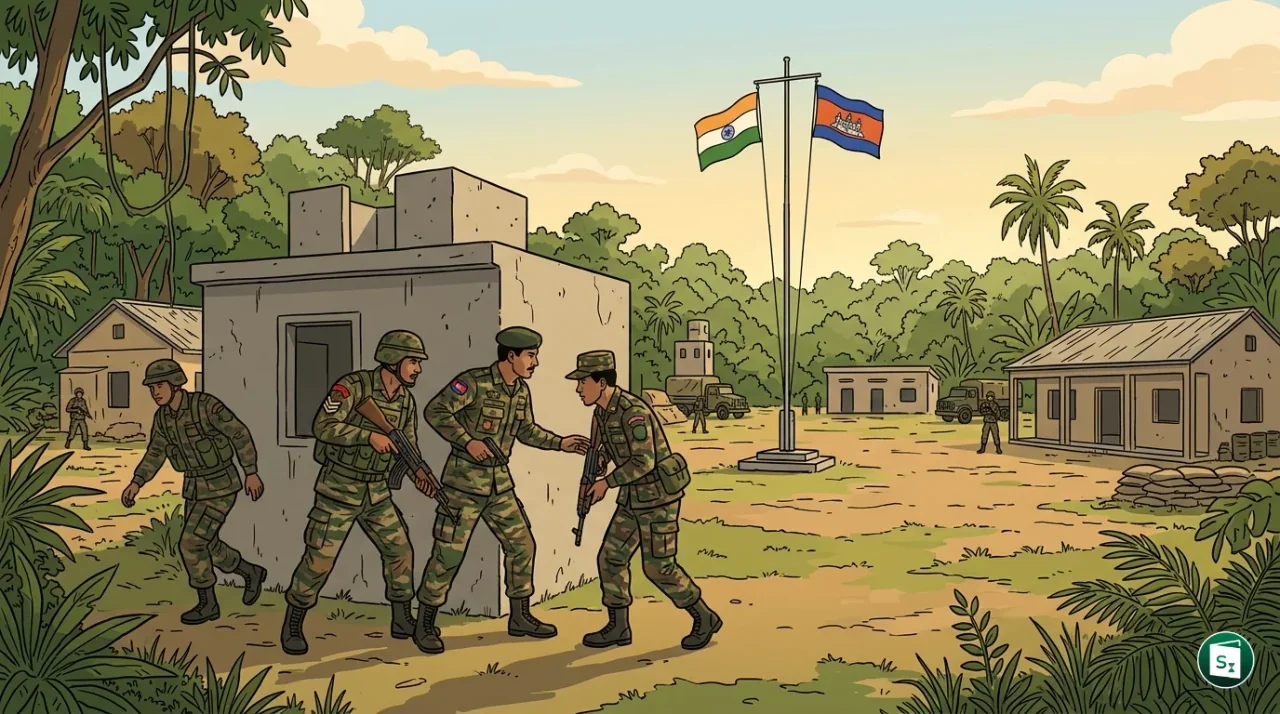
The Indian Army and the Royal Cambodian Army have commenced the second edition of their bilateral military exercise, CINBAX-II, at Kampong Speu Province in Cambodia. Scheduled from May 4 to May 17, 2026, the exercise focuses on enhancing interoperability through joint training in sub-conventional operations and United Nations peacekeeping tasks. This engagement marks a significant milestone in India’s defence diplomacy and its ongoing commitment to the Act East Policy in the Indo-Pacific region.
Scope and Participants of CINBAX-II
The 14-day exercise is being hosted at the Techo Sen Phnom Thom Mreas Prov Royal Cambodian Air Force Training Centre, also known as Camp Basil, located in the Kampong Speu Province of Cambodia. This edition follows the successful inaugural exercise held in Pune, India, in December 2024, signifying a steady progression in bilateral military cooperation.
The Indian contingent is represented by 120 personnel from a battalion of the Maratha Light Infantry Regiment, one of the oldest and most decorated infantry units of the Indian Army. The Royal Cambodian Army has deployed a larger contingent of 160 personnel for the joint drills. The participation of the Maratha Light Infantry is particularly significant given their extensive experience in varied terrains and their long history of participation in global peacekeeping missions.
Training Objectives and UN Mandate
The primary focus of CINBAX-II is on conducting sub-conventional operations within jungle and semi-urban environments. These operations involve handling irregular forces or insurgents rather than traditional state-on-state warfare. The exercise is structured around the framework of Chapter VII of the United Nations Charter, which outlines the UN’s authority to take enforcement actions to maintain or restore international peace and security.
Throughout the exercise, the two armies will engage in a series of tactical drills, including:
- Counter-terrorism operations in specialized environments.
- Drone and counter-drone warfare techniques.
- Precision sniper tactics and advanced mortar drills.
- Humanitarian assistance and disaster relief (HADR) simulations.
- Joint planning and execution of UN-mandated peacekeeping tasks.
By simulating real-world scenarios, the exercise aims to develop tactical synergy and refine the exchange of best practices. This collaboration is designed to help both nations prepare for future deployments in complex international peacekeeping environments.
Strategic Depth of India-Cambodia Defence Ties
The commencement of CINBAX-II reflects the deepening security relationship between New Delhi and Phnom Penh. Defence cooperation has emerged as a cornerstone of India’s Act East Policy, which seeks to strengthen ties with ASEAN nations to ensure a stable and open Indo-Pacific. This partnership has recently seen significant institutional growth, including India’s decision to establish a dedicated Defence Attaché (DA) Office at the Indian Embassy in Phnom Penh.
For Cambodia, India is a reliable partner for capacity building and professional military education. The Cambodian leadership has consistently expressed interest in specialized training and modern military technology from India. By conducting joint exercises like CINBAX, India not only assists in the modernization of the Cambodian armed forces but also enhances its own presence as a “first responder” and security provider in Southeast Asia. This engagement helps in diversifying Cambodia’s strategic partnerships and contributes to the broader regional balance of power.
Static GK: The Maratha Light Infantry and Cambodia
To better understand the participants and the context of the exercise, it is essential to look at the history of the Maratha Light Infantry and the strategic profile of Cambodia.
The Maratha Light Infantry (MLI)
The Maratha Light Infantry is one of the oldest regiments of the Indian Army, tracing its roots back to 1768. It is known for its agility and specialized “light infantry” role, which involves rapid movement and reconnaissance.
| Feature | Details |
|---|---|
| Established | 1768 (as Bombay Sepoys) |
| Regimental Centre | Belagavi, Karnataka |
| Battle Cry | ”Bol Shri Chhatrapati Shivaji Maharaj Ki Jai!” |
| Regimental Day | February 4 (Commemorating the 1670 capture of Sinhagad) |
| Special Honor | Bestowed “Light Infantry” title in 1922 |
Cambodia at a Glance
Cambodia is a key Southeast Asian nation located in the southern part of the Indochina Peninsula. It shares historical and cultural ties with India, notably through the architectural heritage of Angkor Wat.
| Category | Information |
|---|---|
| Capital | Phnom Penh |
| Currency | Riel |
| Prime Minister | Hun Manet |
| Official Language | Khmer |
| Border Countries | Thailand, Laos, and Vietnam |
Understanding Chapter VII of the UN Charter
The United Nations Charter’s Chapter VII gives the UN Security Council the power to determine the existence of any threat to peace or act of aggression. It allows the Council to authorize military and non-military action to “restore international peace and security.” Exercises conducted under this mandate prepare soldiers for the legal and operational complexities of active peacekeeping missions.
Key Takeaways
- The 2nd edition of the India-Cambodia bilateral army exercise, CINBAX-II, is being held from May 4 to May 17, 2026.
- The exercise is hosted at Camp Basil in the Kampong Speu Province of Cambodia.
- The Indian Army contingent consists of 120 personnel from the Maratha Light Infantry Regiment.
- The joint training focuses on sub-conventional operations and peacekeeping tasks under Chapter VII of the UN Mandate.
- The first edition of CINBAX was held in Pune, India, in December 2024.
- The Maratha Light Infantry, established in 1768, is headquartered in Belagavi, Karnataka.
- India has recently established a Defence Attaché (DA) Office in Phnom Penh to strengthen bilateral military ties.