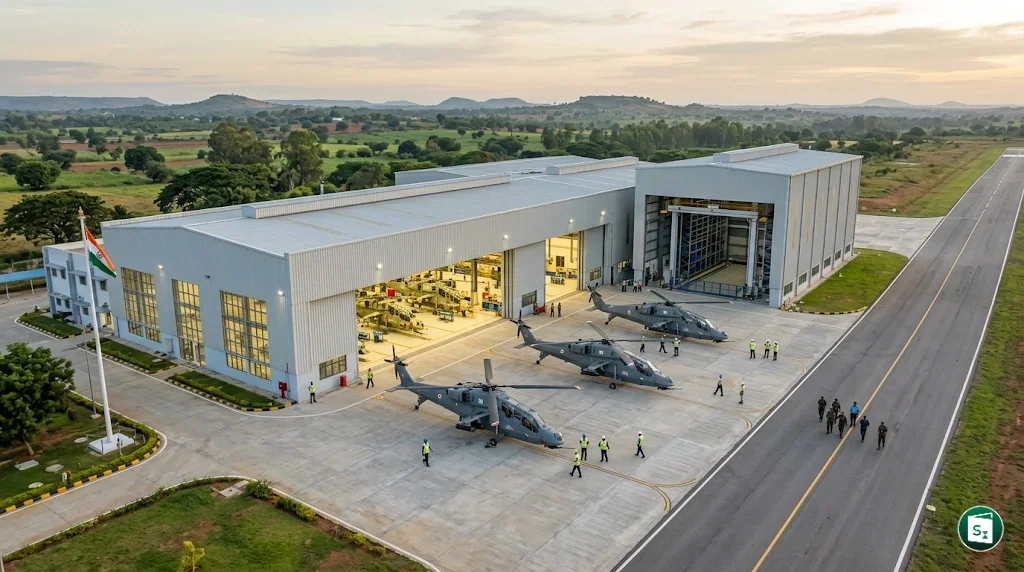
Hindustan Aeronautics Limited (HAL) inaugurated a new structure assembly line for the Prachand Light Combat Helicopter at its flagship factory in Tumakuru, Karnataka, on April 15, 2026. This facility expansion is designed to facilitate the rapid execution of a ₹62,700 crore contract for 156 additional helicopters for the Indian Army and the Indian Air Force. The move significantly strengthens India’s domestic aerospace ecosystem and its strategic readiness for high-altitude operations.
Expanding the Footprint of Asia’s Largest Helicopter Factory
The Tumakuru helicopter factory, which was inaugurated by Prime Minister Narendra Modi in February 2023, stands as the largest helicopter manufacturing facility in Asia. Spread over 615 acres in Karnataka, this greenfield project was originally set up to manufacture the Light Utility Helicopter (LUH). The addition of the Prachand LCH structure assembly line represents a major milestone in transforming the site into a comprehensive hub for multiple helicopter platforms.
Currently, the Tumakuru facility operates with a production capacity of 30 helicopters per year. However, HAL has laid out a roadmap to scale this up dramatically to 100 units annually. This ramp-up is essential to meet the burgeoning requirements of the Indian Armed Forces and potentially tap into the global export market. The facility is also being prepared to support future strategic programmes, including the Indian Multi-Role Helicopter (IMRH) and the Deck-based Multi-Role Helicopter (DBMRH).
To support this high-volume production, HAL has integrated an Automated Storage and Retrieval System (ASRS). This state-of-the-art logistics technology automates the storage and retrieval of manufacturing components, ensuring precise inventory management and reducing the turnaround time for parts. By minimizing manual handling and streamlining the supply chain, the ASRS will be a key enabler in achieving the factory’s ambitious annual production targets.
The ₹62,700 Crore LCH Contract: A Major Production Push
In March 2025, the Ministry of Defence signed a landmark contract worth ₹62,700 crore with HAL for the procurement of 156 Prachand Light Combat Helicopters. This massive order is divided between the services, with 90 units allocated to the Indian Army and 66 units to the Indian Air Force (IAF). This represents one of the largest single orders for indigenously developed aerial platforms, underscoring the government’s trust in domestic manufacturing capabilities.
To fulfill this commitment, HAL is utilizing its two primary manufacturing bases in Bengaluru and Tumakuru. The project aims for a high degree of self-reliance, with a target of over 65% indigenous content. This massive undertaking is expected to involve more than 250 domestic companies, many of which are MSMEs, creating over 8,500 jobs across the supply chain. The phased delivery of these helicopters is scheduled to commence within three years, ensuring a steady modernization of India’s combat rotorcraft fleet.
Strategic Significance of the LCH Prachand
The Prachand, which translates to ‘fierce’, is India’s first indigenously designed and developed multi-role attack helicopter in the 5.8-tonne class. Its inception can be traced back to the lessons of the 1999 Kargil War, which exposed the need for a dedicated combat helicopter capable of operating at extreme altitudes where most standard rotorcraft lose performance. Today, the Prachand is the only attack helicopter in the world capable of operating at altitudes of 5,000 metres, making it a vital asset for the Siachen glacier and other high-altitude Himalayan regions.
Powered by twin Shakti engines, the helicopter features a narrow fuselage and advanced stealth characteristics, including a low radar cross-section and reduced infrared signature. It is equipped with a 20mm turret gun, 70mm rockets, and air-to-air missiles, allowing it to perform a variety of missions such as anti-armour operations, bunker-busting, and search and rescue. Its crash-resistant structure and self-sealing fuel tanks ensure high survivability, providing the Indian Armed Forces with a lethal and robust platform for specialized mountain warfare.
Strengthening India’s Defence Industrial Base
The expansion of the Tumakuru facility is a cornerstone of India’s Atmanirbhar Bharat (self-reliant India) vision in the defence sector. By establishing a robust ecosystem for helicopter manufacturing that encompasses design, testing, and mass production under one roof, India is steadily reducing its historical reliance on foreign aerospace imports. The capacity to produce 100 units annually will not only secure domestic requirements but also position India as a potential exporter of advanced combat rotorcraft to friendly nations.
The integration of Industry 4.0 technologies, such as the ASRS and advanced assembly lines, signals a shift towards a high-tech manufacturing paradigm at HAL. This infrastructure is not limited to the Prachand LCH; it is also designed to support future flagship projects like the Indian Multi-Role Helicopter (IMRH). By fostering a sustainable aerospace industrial base, the Tumakuru factory is set to remain at the heart of India’s strategic defence planning for the foreseeable future.
Key Takeaways
- HAL inaugurated a new Prachand LCH structure assembly line and an Automated Storage and Retrieval System (ASRS) at its Tumakuru factory in Karnataka on April 15, 2026.
- The Tumakuru facility is currently Asia’s largest helicopter manufacturing plant, with plans to ramp up production to 100 units annually.
- The new assembly line will execute a ₹62,700 crore contract for 156 additional LCHs, comprising 90 for the Indian Army and 66 for the Indian Air Force.
- The Prachand LCH is a 5.8-tonne class helicopter and the only platform in the world capable of operating at an altitude of 5,000 metres.
- The LCH project aims for over 65% indigenous content, involving more than 250 domestic firms, including several MSMEs.
- The factory is a key part of the Atmanirbhar Bharat initiative and was originally inaugurated by the Prime Minister in February 2023.