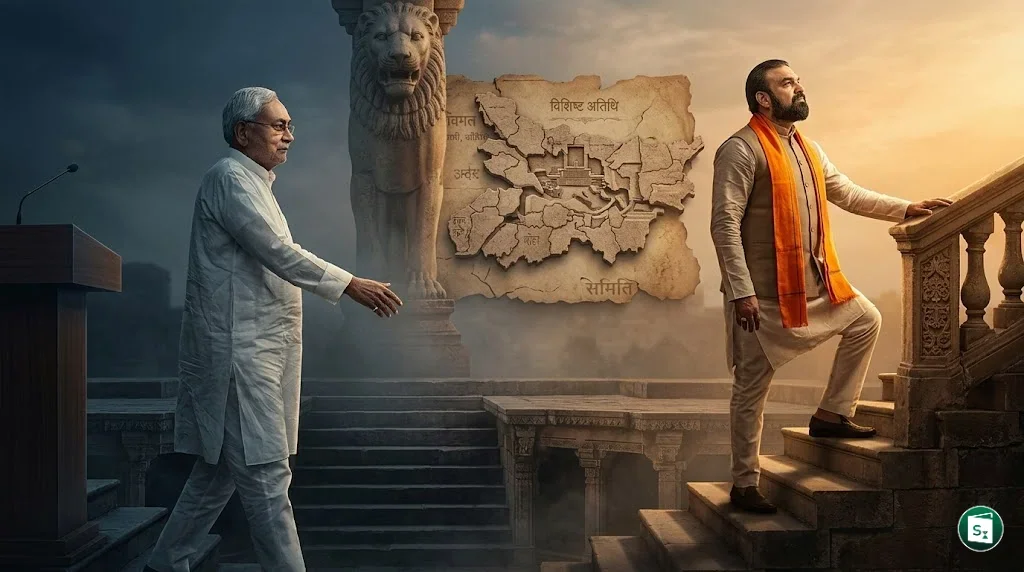
Samrat Choudhary took the oath of office as the 24th Chief Minister of Bihar on April 15, 2026, following the resignation of multi-term Chief Minister Nitish Kumar. This transition marks a historic shift in the state’s political landscape, as it is the first time a leader from the Bharatiya Janata Party (BJP) is heading the government in Bihar. Nitish Kumar, who served as the Chief Minister for nearly two decades, has resigned from his state post to take up a national role as a member of the Rajya Sabha.
The Conclusion of the Nitish Kumar Era
Nitish Kumar tendered his resignation as the Chief Minister of Bihar on April 14, 2026, bringing to a close a tenure that spanned nearly two decades and redefined the state’s governance. Often referred to as “Sushasan Babu” (Mr. Good Governance), Kumar is Bihar’s longest-serving Chief Minister, having held the office for ten terms. His leadership was predominantly characterized by a focus on infrastructure development, including roads and electricity, and social welfare programs such as the bicycle scheme for girl students and 50 percent reservation for women in local bodies.
The move to the Rajya Sabha marks the completion of a unique personal and political milestone for Nitish Kumar. He has now achieved the rare distinction of serving in all four legislative bodies in India: the Bihar Legislative Assembly, the Lok Sabha, the Bihar Legislative Council, and the Rajya Sabha. Before his long stint as Chief Minister, Kumar had served as the Union Minister for Railways, Agriculture, and Surface Transport in the Atal Bihari Vajpayee government. He was sworn in as a member of the Rajya Sabha on April 10, 2026, necessitating his exit from state executive leadership.
Samrat Choudhary: Leading the State’s First BJP Government
With the swearing-in of Samrat Choudhary, the BJP has secured the top executive post in Bihar for the first time in its history. Choudhary, who served as the Deputy Chief Minister since January 2024, is a prominent Other Backward Class (OBC) leader from the Koeri-Kushwaha community. His appointment is seen as a strategic move by the BJP to consolidate its position among the Backward Classes and provide a fresh leadership face to the state.
Coming from a political family, he is the son of Shakuni Choudhary, a veteran politician and former Member of Parliament. Samrat Choudhary’s political career began in the late 1990s, and he has previously served in the cabinets of Rabri Devi and Jitan Ram Manjhi. Since joining the BJP in 2017, his rise within the party has been swift. He was appointed as the Bihar BJP State President in 2023, where he played a pivotal role in strengthening the party’s organizational structure before being elevated to the Deputy Chief Minister’s role and now the Chief Ministership.
Constitutional and Legislative Framework
The appointment of the Chief Minister is governed by Article 164 of the Indian Constitution, which states that the Chief Minister shall be appointed by the Governor. In accordance with constitutional conventions, the Governor invites the leader of the party or coalition that commands a majority in the Legislative Assembly. The Council of Ministers, headed by the Chief Minister, is collectively responsible to the State Legislative Assembly under Article 164(2).
The current political landscape in Bihar is dominated by the National Democratic Alliance (NDA), which secured a significant mandate in the November 2025 Assembly elections. The Bihar Legislative Assembly comprises 243 seats, and the NDA coalition holds a commanding total of 202 seats. The seat distribution within the alliance is as follows:
| Party | Seats in Bihar Assembly |
|---|---|
| Bharatiya Janata Party (BJP) | 89 |
| Janata Dal (United) | 85 |
| Lok Janshakti Party (Ram Vilas) | 19 |
| Hindustani Awam Morcha (Secular) | 5 |
| Rashtriya Lok Morcha (RLM) | 4 |
This stable majority ensured a smooth transition of power within the alliance following Nitish Kumar’s decision to shift to national politics.
Key Takeaways
- Samrat Choudhary was sworn in as the Chief Minister of Bihar on April 15, 2026, making him the first leader from the BJP to hold the post.
- Nitish Kumar resigned as Chief Minister on April 14, 2026, to transition to a national role as a member of the Rajya Sabha.
- Nitish Kumar has now served in all four legislative bodies in India: the Legislative Assembly, the Legislative Council, the Lok Sabha, and the Rajya Sabha.
- The appointment of a Chief Minister is carried out by the Governor under Article 164 of the Constitution of India.
- The National Democratic Alliance (NDA) holds a majority of 202 seats in the 243-member Bihar Legislative Assembly following the 2025 elections.
- Samrat Choudhary represents the Koeri-Kushwaha community and previously served as the Bihar BJP State President and Deputy Chief Minister.