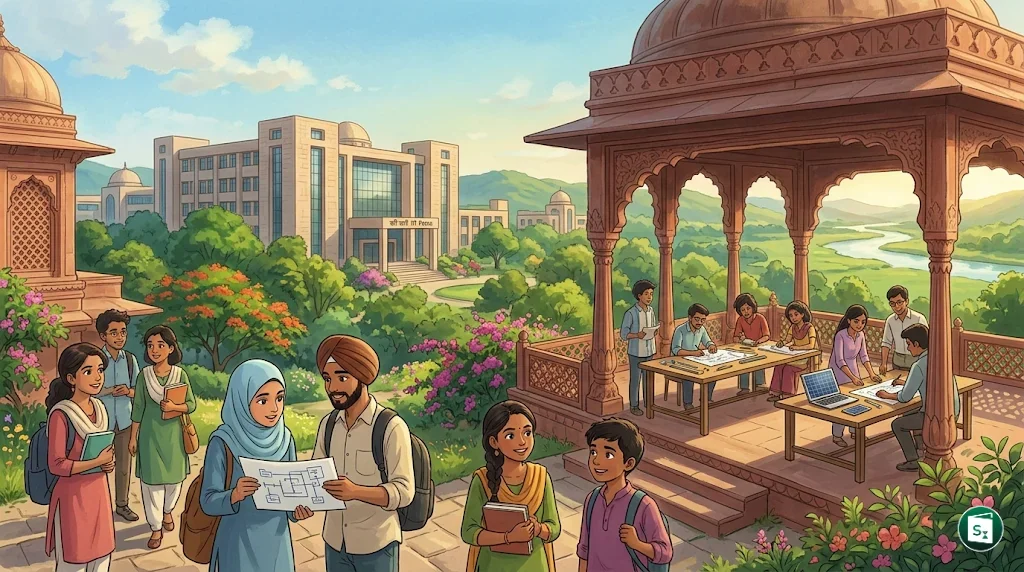
The Ministry of Minority Affairs (MoMA) and the Indian Institute of Technology (IIT) Patna signed a Memorandum of Understanding on April 20, 2026, to empower minority youth through advanced technology-driven skilling. This partnership, established under the PM Virasat Ka Samvardhan (PM VIKAS) scheme, focuses on enhancing employability by training participants in high-demand roles like artificial intelligence and business analytics. The initiative is a strategic effort to bridge the skills gap and provide sustainable livelihood opportunities in the state of Bihar.
Skill Development for the Modern Economy: AI and Business Analytics
The collaboration specifically targets 600 minority youth in Bihar, providing them with specialized training in two of the most critical fields of the modern digital economy: Artificial Intelligence (AI) Technocrats and Business Analytics Executives. These roles have been identified based on their high market demand and potential for long-term career growth. The curriculum is designed to be industry-relevant, moving beyond theoretical knowledge to include intensive practical learning, hands-on project work, and direct industry exposure.
IIT Patna, established in 2008 and headquartered in Bihta, serves as the technical partner for this initiative. By leveraging the institute’s cutting-edge infrastructure and faculty expertise, the program ensures that participants receive training that meets global standards. The training interventions are structured to be technology-driven, ensuring that the youth are equipped with the technical proficiency required to compete in the evolving national and international job markets.
The PM VIKAS Framework and Integrated Objectives
The Pradhan Mantri Virasat Ka Samvardhan (PM VIKAS) scheme is a Central Sector Scheme under the Ministry of Minority Affairs, designed to achieve the socio-economic empowerment of India’s six notified minority communities: Muslims, Christians, Sikhs, Buddhists, Jains, and Parsis. In 2024, the government restructured several independent initiatives into this single umbrella framework to improve efficiency and reach. The scheme unified five erstwhile programs, namely Seekho aur Kamao, USTTAD (Upgrading the Skills and Training in Traditional Arts/Crafts for Development), Hamari Dharohar, Nai Roshni, and Nai Manzil.
The integrated architecture of PM VIKAS is built upon four primary pillars:
- Skilling and Training: Aligning vocational courses with the National Skills Qualification Framework (NSQF).
- Leadership and Entrepreneurship: Focusing on women and youth (mentored by ‘Biz Sakhis’).
- Education: Supporting school dropouts through the National Institute of Open Schooling (NIOS).
- Infrastructure Development: Creating physical hubs for artisan training and cultural preservation.
This holistic approach ensures that skilling is not an isolated activity but part of a broader ecosystem that includes credit linkages through the National Minorities Development and Finance Corporation (NMDFC) and market support for local artisans.
Impact on Minority Youth and Regional Employability
By focusing on high-tech sectors like Artificial Intelligence and analytics, the partnership addresses the historical gap in technical vocational training available to minority communities. This shift from traditional skilling to technology-intensive interventions is expected to significantly improve the placement rates of youth in Bihar’s competitive job market. The program not only provides technical skills but also fosters digital literacy and professional confidence, enabling participants to secure high-paying roles in the corporate sector.
Furthermore, the regional focus on Bihar is significant. By decentralizing high-quality training through institutes like IIT Patna, the government aims to create localized centers of excellence. This reduces the need for distress migration and empowers local youth to contribute to the state’s growing digital footprint. The project acts as a model for how premier academic institutions can collaborate with government ministries to deliver socially inclusive and economically viable educational programs.
Building a Robust Network of Premier Skilling Partners
The agreement with IIT Patna is not an isolated event but part of a larger, nation-wide strategy by the Ministry of Minority Affairs to build a diverse network of high-caliber training partners. In recent months, the Ministry has entered into similar collaborations with other premier institutions, including IIT Dharwad, the National Institute of Technology (NIT) Manipur, and the CSIR-Central Mechanical Engineering Research Institute (CMERI) in Durgapur. This expanding network allows the government to offer a wide range of skill sets, from advanced robotics and mechanical engineering to environmental management and data science.
By partnering with organizations like the Arunachal Pradesh Forest Corporation Limited and various technical institutes, the Ministry is ensuring that the reach of PM VIKAS extends to the most remote corners of the country. These collaborations signify a shift toward modernizing the skilling landscape for minorities, ensuring that they are not left behind in the Fourth Industrial Revolution. The Ministry’s continued focus on forging such MoUs highlights its commitment to creating a future-ready workforce through shared expertise and institutional synergy.
Key Takeaways
- The Ministry of Minority Affairs and IIT Patna signed a Memorandum of Understanding on April 20, 2026, to provide high-end skill training to minority youth.
- The program aims to train 600 minority youth from Bihar in specialized roles such as AI Technocrats and Business Analytics Executives.
- The partnership is implemented under the PM Virasat Ka Samvardhan (PM VIKAS) scheme, which serves as a unified umbrella for five earlier empowerment programs.
- PM VIKAS integrates schemes like Seekho aur Kamao, USTTAD, Hamari Dharohar, Nai Roshni, and Nai Manzil into a single framework.
- IIT Patna, established in 2008, acts as the technical partner to ensure industry-relevant training and placement support.