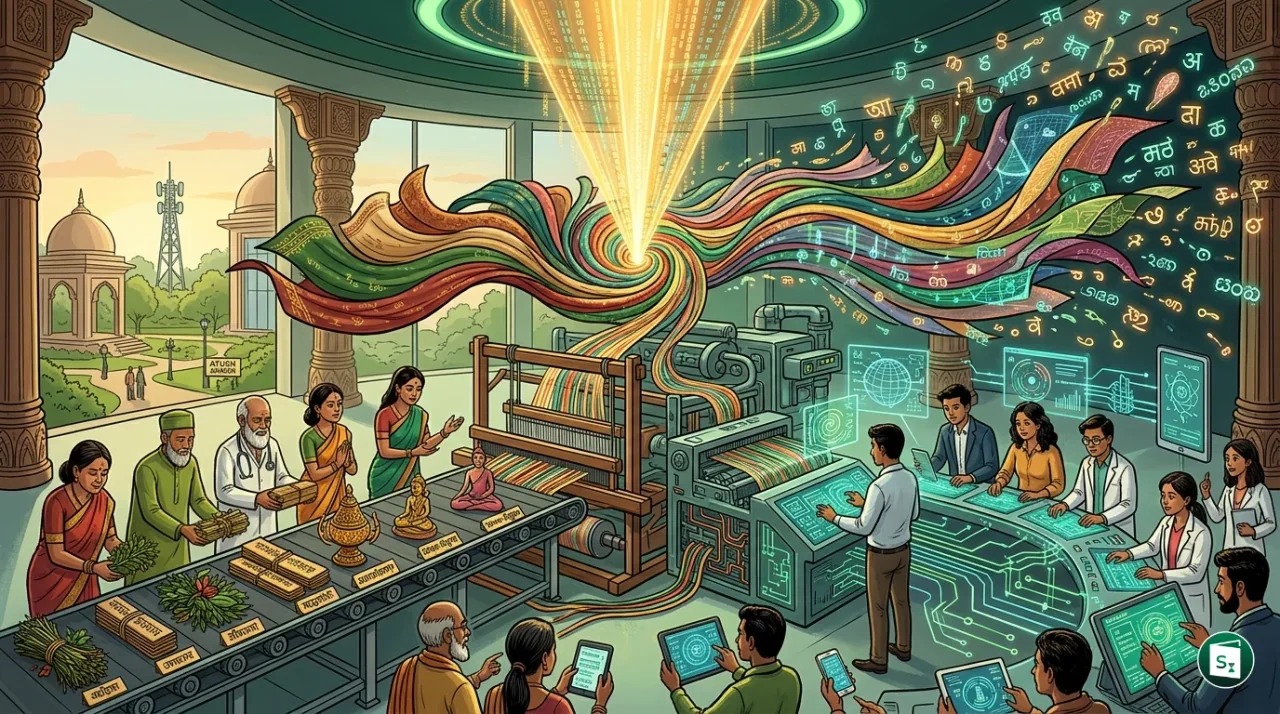
The Ministry of AYUSH signed a Memorandum of Understanding (MoU) with the Digital India BHASHINI Division on May 14, 2026, to break language barriers in healthcare access. This partnership will integrate advanced Artificial Intelligence (AI) and Natural Language Processing (NLP) technologies into AYUSH digital platforms. As a result, citizens will soon be able to access traditional Indian medicine knowledge and services in all 22 Scheduled languages.
The BHASHINI Rajyam Initiative
The collaboration was launched under a specialized program titled BHASHINI Rajyam, which functions as a BHASHINI Sahayogi (collaborative) initiative. The primary goal is to ensure that language does not remain a hurdle for citizens seeking treatment or information related to Ayurveda, Yoga, Unani, Siddha, Sowa-Rigpa, and Homeopathy.
Through this initiative, the Digital India Bhashini Division (DIBD), which operates under the Ministry of Electronics and Information Technology (MeitY), will embed its advanced language translation APIs into AYUSH platforms. This will include text-to-text translation, voice-to-voice communication, and automatic language detection features. Ultimately, these AI models will help build a strong, domain-specific multilingual dataset for traditional medicine.
Strengthening the Ayush Grid
The technological integration will be implemented across the Ayush Grid, the flagship digital initiative launched by the Ministry in 2018. The Ayush Grid was designed to serve as the comprehensive Information Technology (IT) backbone for the traditional medicine sector, aligning with the Ayushman Bharat Digital Mission (ABDM).
By linking BHASHINI with the Ayush Grid, major portals like the Ayush Hospital Management Information System (A-HMIS) and the Ayush Sanjivani app will become natively multilingual. Patients from rural or linguistically diverse regions will be able to book appointments, view diagnostic reports, and consult doctors using their local dialects. Additionally, it will streamline drug administration processes and support research by translating historical and clinical texts.
Why Multilingual Healthcare Matters
Digital India BHASHINI (BHASHA INterface for India) was originally launched by Prime Minister Narendra Modi in July 2022 as part of the National Language Translation Mission (NLTM). The overarching mission is to act as a “Language Digital Public Infrastructure” (DPI), hosting pre-trained AI models to make the digital ecosystem self-reliant and inclusive.
In the healthcare sector, this inclusion is critical. Traditional medical practices like Ayurveda and Siddha are deeply rooted in specific regions and local cultures. By utilizing the Bhasha Daan crowdsourcing initiative and sovereign AI infrastructure, the government can effectively bridge the communication gap between rural patients and specialized practitioners. This alignment ensures that non-English speakers have equal access to essential health resources and telemedicine consultations.
Key Takeaways
- The Ministry of AYUSH signed an MoU with the Digital India BHASHINI Division on May 14, 2026.
- The partnership falls under the BHASHINI Rajyam initiative to provide AYUSH-related services in all 22 Scheduled languages.
- AI-powered translation tools will be integrated directly into the Ayush Grid, the IT backbone for traditional medicine launched in 2018.
- Major applications like the Ayush Hospital Management Information System (A-HMIS) will become natively multilingual.
- Digital India BHASHINI was originally launched in July 2022 by the Ministry of Electronics and Information Technology (MeitY) as part of the National Language Translation Mission.