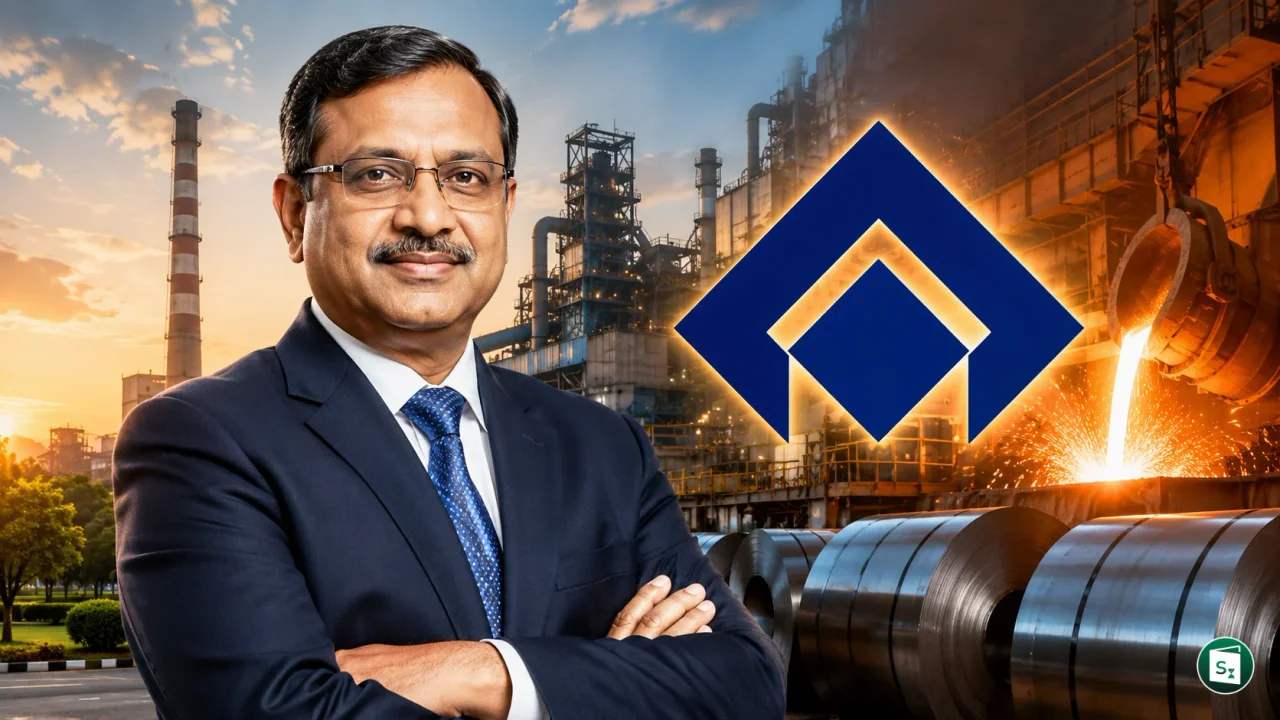
Dr. Ashok Kumar Panda has taken charge as the Chairman and Managing Director (CMD) of the Steel Authority of India Limited (SAIL) on May 15, 2026. He succeeds Krishna Kumar Singh, who had been holding the additional charge of the top post since April 2, 2026. The appointment of the veteran executive comes at a critical time as India’s largest state-owned steelmaker embarks on a massive capacity expansion drive to meet soaring domestic demand.
Profile and Career of Dr. Ashok Kumar Panda
Dr. Ashok Kumar Panda brings a unique blend of technical expertise and financial acumen to the top leadership role at SAIL. He holds a Bachelor of Engineering in Electrical Engineering completed in 1992, followed by a Post Graduate Diploma in Management (PGDM) with a specialisation in Finance from the Xavier Institute of Management (XIM) in Bhubaneswar. He further consolidated his academic credentials by obtaining a doctorate in Business Administration with a focus on finance. This dual engineering and management background has shaped his long career in the steel industry.
Dr. Panda began his professional journey with SAIL in 1992 as a Management Trainee (Technical). Over the next three decades, he held various key positions across several major manufacturing units, including the Bokaro Steel Plant and the Rourkela Steel Plant. His deep operational experience at the shop-floor level combined with his financial qualifications eventually led him to the company’s corporate headquarters. In May 2025, he was appointed as the Director (Finance) of SAIL, where he played a pivotal role in the company’s financial management.
During his tenure as the financial head, Dr. Panda spearheaded a massive debt reduction drive that successfully deleveraged the company’s balance sheet by ₹20,000 crore. He was also responsible for introducing critical cost optimization measures, restructuring tax policies, and executing the transition to advanced digital invoicing systems. Additionally, he held the additional charge of Director (Commercial) for approximately nine months. In this commercial role, he successfully worked on inventory reduction, market alignment, and maximizing sales realizations, cementing his reputation as a versatile leader capable of driving growth under challenging market conditions.
The Interim Term and Predecessor’s Role
Before Dr. Panda took regular charge, the daily operations and strategic oversight of SAIL were managed by Krishna Kumar Singh. He assumed the additional charge of CMD on April 2, 2026, following the resignation of the previous regular chief, Amarendu Prakash. During this interim period, he worked to maintain industrial harmony and operational continuity across the company’s plants. He concurrently serves as the Director (Personnel) of SAIL, a position he has held since August 2022.
Shri Singh has a distinguished career spanning nearly four decades within the public sector steel major. He joined SAIL in 1987 as a Management Trainee (Technical) at the Bhilai Steel Plant located in Chhattisgarh. After spending eleven years in the blooming and billet mill, he transitioned to human resource development. An alumnus of the Indian Institute of Technology, Banaras Hindu University (IIT BHU), he holds a degree in electrical engineering and a postgraduate diploma in human resource management. During his long tenure, he led critical initiatives including wage negotiations in the National Joint Committee for Steel (NJCS) and the roll-out of the New Pension Scheme (NPS) for the workforce.
Steel Authority of India Limited: An Institutional Profile
The Steel Authority of India Limited (SAIL) is one of the largest state-owned steel producers in India and a critical pillar of the country’s core industrial sector. Headquartered in New Delhi, SAIL operates as a Maharatna Central Public Sector Enterprise (CPSE). The Maharatna status, granted by the Government of India, provides the corporation with significant financial and operational autonomy. This enables the management to approve large capital investment projects, establish joint ventures, and pursue international acquisitions without requiring prior government approval up to specified limits.
The institutional origins of the company trace back to Hindustan Steel Limited (HSL), which was incorporated on January 19, 1954, to manage the new steel plants set up under the early Five-Year Plans. To integrate the management of these public sector steel assets, SAIL was formally incorporated on January 24, 1973, as a holding company. Under its current structure, it functions under the administrative control of the Ministry of Steel, Government of India. The company operates major integrated steel plants across the country, including those in Bhilai, Bokaro, Rourkela, Durgapur, and Burnpur, alongside several special steel units.
Strategic Priorities and the 35 MTPA Expansion Plan
As Dr. Panda assumes the leadership of SAIL, his primary strategic focus revolves around steering the company through its next phase of rapid capacity expansion. Under its current modernisation roadmap, SAIL aims to scale up its crude steel production capacity to 35 million tonnes per annum (MTPA) by 2030–31, from its current operational level of approximately 20 MTPA. This expansion is aligned with India’s National Steel Policy, 2017, which envisions a domestic steelmaking capacity of 300 MTPA by 2030 to fuel the country’s infrastructure and manufacturing sectors. The total estimated capital expenditure (capex) for SAIL’s multi-stage expansion programme is projected to be between ₹1 lakh crore and ₹1.05 lakh crore.
The expansion strategy relies heavily on brownfield expansions to optimize capital efficiency and leverage existing infrastructure. A major share of the investment will flow into upgrading key integrated steel plants, as outlined below:
| Steel Plant | State | Current Capacity (MTPA) | Targeted Capacity (MTPA) | Key Upgrades |
|---|---|---|---|---|
| Bokaro Steel Plant | Jharkhand | 5.25 | 7.55 | New blast furnace, sinter plant expansion, thin slab casting |
| IISCO Steel Plant | West Bengal | 2.50 | 4.50 | Modernisation of mills, new steelmaking facilities |
| Durgapur Steel Plant | West Bengal | 2.20 | 3.09 | Blast furnace upgrades, rolling mill modernisation |
| Rourkela Steel Plant | Odisha | 4.20 | 9.80 | Expansion of greenfield and brownfield units |
Beyond physical plant expansion, the new leadership has highlighted raw material security as a key operational priority. SAIL is focusing on expanding its captive domestic mines and securing overseas mineral assets to safeguard supply chains for iron ore and coking coal. Furthermore, the company is integrating advanced digital technologies and automation while establishing a decarbonisation roadmap. This roadmap includes piloting hydrogen-based steelmaking, carbon capture technologies, and increasing the share of renewable energy in its manufacturing operations.
Key Takeaways
- Dr. Ashok Kumar Panda assumed charge as the Chairman and Managing Director (CMD) of the Steel Authority of India Limited (SAIL) on May 15, 2026.
- He succeeds Krishna Kumar Singh, who served as the interim CMD after the resignation of the former regular chief, Amarendu Prakash.
- The Steel Authority of India Limited (SAIL) is a Maharatna Central Public Sector Enterprise (CPSE) incorporated on January 24, 1973, under the administrative control of the Ministry of Steel.
- SAIL has set a target to expand its crude steel capacity to 35 million tonnes per annum (MTPA) by 2030–31, requiring an investment of ₹1 lakh crore to ₹1.05 lakh crore.
- The corporate capacity expansion aligns with the National Steel Policy, 2017, which sets a country-wide target of 300 MTPA of steel capacity by 2030.