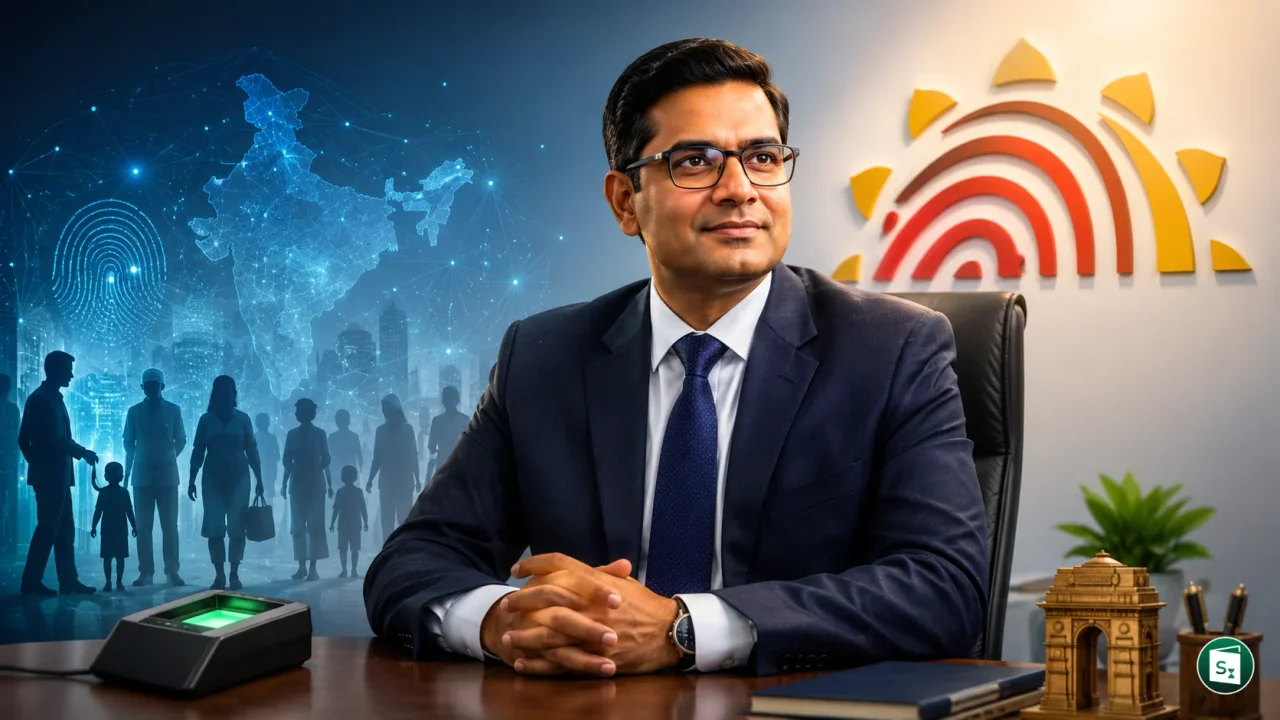
Senior Indian Administrative Service officer Saurabh Vijay took charge as the Chief Executive Officer of the Unique Identification Authority of India (UIDAI) on 18 May 2026. He succeeds Bhuvnesh Kumar, who has transitioned to a new role as the Tourism Secretary of India. This high-profile administrative transition comes at a time when the federal identity organization is expanding its digital infrastructure and authentication services.
Appointment of Saurabh Vijay as UIDAI CEO
The Appointment Committee of the Cabinet approved the posting of Saurabh Vijay to head the federal identity database authority. He officially assumed the office of the Chief Executive Officer on 18 May 2026. Prior to his permanent appointment, the day-to-day operations of the authority were managed under interim arrangements, including a brief period where Deputy Director General Vivek Chandra Verma held the additional charge of the top post following the transition of the previous CEO.
As the chief executive, the officer is responsible for directing the operations of the national digital identity system, which administers Aadhaar cards to over 1.3 billion residents. The CEO also acts as the Member-Secretary of the UIDAI board, bridging the executive team and the part-time governing board members.
Profile of Saurabh Vijay
The newly appointed CEO brings a wealth of administrative experience spanning over two decades. A 1998-batch officer of the Indian Administrative Service from the Maharashtra cadre, he holds a degree in civil engineering from the Indian Institute of Technology (IIT) Delhi. His administrative career includes roles across state governance, central ministries, and international financial institutions.
Before taking charge at the federal identity database authority, he served as the Secretary of the National Disaster Management Authority (NDMA). In the Maharashtra state government, he held several key portfolios, overseeing sectors such as finance, planning, tourism, and education. His international posting at the World Bank in Washington, D.C. as an Advisor to the Executive Director further highlights his expertise in developmental economics and policy execution.
The table below outlines the prominent administrative positions held by Saurabh Vijay during his career:
| Administrative Level | Organization or Department | Role or Position Held |
|---|---|---|
| Central Government | National Disaster Management Authority (NDMA) | Secretary |
| Central Government | President’s Secretariat | Director |
| International | World Bank, Washington, D.C. | Advisor to the Executive Director |
| State Government | Finance Department, Maharashtra | Principal Secretary (Expenditure) |
| State Government | Planning and Development Department, Maharashtra | Principal Secretary |
| State Government | Tourism Department, Maharashtra | Principal Secretary |
| State Government | Higher and Technical Education, Maharashtra | Secretary |
| State Government | Medical Education Department, Maharashtra | Secretary |
Transition of Bhuvnesh Kumar
Saurabh Vijay succeeds Bhuvnesh Kumar, a 1995-batch Indian Administrative Service officer of the Uttar Pradesh cadre. Bhuvnesh Kumar served as the chief executive of the identity database authority before being elevated to the rank of Secretary to the Government of India.
Following this elevation, Bhuvnesh Kumar assumed charge as the Secretary of the Ministry of Tourism on 31 March 2026, succeeding Srivatsa Krishna. During his tenure at the identity database authority, the organization focused on strengthening security protocols, facilitating verification systems, and expanding the integration of the identity cards with multiple central and state social welfare schemes.
Unique Identification Authority of India (UIDAI): An Overview
The Unique Identification Authority of India (UIDAI) is the statutory body responsible for managing India’s national biometric and demographic database. Originally established on 28 January 2009 as an attached office under the Planning Commission, it was later reconstituted as a statutory authority on 12 July 2016. The transition was enacted under the Aadhaar (Targeted Delivery of Financial and Other Subsidies, Benefits and Services) Act, 2016, commonly referred to as the Aadhaar Act. The organization operates under the administrative control of the Ministry of Electronics and Information Technology (MeitY).
The main mandate of the authority is to issue a unique 12-digit random identification number, known as the Aadhaar, to all residents of India. This system serves as the foundational infrastructure for target-based delivery of welfare services, financial subsidies, and digital identity verification across public and private platforms.
Composition and Structure
The authority is governed by a board that oversees the implementation of policies and regulations. The structure consists of the following components:
- Chairperson: A part-time chairperson appointed by the central government. Econometrician Neelkanth Mishra currently serves in this role.
- Members: Two part-time members who advise the authority on administrative and technological implementations. The current part-time members are Nilesh Shah and Prof. Mausam.
- Chief Executive Officer: The CEO is the administrative head of the organization and serves as the Member-Secretary of the authority.
Regional and Technical Infrastructure
To manage operations across different states and union territories, the authority has established a decentralized administrative network. It is headquartered in New Delhi and runs a state-of-the-art Technology Centre in Bengaluru, Karnataka, which manages the massive data repository and verification requests.
The authority also coordinates field operations through eight Regional Offices located across the country:
| Regional Office | Area of Jurisdiction |
|---|---|
| Bengaluru | Karnataka, Kerala, Tamil Nadu, Puducherry, and Lakshadweep |
| Chandigarh | Punjab, Haryana, Himachal Pradesh, Chandigarh, Jammu and Kashmir, and Ladakh |
| Delhi | Uttarakhand, Madhya Pradesh, Delhi, and Rajasthan |
| Guwahati | Assam, Arunachal Pradesh, Meghalaya, Manipur, Nagaland, Mizoram, Tripura, and Sikkim |
| Hyderabad | Andhra Pradesh, Telangana, Odisha, Chhattisgarh, and Andaman and Nicobar Islands |
| Lucknow | Uttar Pradesh |
| Mumbai | Gujarat, Maharashtra, Goa, Dadra and Nagar Haveli, and Daman and Diu |
| Ranchi | Bihar, Jharkhand, and West Bengal |
Key Takeaways
- Saurabh Vijay, a 1998-batch Indian Administrative Service officer of the Maharashtra cadre, assumed charge as the CEO of the Unique Identification Authority of India (UIDAI) on 18 May 2026.
- He succeeds Bhuvnesh Kumar, a 1995-batch officer of the Uttar Pradesh cadre, who took charge as the Secretary of the Ministry of Tourism on 31 March 2026.
- UIDAI was originally set up on 28 January 2009 as an attached office under the Planning Commission, which has since been replaced by the NITI Aayog.
- The authority was granted statutory status on 12 July 2016 under the provisions of the Aadhaar (Targeted Delivery of Financial and Other Subsidies, Benefits and Services) Act, 2016.
- UIDAI operates under the administrative jurisdiction of the Ministry of Electronics and Information Technology (MeitY) and is headquartered in New Delhi.
- The governing board of UIDAI is headed by part-time chairperson Neelkanth Mishra, while its central database is managed by the Technology Centre in Bengaluru.