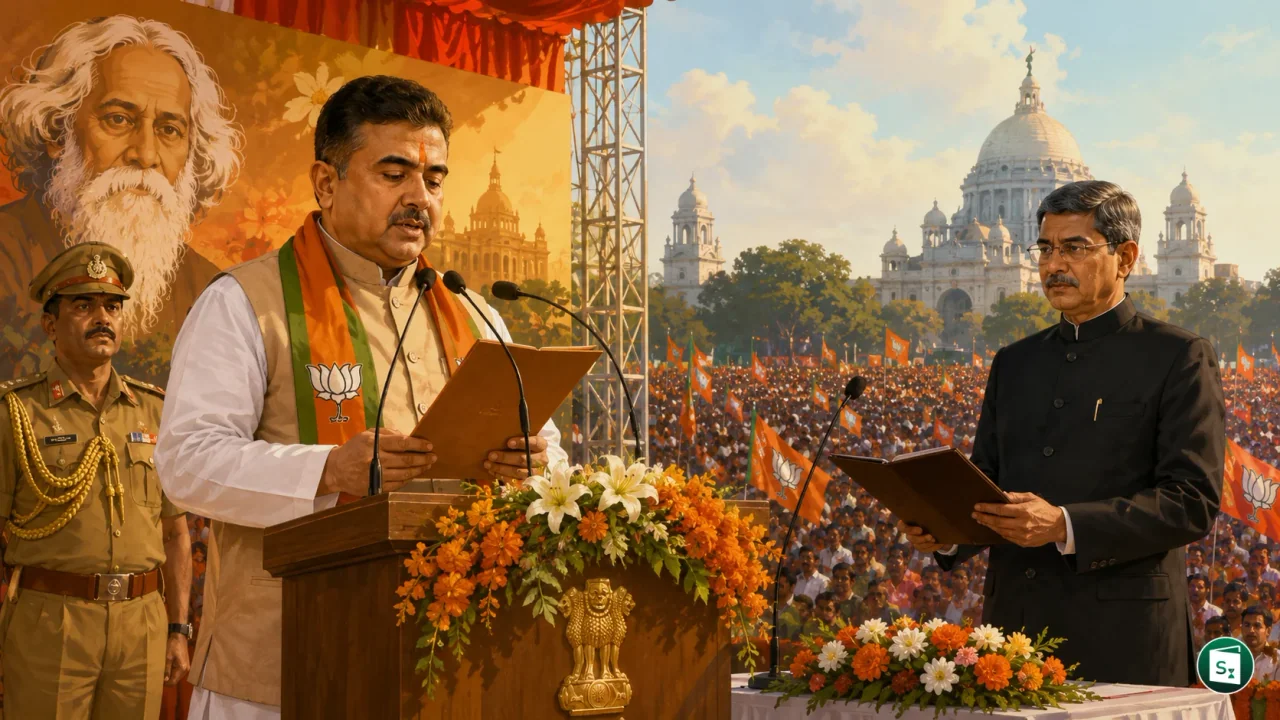
Suvendu Adhikari was sworn in as the first Chief Minister of West Bengal from the Bharatiya Janata Party on May 11, 2026, at the historic Brigade Parade Ground in Kolkata. The ceremony, conducted by Governor RN Ravi, coincided with the 165th birth anniversary of Rabindranath Tagore, a day celebrated as Pochishe Boishakh. This transition follows a landslide victory for the BJP in the 2026 Assembly elections, where the party secured a dominant majority of 207 seats.
Historic Swearing-in Ceremony at Brigade Parade Ground
The oath-taking ceremony was held at the Brigade Parade Ground, a venue historically significant for hosting some of India’s largest political gatherings. Governor RN Ravi administered the oath of office and secrecy to Suvendu Adhikari in Bengali, a gesture that resonated with the local cultural identity. The choice of Pochishe Boishakh for the ceremony added a layer of cultural solemnity, as the state celebrated the 165th birth anniversary of its greatest cultural icon, Rabindranath Tagore.
The event saw the presence of several national leaders and dignitaries. The Brigade Parade Ground, often referred to as the “lungs of Kolkata,” is managed by the Eastern Command of the Indian Army. It has been a stage for pivotal political transitions in West Bengal’s history, and this event marked the first time a non-regional party leader assumed the Chief Minister’s role in the state since the early decades after independence.
Profile of the New Chief Minister: Suvendu Adhikari
Suvendu Adhikari’s political journey has been marked by significant grassroots mobilization. He first rose to national prominence during the Nandigram movement (2007-2008), which was instrumental in ending the 34-year rule of the Left Front in West Bengal. Initially a member of the Trinamool Congress (TMC), Adhikari served as a Member of Parliament from the Tamluk constituency and later as a minister in the state cabinet, holding portfolios such as Transport and Irrigation.
In December 2020, Adhikari joined the Bharatiya Janata Party (BJP), citing ideological shifts. He famously defeated the then-sitting CM Mamata Banerjee in the Nandigram assembly seat during the 2021 elections by a margin of 1,956 votes. In the 2026 elections, he contested from the Bhabanipur constituency, a traditional stronghold of the TMC, and secured a victory against the former Chief Minister.
Understanding the 2026 Assembly Election Results
The 2026 West Bengal Legislative Assembly elections witnessed a historic mandate. The BJP emerged victorious by winning 207 seats out of the total 294 constituencies, crossing the two-thirds majority mark. This result signifies a major shift in the state’s political landscape, which had been dominated by the Trinamool Congress since 2011.
The West Bengal Legislative Assembly is a unicameral legislature. Historically, it was bicameral, but the West Bengal Legislative Council was abolished in 1969. The current assembly has a five-year term unless dissolved earlier. Of the 294 seats, 68 are reserved for Scheduled Castes (SC) and 16 for Scheduled Tribes (ST). The 2026 results reflected a widespread geographical shift in voter preference across both rural and urban sectors of the state.
Constitutional Provisions and the Role of the Governor
The appointment and swearing-in of the Chief Minister are governed by specific articles of the Constitution of India. Under Article 164, the Chief Minister is appointed by the Governor, and other ministers are appointed by the Governor on the advice of the Chief Minister. The Governor also administers the oath of office and secrecy to the members of the Council of Ministers according to the forms set out in the Third Schedule of the Constitution.
Governor RN Ravi, who assumed office in West Bengal in March 2026, previously served as the Governor of Tamil Nadu and Nagaland. A former Indian Police Service (IPS) officer of the 1976 batch, Ravi has also served as the Deputy National Security Advisor and was the government’s interlocutor for the Naga peace talks. The Governor functions as the constitutional head of the state under Article 153, acting as a vital link between the Union and the State.
Rabindranath Tagore’s 165th Birth Anniversary: A Cultural Backdrop
The swearing-in ceremony was held on Pochishe Boishakh, the 25th day of the Bengali month of Boishakh, which marks the birth anniversary of Rabindranath Tagore. Born on May 7, 1861, Tagore was a polymath who reshaped Bengali literature and music. In 2026, the state observed his 165th birth anniversary. Tagore was the first non-European to win the Nobel Prize in Literature in 1913 for his collection of poems, Gitanjali.
His influence extends beyond literature, as he composed the national anthems of two nations: Jana Gana Mana for India and Amar Shonar Bangla for Bangladesh. The decision to hold the political transition on this culturally auspicious day emphasized the new administration’s commitment to the state’s rich heritage and intellectual legacy.
Significance for West Bengal’s Political Landscape
The installation of a BJP government in West Bengal marks a watershed moment in the state’s post-independence history. For decades, the state was governed by the Congress, followed by the Left Front for 34 years, and subsequently by the Trinamool Congress for 15 years. This transition represents the first time a national party with a distinct ideological framework from its predecessors has taken control of the state administration.
The venue of the ceremony, the Brigade Parade Ground, has traditionally been the site where political parties in Bengal demonstrate their public support. By choosing this location for the oath-taking, the new government sought to project a mandate of “Paribartan” or change, signaling a shift in the state’s economic and social policy directions. The focus is now expected to move toward industrialization, infrastructure development, and integration with central government schemes.
Key Takeaways
- Suvendu Adhikari was sworn in as the first BJP Chief Minister of West Bengal on May 11, 2026.
- The oath of office was administered in Bengali by Governor RN Ravi at the Brigade Parade Ground in Kolkata.
- The ceremony coincided with Pochishe Boishakh, the 165th birth anniversary of Nobel laureate Rabindranath Tagore.
- The BJP won a landslide victory in the 2026 Assembly elections, securing 207 out of 294 seats.
- Suvendu Adhikari won the election from the Bhabanipur constituency, defeating the former CM Mamata Banerjee.
- The West Bengal Legislative Assembly is a unicameral body with 294 seats, following the abolition of the Legislative Council in 1969.
- Article 164 of the Indian Constitution governs the appointment of the Chief Minister by the Governor.