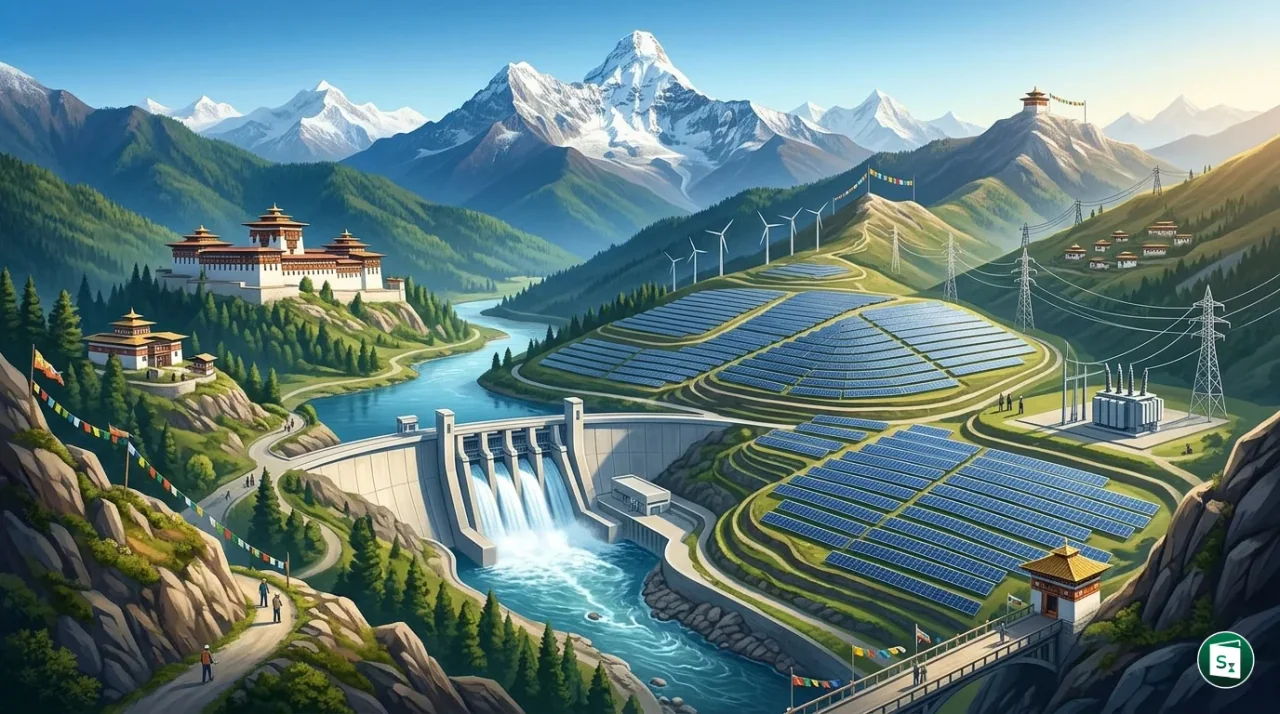
Tata Power and Bhutan’s state-owned Druk Green Power Corporation (DGPC) signed a landmark Memorandum of Understanding on May 28, 2026, to develop over 5,000 Megawatt (MW) of clean energy capacity in Bhutan. This strategic partnership aims to harness the Himalayan nation’s vast renewable potential through a combination of hydropower, solar, and pumped storage projects. The collaboration is set to significantly enhance regional energy security while supporting Bhutan’s ambitious goal of reaching 25,000 MW of installed capacity by 2040.
Overview of the Clean Energy Cooperation Framework
The agreement between Tata Power and DGPC represents one of the largest clean energy collaborations in Asia. It focuses on a diversified portfolio that includes 4,500 MW of hydropower and pumped storage, along with 500 MW of solar energy. This cooperation is designed to provide round-the-clock (RTC) clean power, addressing the seasonal variability of hydropower by integrating solar and storage solutions. The framework also facilitates technical exchange and joint project management, ensuring that both nations benefit from shared expertise in large-scale infrastructure development.
Key Projects and Renewable Infrastructure
The partnership has identified several high-impact projects that will form the backbone of Bhutan’s energy expansion. These include large-scale reservoir hydropower plants and innovative pumped storage projects, which act like giant water batteries to store energy for peak demand.
| Project Name | Type | Capacity (MW) |
|---|---|---|
| Dorjilung HEP | Hydropower | 1,125 |
| Jeri Pumped Storage | Pumped Storage | 1,800 |
| Gongri Reservoir | Hydropower | 740 |
| Khorlochhu HEP | Hydropower | 600 |
| Solar Projects | Solar PV | 500 |
Notably, the Khorlochhu Hydroelectric Project is already in advanced stages, with Tata Power holding a 40% equity stake. This project, with an estimated investment of approximately ₹6,900 crore, serves as a blueprint for future joint ventures under this framework.
Strategic Significance for Regional Power Trade
The collaboration is a vital component of the broader BBIN (Bangladesh, Bhutan, India, Nepal) initiative for regional power integration. By developing 5,000 MW of surplus power, Bhutan can significantly increase its electricity exports to India, which will help meet India’s growing industrial and domestic demand during peak hours.
For Bhutan, these projects are expected to double its current power generation capacity, providing a major boost to the national treasury through export revenues. This aligns with India’s vision of “One Sun, One World, One Grid”, where regional neighbors collaborate to build a resilient and green energy corridor. The cross-border transmission of this power will be facilitated by existing high-voltage lines, such as the 1,200 km Tala transmission line, which connects Bhutan’s power plants to the Indian grid.
Skill Development and Workforce Readiness
Parallel to the infrastructure projects, Tata Power and DGPC have established a comprehensive skill development ecosystem. An earlier MoU signed on May 18, 2026, focused on training the local Bhutanese workforce through the Tata Power Skill Development Institute (TPSDI).
This initiative aims to create a future-ready talent pool capable of handling the entire lifecycle of clean energy assets, from construction and equipment maintenance to advanced operations. The training program is being implemented in three distinct phases, prioritizing safety standards and technical proficiency to ensure that Bhutanese citizens are the primary beneficiaries of the employment opportunities generated by these projects.
Historical Context of Indo-Bhutan Power Ties
The partnership between Tata Power and DGPC builds on a long history of successful cooperation. In 2008, the two entities collaborated on the 126 MW Dagachhu Hydropower Plant, which was Bhutan’s first project developed through a public-private partnership (PPP) model. Tata Power, established in 1915 and headquartered in Mumbai, has since remained a key technical and investment partner for Bhutan.
Druk Green Power Corporation, established in 2008 and headquartered in Thimphu, is the holding company for all state-owned hydropower assets in Bhutan. Under the leadership of Managing Director Dasho Chhewang Rinzin, DGPC has been instrumental in executing the country’s vision of becoming a regional green energy hub. This new 5,000 MW framework is the culmination of nearly two decades of trust and shared growth between the two organizations.
Key Takeaways
- Tata Power and Bhutan’s Druk Green Power Corporation (DGPC) signed a landmark clean energy MoU on May 28, 2026.
- The partnership aims to develop at least 5,000 MW of renewable energy capacity, including hydro, solar, and pumped storage.
- Key identified projects include the Dorjilung HEP (1,125 MW) and the Jeri Pumped Storage (1,800 MW).
- Tata Power holds a 40% equity stake in the Khorlochhu Hydroelectric Project, which involves an investment of approximately ₹6,900 crore.
- A separate MoU for skill development was signed on May 18, 2026, to train the local workforce through the Tata Power Skill Development Institute (TPSDI).
- DGPC, headquartered in Thimphu, was established in 2008 as the state-owned utility managing Bhutan’s hydropower assets.