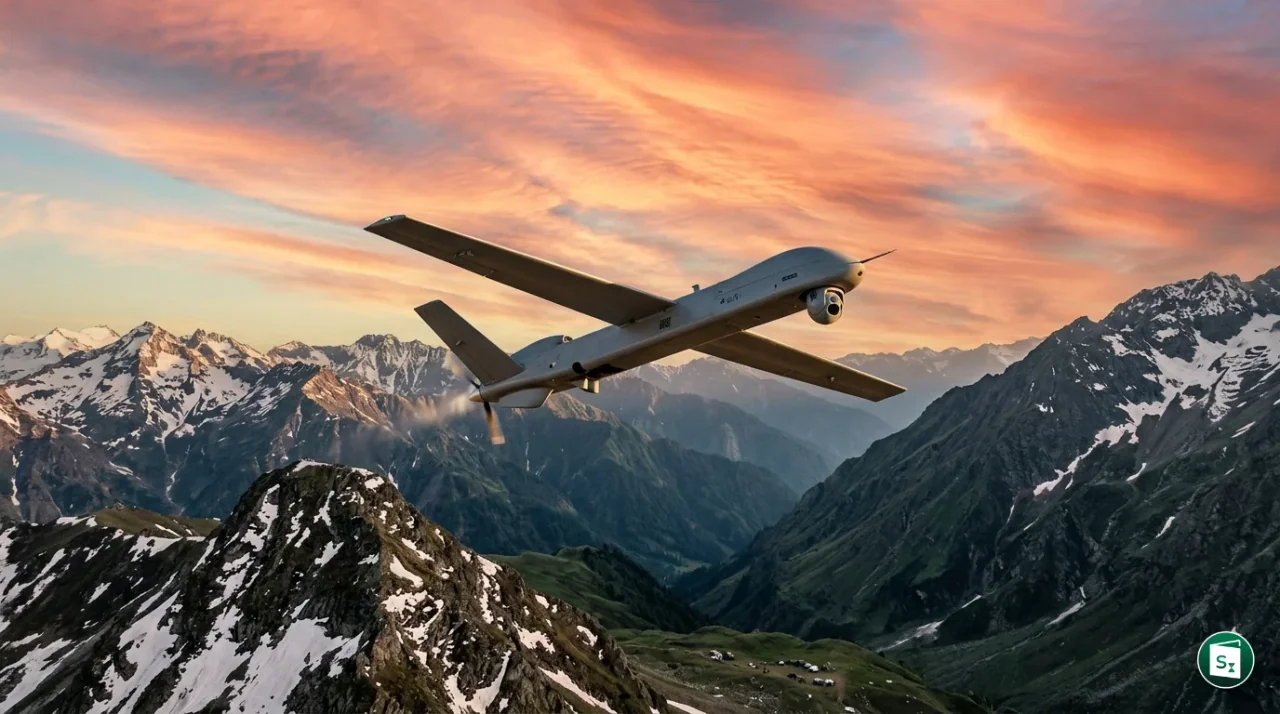
Pune-based NIBE Limited successfully completed technical trials for its Vayu Astra-1 loitering munition, demonstrating its multi-terrain capabilities across the deserts of Rajasthan and high-altitude regions of Uttarakhand. Developed in collaboration with Israel’s Elbit Systems, the system showcased a 100-km operational range and high precision under the No-Cost, No-Commitment (NCNC) procurement model. This milestone marks a significant step toward indigenizing long-range precision strike capabilities for the Indian Army.
What is the Vayu Astra-1 Loitering Munition?
A loitering munition, often referred to as a kamikaze drone, is an unmanned aerial vehicle designed to loiter around a target area until an objective is identified, after which it executes a precision strike by crashing into the target. The Vayu Astra-1 is a dual-role system capable of both anti-personnel and anti-armour missions. It is equipped with a 10 kg warhead, which is significantly larger than conventional 155mm artillery shells, ensuring high lethality upon impact.
The system features advanced tactical flexibility, including abort and re-attack functions. This allows operators to wave off an attack if the situation changes and either re-engage the same target or switch to a new one. Notably, the Vayu Astra-1 is reusable; if a mission is aborted without a strike, the munition can be recovered and redeployed for future operations, making it a cost-effective solution for long-range surveillance and engagement.
Technical Specifications of Vayu Astra-1
| Parameter | Specification |
|---|---|
| Operational Range | 100 kilometres |
| Warhead Weight | 10 kg |
| Flight Endurance | Over 90 minutes |
| Operational Altitude | Up to 14,000 feet and above |
| Strike Precision (Day) | Less than 1 metre CEP |
| Strike Precision (Night) | Less than 2 metres CEP |
| Key Features | Abort, Re-attack, and Reusable |
Successful Multi-Terrain Trials: From Deserts to High Altitudes
The trials for the Vayu Astra-1 were conducted in two distinct phases to validate its performance in India’s diverse and challenging geographical conditions. The first phase took place in Pokhran, Rajasthan, on 18-19 April 2026. During these desert trials, the munition successfully struck a target at a range of 100 km with a Circular Error Probable (CEP) of less than one metre. The trials also validated its anti-armour night strike capabilities, where it hit a target within a 2-metre CEP using its infrared camera.
The second phase was conducted at Joshimath (Malari) in Uttarakhand on 26-27 April 2026, focusing on high-altitude endurance. The system operated at altitudes exceeding 14,000 feet, maintaining a continuous flight for over 90 minutes. These trials demonstrated the munition’s ability to maintain structural and operational integrity in thin air and freezing temperatures, which are critical for operations along India’s northern borders.
Understanding the No-Cost No-Commitment (NCNC) Procurement Model
The Vayu Astra-1 trials were conducted under the No-Cost, No-Commitment (NCNC) model, which is a standard procedure in the Indian Ministry of Defence capital procurement cycle. In this model, the vendor (NIBE Limited in this case) bears all the expenses related to the trials, including the cost of transporting equipment, deploying technical teams, and providing ammunition or consumables. The government does not provide any financial support during this phase.
The No-Commitment aspect means that even if the equipment successfully meets all technical requirements and parameters set by the military, the government is not legally or financially obligated to award a contract or purchase the system. This model allows the Indian Armed Forces to rigorously test multiple competing systems in actual field conditions without financial risk, ensuring that only the most capable and reliable technology is considered for final procurement.
Strategic Significance for India’s Border Defence
The induction of long-range loitering munitions like the Vayu Astra-1 is strategically vital for India’s national security, particularly along the Line of Actual Control (LAC). In high-altitude mountainous terrains, traditional artillery and air support can be constrained by difficult topography and unpredictable weather. Loitering munitions provide a cost-effective alternative for conducting precision strikes against high-value targets such as command centres, missile launchers, and enemy armoured formations from a safe distance of 100 km.
The success of these trials also aligns with the Aatmanirbhar Bharat (Self-Reliant India) and Make in India initiatives. By developing these systems indigenously through collaborations with global leaders like Elbit Systems, India reduces its dependence on foreign imports for critical defence technologies. Furthermore, the ability to recover and reuse the munition adds a significant economic advantage over single-use strike systems, allowing for sustained operations during prolonged conflicts.
About NIBE Limited and the Collaboration with Elbit Systems
NIBE Limited is a Pune-based defence technology company specializing in the manufacturing of strategic defence systems and components. It has emerged as a key player in India’s defence ecosystem, providing localized solutions for global platforms. The company’s collaboration with Israel’s Elbit Systems is central to its precision strike portfolio. Elbit Systems, headquartered in Haifa, Israel, is a global leader in aerospace and defence technology, known for its expertise in unmanned aerial systems and loitering munitions.
The partnership involves the transfer of technology and local manufacturing of advanced systems, such as the Vayu Astra-1, which is adapted from Elbit’s proven designs. This synergy allows NIBE Limited to combine Israeli technical expertise with Indian manufacturing capabilities, creating systems that are tailored to the unique operational requirements of the Indian Armed Forces while promoting domestic production.
Key Takeaways
- The Vayu Astra-1 loitering munition successfully completed multi-terrain trials in Pokhran and Joshimath, demonstrating an operational strike range of 100 km.
- The munition is equipped with a 10 kg warhead and features advanced tactical capabilities such as abort, re-attack, and reusability.
- During high-altitude trials in Uttarakhand, the system maintained a continuous flight for over 90 minutes at altitudes exceeding 14,000 feet.
- The trials were conducted under the No-Cost, No-Commitment (NCNC) procurement model, with NIBE Limited bearing all technical and operational costs.
- Developed in collaboration with Israel’s Elbit Systems, the project supports India’s Aatmanirbhar Bharat and Make in India initiatives in the defence sector.
- The system achieved a precision of less than one metre Circular Error Probable (CEP) during day strikes and less than two metres during night missions.