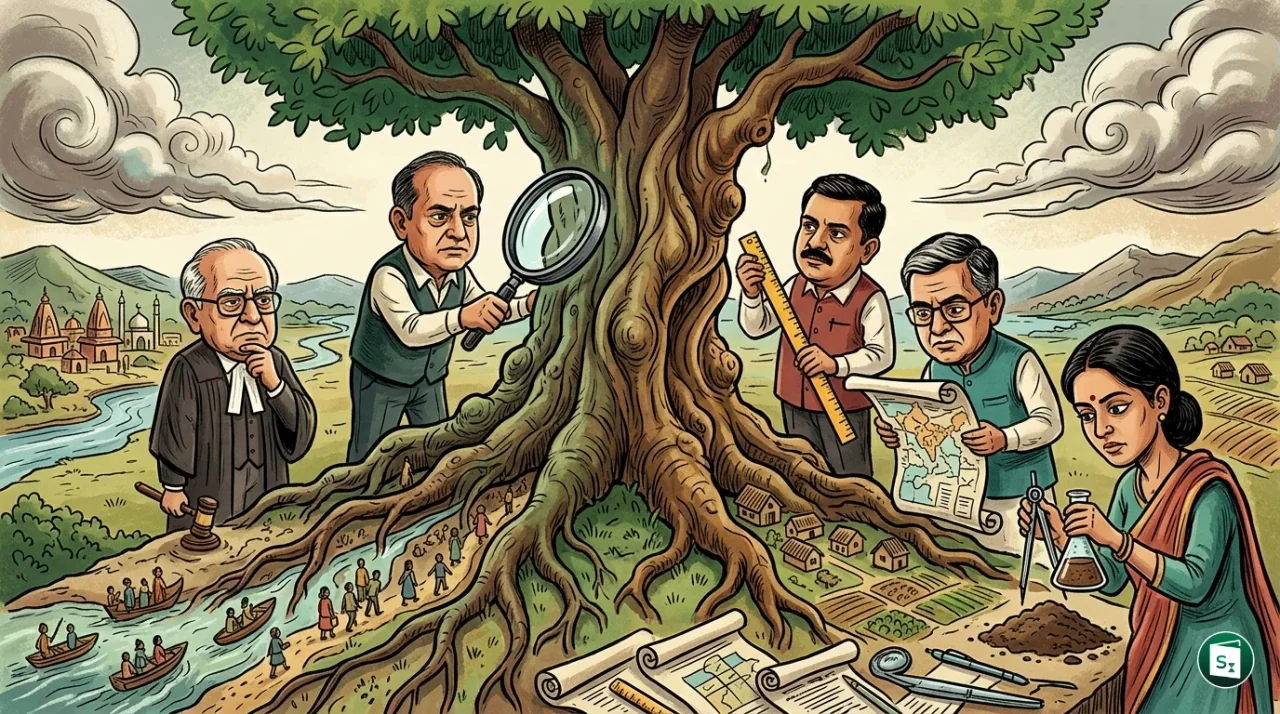
The Ministry of Home Affairs (MHA) has officially constituted the High-Level Committee on Demographic Change (HLCDC) to conduct a scientific study of shifting population patterns in India. Chaired by retired Supreme Court judge Justice Prakash Prabhakar Naolekar, the panel is tasked with investigating unnatural demographic shifts caused by illegal immigration and irregular mobility. This move aligns with the government’s strategic vision to address population challenges and ensure the preservation of social and national security structures.
Composition of the High-Level Committee
The committee brings together a diverse group of experts from the judiciary, administration, security, and economics. This multi-disciplinary approach ensures that demographic changes are analyzed not just as statistical data, but through the lenses of national security and economic policy.
| Name | Role / Background |
|---|---|
| Justice Prakash Prabhakar Naolekar | Chairperson (Retired Judge, Supreme Court of India) |
| Mritunjay Kumar Narayan | Member (Registrar General and Census Commissioner of India) |
| Durga Shankar Mishra | Member (Retired IAS officer and former Chief Secretary of Uttar Pradesh) |
| Balaji Srivastava | Member (Retired IPS officer and former chief of BPR&D) |
| Dr. Shamika Ravi | Member (Economist and Member, Economic Advisory Council to the PM) |
The Joint Secretary (Foreigners-I) of the Ministry of Home Affairs will serve as the Member Secretary of the committee. The headquarters of the HLCDC is established in New Delhi.
Mandate and Terms of Reference
The primary objective of the HLCDC is to provide a “scientific assessment” of population shifts that deviate from normal demographic trends. Unlike traditional census exercises, this committee will utilize a data-driven approach to identify the underlying causes of rapid population growth in specific regions.
The committee is empowered to seek records and information from all Union Ministries, State Governments, and public authorities. It will also consult with security agencies, academic institutions, and social organizations to build a comprehensive picture of demographic dynamics. The government has directed the panel to submit its final report within one year from its date of constitution.
Key Focus Areas
The terms of reference for the committee include:
- Identification of Trends: Distinguishing between normal population growth driven by fertility and mortality and “unnatural” changes caused by external factors.
- Geographic Mapping: Analyzing abnormal settlement patterns in border districts, urban centers, and tribal regions.
- Impact Assessment: Evaluating how demographic imbalances affect public service delivery, local governance, and resource distribution.
- Policy Recommendations: Suggesting a permanent legal and administrative framework for the identification and management of illegal immigrants.
Background: From Interim Budget to Constitution
The formation of the HLCDC was first proposed during the Interim Budget 2024-25. Union Finance Minister Nirmala Sitharaman announced that the government would form a high-level committee to examine the challenges arising from fast population growth and demographic changes. This was followed by a mention in Prime Minister Narendra Modi’s Independence Day speech on August 15, 2025, where he emphasized the need for a scientific study to safeguard the country’s social fabric.
The committee’s work is intrinsically linked to the larger goal of ‘Viksit Bharat’ by 2047. By understanding and managing demographic shifts, the government aims to ensure that development benefits reach the intended beneficiaries and that resource distribution remains equitable across all regions.
Addressing ‘Unnatural’ Demographic Changes
The term unnatural demographic change refers to structural population fluctuations that cannot be explained by standard births and deaths. The MHA has expressed concern over orchestrated migration and illegal infiltration, which can lead to social friction and administrative challenges. The committee will look at granular community analysis in regions where data deviates significantly from national averages to provide evidence-based solutions.
National Security and Sovereign Interests
The HLCDC’s findings are expected to have a profound impact on India’s national security framework. The committee will recommend institutional mechanisms to strengthen border management and optimize identity verification systems. By addressing abnormal settlement patterns in sensitive border areas, the panel aims to protect India’s sovereignty and prevent further infiltration.
Furthermore, the committee will suggest policy frameworks for population stabilization in regions where demographic imbalances pose a challenge to social cohesion. The final recommendations will likely influence future updates to the Foreigners Act and other migration-related laws, ensuring a fair yet robust mechanism for managing India’s demographic integrity.
Key Takeaways
- The Ministry of Home Affairs (MHA) has formed the High-Level Committee on Demographic Change (HLCDC) to study population shifts.
- Retired Supreme Court judge Justice Prakash Prabhakar Naolekar will chair the five-member committee.
- The committee will conduct a scientific assessment of unnatural demographic changes resulting from illegal immigration and abnormal settlement patterns.
- The formation of the committee was originally announced in the Interim Budget 2024-25 by Finance Minister Nirmala Sitharaman.
- The panel includes the Census Commissioner of India, Mritunjay Kumar Narayan, and economist Dr. Shamika Ravi.
- The HLCDC has been given a one-year deadline to submit its final report and policy recommendations to the central government.