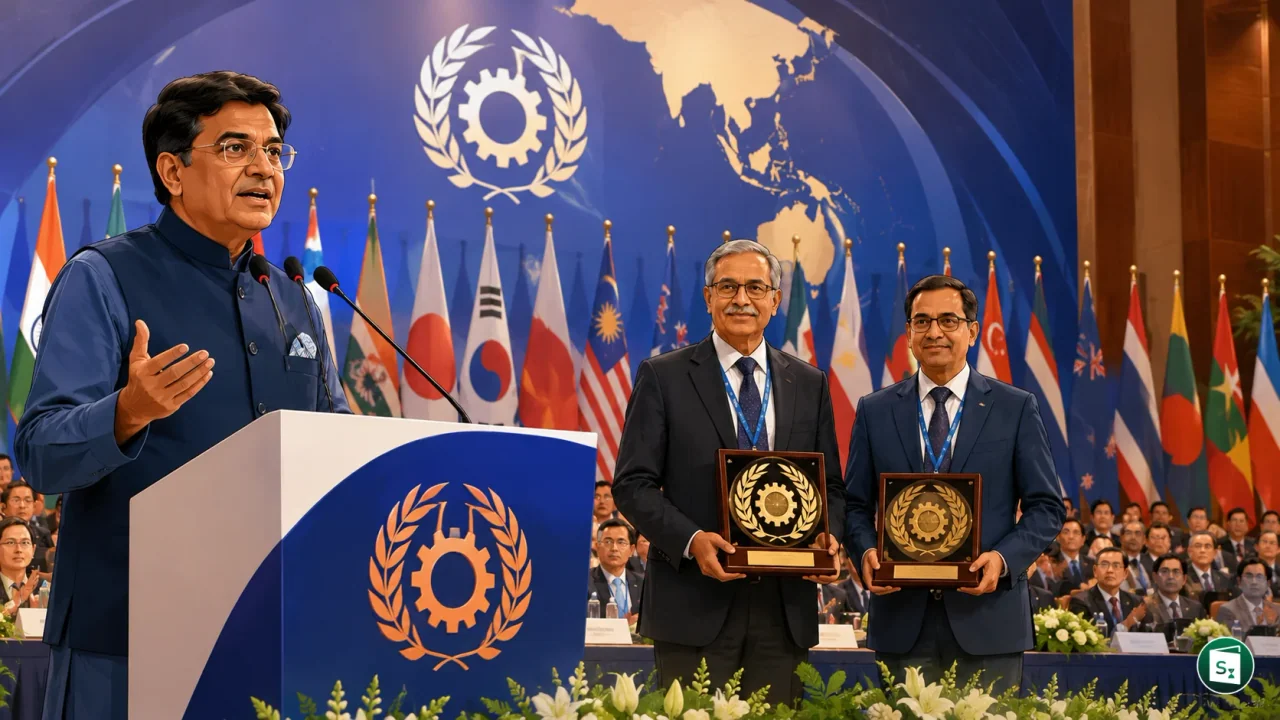
Union Minister Piyush Goyal inaugurated the 68th Session of the Governing Body Meeting (GBM) of the Asian Productivity Organization (APO) at Bharat Mandapam in New Delhi on May 28, 2026. The session brought together representatives from member countries to review the progress of the APO Vision 2030, which aims for productivity-led economic and social transformation across the Asia-Pacific region. This meeting underscores India’s growing leadership in fostering regional cooperation for sustainable growth and industrial efficiency.
What is the Asian Productivity Organization (APO)?
The Asian Productivity Organization (APO) is a regional intergovernmental organization established on May 11, 1961, to promote productivity and economic development in the Asia-Pacific region. Headquartered in Tokyo, Japan, the organization currently comprises 21 member economies that collaborate to share knowledge, expertise, and technological innovations. The APO works on a non-political, non-profit, and non-discriminatory basis, focusing on enhancing efficiency across sectors ranging from agriculture to manufacturing and services.
India is one of the founding members of the APO and has played a pivotal role in its governance and programs since its inception. The National Productivity Council (NPC), which operates under the Department for Promotion of Industry and Internal Trade (DPIIT) of the Ministry of Commerce and Industry, serves as India’s designated National Productivity Organization (NPO). Through the NPC, India implements various APO initiatives aimed at improving industrial competitiveness and sustainable development.
Highlights of the 68th Governing Body Meeting
The 68th Session of the GBM served as a critical platform for member countries to evaluate the progress of the APO Vision 2030. This long-term strategic framework is built on four core pillars: Digital Transformation, Innovation and Entrepreneurship, Sustainable Development, and Capacity Building. A significant outcome of the meeting was the announcement of the GAIA (Genuine AI Action) initiative, which aims to leverage Artificial Intelligence to drive productivity gains across member economies.
During the session, the leadership of the APO Governing Body also underwent a transition. India, represented by the Secretary of DPIIT, handed over the chairmanship to Indonesia for the 2026–27 term. Prof. Anwar Sanusi of Indonesia was appointed as the new APO Chair, succeeding India’s Amardeep Singh Bhatia. The delegates also confirmed that the 69th Governing Body Meeting would be hosted by Lao PDR in 2027, ensuring a continued roadmap for regional cooperation.
Redefining Productivity: Minister Piyush Goyal’s Vision
In his inaugural address, Union Minister Piyush Goyal challenged the traditional understanding of productivity, asserting that it must now encompass resilience, innovation, and inclusive growth. He highlighted that for a nation to remain competitive in a rapidly changing global economy, it must move beyond mere output efficiency and focus on creating value that benefits all segments of society. The Minister specifically noted that Micro, Small, and Medium Enterprises (MSMEs) are the real engines of economic growth and need focused support to adopt advanced technologies and digital capabilities.
Goyal also showcased India’s successful implementation of Digital Public Infrastructure (DPI), such as UPI and Aadhaar, as global benchmarks for productivity-led transformation. He urged member countries to collaborate on building resilient supply chains and adopting “Green Productivity” practices to ensure that economic progress does not compromise environmental sustainability. By integrating these elements, the APO member economies can achieve a more robust and sustainable innovation ecosystem that drives shared prosperity across the region.
Recognizing Excellence: APO National Award Winners
A key highlight of the 68th Session was the presentation of the APO National Awards, which recognize individuals who have demonstrated exceptional leadership and innovation in advancing the productivity movement in India. These awards are among the highest recognitions in the field and have previously been conferred on legendary figures such as Dr. Verghese Kurien, the pioneer of India’s White Revolution, and Anil Naik of Larsen & Toubro.
The 2026 awardees were selected for their pioneering work in sustainability and high-tech manufacturing:
| Awardee | Category | Key Contribution |
|---|---|---|
| Ashok Panjwani | Productivity Advocate | Recognized for his leadership in sustainability, waste management, and strategic policy advocacy at BEIL Infrastructure and UPL Ltd. |
| Bakul Limbasiya | Productivity Technical Expert | Honored for his pioneering role in India’s lab-grown diamond (LGD) sector, establishing a high-tech manufacturing ecosystem. |
Ashok Panjwani has been instrumental in integrating environmental considerations into industrial productivity, particularly through large-scale waste management and circular economy initiatives. Bakul Limbasiya, on the other hand, is credited with producing India’s first lab-grown diamond in 2004. His efforts have helped position India as a global hub for technology-driven gemstone manufacturing, directly contributing to the Atmanirbhar Bharat vision.
The National Productivity Council: Driving India’s Growth Agenda
The National Productivity Council (NPC) is the nodal agency responsible for promoting the productivity movement in India. Established on February 12, 1958, as an autonomous, multipartite, non-profit organization, it operates under the Department for Promotion of Industry and Internal Trade (DPIIT) of the Ministry of Commerce and Industry. Every year, February 12 is celebrated as National Productivity Day, marking the beginning of National Productivity Week, which focuses on a specific theme related to efficiency and innovation.
Headquartered in New Delhi, the NPC is led by the Union Minister of Commerce and Industry as its President. It serves as the primary link between India and the Asian Productivity Organization, facilitating the adoption of international best practices in Indian industries. From established sectors like agriculture and manufacturing to emerging areas like Artificial Intelligence and Green Productivity, the NPC provides consultancy, research, and training services to enhance national competitiveness. In July 2023, the NPC further strengthened its position by becoming an accredited body to certify productivity specialists, a significant step toward professionalizing the productivity landscape in India.
Key Takeaways
- Union Minister Piyush Goyal inaugurated the 68th Session of the APO Governing Body Meeting at Bharat Mandapam, New Delhi, on May 28, 2026.
- The meeting focused on the APO Vision 2030 framework and the newly announced GAIA (Genuine AI Action) initiative for AI-driven productivity.
- India completed its term as Chair and handed over the leadership to Indonesia for the 2026–27 period, with Prof. Anwar Sanusi assuming the role of Chair.
- The APO National Award for Productivity Advocate was awarded to Ashok Panjwani for his contributions to sustainability and waste management.
- The APO National Award for Productivity Technical Expert was presented to Bakul Limbasiya for his pioneering work in India’s lab-grown diamond sector.
- The National Productivity Council (NPC), established in 1958, is India’s designated National Productivity Organization (NPO) under the Ministry of Commerce and Industry.
- The Asian Productivity Organization (APO) is an intergovernmental body founded in 1961, headquartered in Tokyo, Japan, with 21 member economies.