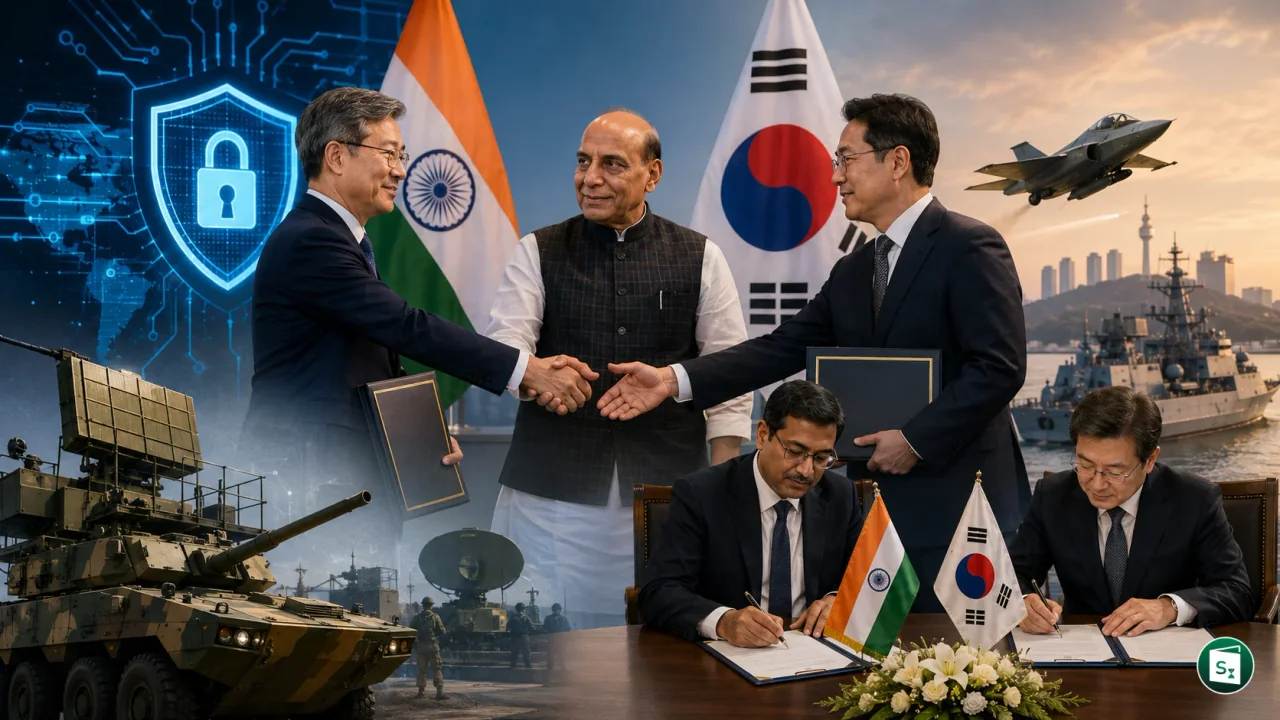
Union Minister for Defence Rajnath Singh concluded a high-level visit to Seoul, South Korea, on May 20, 2026, aimed at deepening the Special Strategic Partnership through advanced defence technology and industrial co-production. During the visit, India and the Republic of Korea (ROK) signed a landmark Memorandum of Understanding (MoU) on defence cyber security and information sharing, marking a significant shift toward digital collaboration in modern warfare. The visit also featured the signing of new industrial agreements between Larsen & Toubro (L&T) and Hanwha Aerospace, building upon the successful legacy of the K9 Vajra-T howitzer program.
Deepening the Special Strategic Partnership
The visit occurred against the backdrop of the India-ROK Special Strategic Partnership, which was established in 2015. Defence Minister Rajnath Singh held extensive bilateral talks with his South Korean counterpart, Ahn Gyu-back, to review the progress of military-to-military exchanges and maritime security cooperation. The two leaders emphasized the convergence between India’s Act East Policy and South Korea’s strategy for a free and open Indo-Pacific.
A key meeting was also held with Lee Yong-cheol, the Minister of the Defense Acquisition Program Administration (DAPA). DAPA, headquartered in Gwacheon, is the central agency responsible for South Korea’s defence procurement and industry promotion. The discussions with DAPA focused on transitioning the bilateral relationship from a traditional buyer-seller model to a “symbiotic” partnership involving joint research, development, and co-production of advanced military hardware.
New Frontiers in Cyber Security and Information Sharing
A cornerstone of the visit was the exchange of a comprehensive MoU focused on defence cyber security and information sharing. This pact addresses the growing complexity of hybrid warfare and the need to protect critical military infrastructure from digital threats. Under this agreement, both nations will collaborate on countering cyber-attacks, sharing real-time intelligence on vulnerabilities, and exchanging best practices in digital defence.
This institutional mechanism is expected to enhance situational awareness in the maritime and terrestrial domains. By establishing a framework for regular information exchange, India and South Korea aim to build a resilient digital security architecture that supports their broader military cooperation. Additionally, agreements were signed to facilitate academic and training exchanges between India’s National Defence College (NDC) and the Korea National Defence University (KNDU).
Boosting Defence Industrial Collaboration: The L&T-Hanwha Accord
During the India-ROK Defence Industry Business Roundtable, Rajnath Singh invited South Korean companies to integrate their supply chains with the Indian defence industry. A major outcome of this industrial push was the signing of two key agreements between Larsen & Toubro (L&T) and Hanwha Aerospace. These agreements are designed to expand the scope of their existing collaboration beyond assembly toward co-development and joint exports to third countries.
The partnership between L&T and Hanwha is rooted in the success of the K9 Vajra-T 155mm self-propelled howitzer program. This project is a prime example of the Make in India initiative in the defence sector.
| Phase | Year | Scope and Milestone |
|---|---|---|
| Phase 1 | 2017 | Contract for 100 units; achieved over 50% localization at L&T’s Hazira facility. |
| Phase 2 | 2024 | Contract for 100 additional units signed; target localization increased to 60%. |
| Phase 3 | 2026 | Negotiations for joint design and development of advanced variants and unmanned systems. |
These new agreements aim to leverage India’s manufacturing capabilities and South Korea’s high-tech defence prowess to create a global hub for military hardware.
Institutionalizing Innovation: KIND-X and Future Co-development
To sustain long-term collaboration, India and South Korea have introduced the India-Korea Defence Innovation Accelerator Ecosystem (KIND-X). This initiative is designed to connect the defence startups, incubators, and research laboratories of both nations. By fostering a shared innovation space, KIND-X aims to co-develop next-generation military technologies, including Artificial Intelligence (AI), quantum computing, and directed-energy weapons.
This move aligns with India’s broader push for Aatmanirbharta (self-reliance) in defence. The partnership is also expanding into new domains such as space-based intelligence and satellite technology. A Joint Working Group between the Indian Space Research Organisation (ISRO) and the Korea AeroSpace Administration (KASA) is already working on enhancing maritime domain awareness through satellite-derived data.
Historical Ties and the Humanitarian Legacy
The contemporary defence partnership is built on a strong historical foundation. During the Korean War (1950–53), India made a significant humanitarian contribution by sending the 60th Parachute Field Ambulance, a medical unit led by Lt Col AG Rangaraj. The unit treated over 200,000 wounded soldiers and civilians, earning deep respect in South Korea.
In a poignant tribute during his visit, Rajnath Singh inaugurated the Indian War Memorial in Seoul. This memorial honors the Indian soldiers who served during the conflict and serves as a symbol of the enduring bond between the two nations. The legacy of this humanitarian mission continues to influence the “special” nature of the strategic partnership, reminding both countries of their long-standing commitment to peace and regional stability.
Key Takeaways
- India and South Korea signed a landmark MoU on Defence Cyber Security and Defence Information Sharing during a high-level visit to Seoul in May 2026.
- The India-ROK Special Strategic Partnership, established in 2015, serves as the foundational framework for bilateral defence cooperation.
- Larsen & Toubro (L&T) and Hanwha Aerospace signed two new agreements to expand their collaboration beyond the K9 Vajra-T program into co-development and joint exports.
- The Defense Acquisition Program Administration (DAPA) of South Korea, headquartered in Gwacheon, is the central agency coordinating these industrial ties.
- The India-Korea Defence Innovation Accelerator Ecosystem (KIND-X) was introduced to link the defence startup and research ecosystems of both nations.
- During the visit, an Indian War Memorial was inaugurated in Seoul to honor the 60th Parachute Field Ambulance which served during the Korean War (1950–53).