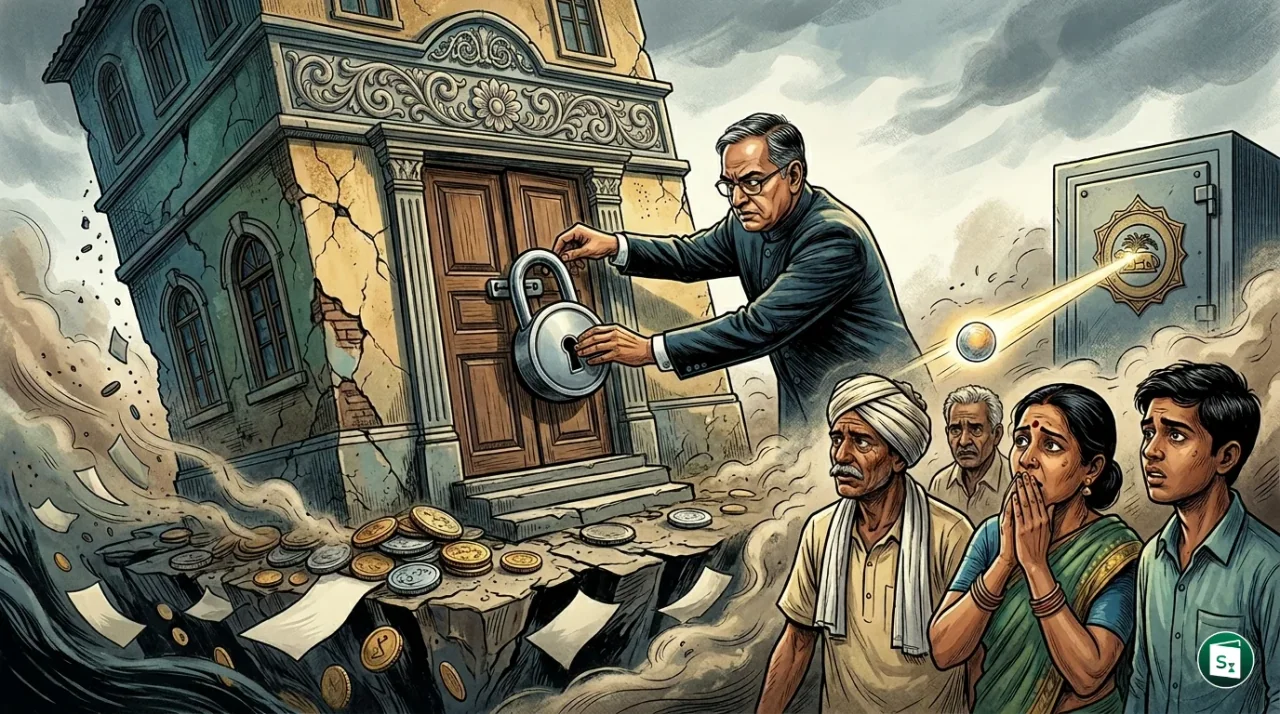
The Reserve Bank of India officially revoked the banking license of Phaltan-based Yashwant Co-operative Bank Ltd on May 19, 2026, due to its deteriorating financial health and inability to safeguard depositor interests. This regulatory action brings an immediate halt to all banking operations, including the acceptance and repayment of deposits. The decision marks a critical intervention by the central bank to maintain the stability of the urban co-operative banking sector in Maharashtra.
Why Did the RBI Cancel the Bank’s License?
The cancellation of the license for The Yashwant Co-operative Bank Ltd., headquartered in Phaltan, Satara district, follows a period of persistent financial instability. The central bank determined that the institution did not possess adequate capital or earning prospects to continue its operations. Under the current financial circumstances, the bank was deemed incapable of repaying its present depositors in full, making its continued existence a risk to the banking system and the public interest.
Specific violations of the Banking Regulation Act, 1949, were cited as the primary legal grounds for this decision. The bank failed to comply with the requirements of Section 11(1), which mandates a minimum level of paid-up capital and reserves, and Section 22(3), which outlines the conditions for a banking license. These provisions, read along with Section 56 of the Act that applies to co-operative societies, ensure that only financially viable institutions are allowed to manage public money.
The DICGC Shield: Protecting Depositor Interests
To mitigate the impact on the bank’s customers, the Deposit Insurance and Credit Guarantee Corporation (DICGC) provides a safety net. Under the existing rules, every depositor in a failed bank is entitled to receive a deposit insurance claim of up to ₹5,00,000 for their deposits, which include savings, current, and fixed deposits. This limit applies to the total of all accounts held by a person in the same right and capacity at that specific bank.
For Yashwant Co-operative Bank, the data submitted by the institution reveals that approximately 99.02% of depositors are eligible to receive the full amount of their deposits from the DICGC. The corporation has already been proactive in this case; as of April 20, 2026, it had processed and paid ₹106.96 crore to eligible depositors based on the claims received. This early disbursement highlights the strengthened role of the DICGC in providing timely relief to small depositors during bank failures.
Understanding the Liquidation and Legal Framework
The cancellation of a license is the first step in the formal dissolution of a bank. Following the RBI’s decision, the Commissioner for Cooperation and Registrar of Cooperative Societies (RCS), Maharashtra, has been requested to issue an order for the winding up of the bank. The RCS is the statutory authority under the Maharashtra Co-operative Societies Act, 1960, responsible for overseeing the liquidation process of co-operative institutions in the state.
Once a liquidator is appointed, they take control of the bank’s assets and records. The liquidator’s primary task is to recover dues from borrowers and dispose of the bank’s property to settle claims. The insurance payout from the DICGC is coordinated through this liquidator, who verifies the list of eligible depositors and submits the necessary claims. This dual-regulator model, involving both the RBI and the state-level RCS, is a unique feature of the co-operative banking structure in India.
The Regulatory Landscape for Urban Co-operative Banks
In recent years, the Reserve Bank of India has adopted a more stringent approach toward Urban Co-operative Banks (UCBs) that display chronic financial weaknesses. This proactive stance follows the Banking Regulation (Amendment) Act, 2020, which significantly expanded the RBI’s powers over the co-operative banking sector. Previously, the central bank had limited oversight compared to the state registrars, but the amendment brought UCBs more closely under the same regulatory umbrella as commercial banks.
The primary objective of these interventions is to protect the integrity of the Indian financial system and safeguard the savings of millions of small depositors. By closing non-viable institutions like Yashwant Co-operative Bank, the regulator prevents the further erosion of capital and ensures that the resources available are used to settle depositor claims through the DICGC mechanism. This shift reflects a broader commitment to professionalizing the co-operative banking space and ensuring that only banks with strong corporate governance and healthy balance sheets remain operational.
Key Takeaways
- The Reserve Bank of India (RBI) revoked the license of Yashwant Co-operative Bank Ltd, based in Phaltan, Maharashtra, effective from May 19, 2026.
- The bank was found in violation of Section 11(1) and Section 22(3) of the Banking Regulation Act, 1949, which govern capital adequacy and licensing conditions.
- Every depositor of the bank is entitled to a deposit insurance claim of up to ₹5 lakh from the Deposit Insurance and Credit Guarantee Corporation (DICGC).
- Data indicates that approximately 99.02% of depositors are eligible to receive the full amount of their deposits under the insurance scheme.
- The Commissioner for Cooperation and Registrar of Cooperative Societies, Maharashtra, is the authority responsible for appointing a liquidator to wind up the bank.
- The Banking Regulation (Amendment) Act, 2020, has empowered the RBI to exercise greater regulatory control over Urban Co-operative Banks to ensure financial stability.