Bharat Heavy Electricals Ltd (BHEL) has signed a Licensing Agreement for Transfer of Technology (LAToT) with the Naval Science and Technological Laboratory (NSTL), a constituent laboratory of the DRDO, for the Gas Turbine–Infrared Suppression System (GT-IRSS).
The technology, developed by the NSTL for LM2500 (Land and Marine) gas turbines, is used to enhance the stealth of naval vessels.
Himadri Speciality Chemical Ltd (HSCL), the largest producer of speciality carbon black in India, has commissioned the first anode material production facility of the country at Mahistikry in the Hooghly district of West Bengal.
The facility has an initial operational capacity of 200 Metric Tonnes Per Annum (MTPA). This marks the entry of HSCL into the lithium-ion battery value chain to strengthen the domestic energy storage sector.
Telangana CM A Revanth Reddy has flagged off the flight hardware of “Vikram-1”, the first privately developed orbital rocket of India, from the Skyroot Aerospace Max-Q campus in Hyderabad to the Satish Dhawan Space Centre (SDSC) in Sriharikota.
Vikram-1 is a multi-stage launch vehicle designed to transport satellites weighing up to 350 kg into Low Earth Orbit (LEO), which covers the region from 160 km to 2,000 km above the Earth. The maiden flight, tentatively scheduled for June 2026, will be a demonstration mission to validate the orbital capabilities of the vehicle through the deployment of several CubeSats. It is to be noted that the mission is subject to final approval from the Indian National Space Promotion and Authorization Center (IN SPACe).
The Indian Junior Shooting Team has topped the medal tally at the International Shooting Sport Federation (ISSF) Junior World Cup 2026 (Rifle / Pistol / Shotgun) held in Cairo, Egypt. India won 16 medals (5 gold, 6 silver, and 5 bronze), followed by Individual Neutral Athletes (AIN) and France. India sent the largest contingent of 71 athletes to the competition. Shambhavi Shravan Kshirsagar and Divyanshu Dewangan won gold and set a new Junior World Record in the 10m Air Rifle Mixed Team event with 499.9 points.
Other gold medallists: Shiva Narwal (men’s 10m air pistol), Vanshika Chaudhary (women’s 10m air pistol), Vanshika Chaudhary and Chirag Sharma (10m air pistol mixed team), and Prachi Gaikwad (women’s 50m rifle 3 positions). The team is set to participate in the upcoming ISSF Junior World Championship 2026 in Suhl, Germany.
Muni Narayana Prasad, the head of Narayana Gurukulam and a prominent spiritual leader, passed away at the age of 87. He was a recipient of Padma Shri in 2024.
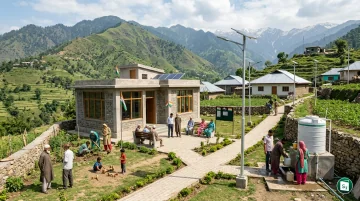
The central government has included 6 strategically located border villages in the Kathua district of Jammu and Kashmir (J&K) into the second phase of the Vibrant Villages Programme (VVP). The initiative aims to accelerate development and improve living conditions in remote frontier regions. The villages designated under the VVP-II include Bobiya, Kadyala, Gajnal, Karol Krishna, Rathua, and Gujjar Chak.
The RBI has cancelled the banking licence of Paytm Payments Bank Ltd (PPBL), effective April 24, 2026. The regulatory action was taken due to persistent non-compliance and material supervisory concerns within the bank.
The RBI has issued the final guidelines titled “RBI (Non-Banking Financial Companies (NBFC) – Registration, Exemptions and Framework for Scale Based Regulation) Amendment Directions, 2026”, applicable to NBFCs that do not use public funds and lack a customer interface.
Effective from July 2026, entities with an asset size under ₹1,000 crore will be classified as ‘Unregistered Type I NBFCs’ and will be exempt from registration with the RBI. All other NBFCs that do not meet this criteria will be categorized as ‘Type II NBFCs’.
Union Minister Piyush Goyal and Todd McClay have signed the India–New Zealand Free Trade Agreement (IN-NZ FTA) at Bharat Mandapam, New Delhi.
Under the IN-NZ FTA, India has secured 100% duty-free access on all 8,284 tariff lines to New Zealand. In return, India has liberalized 70.03% of its tariff lines, which covers 95% of the total bilateral trade value.
New Zealand has opened 118 service sectors with Most Favoured Nation (MFN) commitments across 139 sub-sectors. Furthermore, New Zealand has committed to an investment of $20 billion over a 15 year period in sectors like infrastructure, renewable energy, manufacturing, and startups.
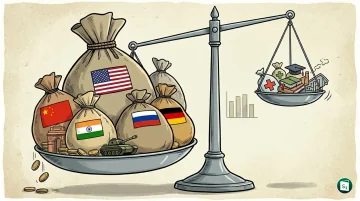
According to the Stockholm International Peace Research Institute (SIPRI) report titled “TRENDS IN WORLD MILITARY EXPENDITURE, 2025” (published as the “SIPRI Fact Sheet April 2026”), India is ranked 5th among the largest military spenders globally in 2025.
The defense expenditure of India reached $92.1 billion, which is an 8.9% increase compared to the preceding year. This expenditure accounts for 3.2% of the total global military spending.
The USA is ranked first with an expenditure of $954 billion, followed by China, Russia, and Germany.
The Asian Development Bank (ADB) has launched a $70 billion connectivity initiative to integrate power and digital networks across the Asia-Pacific region by 2035. The initiative includes a $50 billion programme named “Pan-Asia Power Grid Initiative” to transition from bilateral energy links to a regional power trade framework.
ADB will contribute $25 billion (50% of the funding). By 2035, the project aims to integrate 20 Gigawatts (GW) of renewable energy, construct 22,000 circuit-km of transmission lines, and reduce regional power sector emissions by 15%. It will improve electricity access for 200 million people by focusing on infrastructure.
The “Asia-Pacific Digital Highway” involves a $20 billion investment to bridge the digital divide and facilitate growth driven by AI. By 2035, it targets providing first-time broadband access to 200 million people and enhancing service quality for 450 million others.
The programme aims to reduce connectivity costs by 40% for remote areas. Additionally, a “Centre for AI Innovation and Development” will be established in Seoul, South Korea. The announcement was made during the 59th Annual Meeting of the bank in Samarkand, Uzbekistan.
Dr Neena Malhotra, Secretary (South) of the Ministry of External Affairs (MEA), has chaired the Brazil, Russia, India, China, South Africa (BRICS) Deputy Foreign Ministers and Special Envoys for the Middle East and North Africa (BRICS MENA) meeting in New Delhi.
The deliberations focused on the post-conflict reconstruction in Syria, achieving a political settlement in Yemen, and promoting stability and development in Iraq. The representatives also discussed the progress of the political process in Libya and the humanitarian crisis in Sudan. It is to be noted that the participating members have agreed to meet again in 2027 under the chairship of China.
Union Minister Ashwini Vaishnaw and Andhra Pradesh CM N Chandrababu Naidu laid the foundation stone for the Google Cloud India AI Hub in Tarluvada, Visakhapatnam. Valued at $15 billion (₹1.35 lakh crore), it is the largest single Foreign Direct Investment (FDI) project in India.
The facility will be managed by Raiden Infotech India Pvt Ltd (a subsidiary of Google) in collaboration with AdaniConneX (a Joint Venture (JV) between Adani Enterprises and EdgeConneX) and Nxtra by Airtel. The project will be completed over 5 years with a capacity of 1 gigawatt (GW), making it one of the largest AI focused data centers in India.
Sigma Advanced Systems Ltd (SIGD), an Indian aerospace and defence company, has signed a 7-year agreement with the United Kingdom (UK)-based Rolls-Royce for the manufacture and supply of high-precision, safety-critical components.
The contract is valued at ₹3,800 crore (nearly £300 million). The components will be utilized in the global aerospace programmes of Rolls-Royce.
Sahajanand Medical Technologies Ltd (SMT) has secured the International Organization for Standardization (ISO) 50001:2018 Energy Management System certification. It becomes the first domestic cardiovascular manufacturing unit in India to adopt a structured international energy management system.
The certification applies to the manufacturing facilities of the company located in Surat (Gujarat) and Hyderabad (Telangana). It is to be noted that ISO 50001 is an international framework that defines requirements for establishing, implementing, maintaining, and enhancing an Energy Management System (EnMS).
Pixxel has partnered with Sarvam to develop and operate the first orbital data centre satellite of India named “Pathfinder”. The 200 kg-class spacecraft is projected to be deployed in orbit by the fourth quarter (Q4) of 2026.
It is to be noted that Pixxel will handle the design, construction, and launch of the satellite, while Sarvam will integrate an AI framework to facilitate on-orbit training and inference through full-stack language models.
The Maharashtra Cabinet has approved the ‘AI Policy 2026’ to foster technological growth and infrastructure development in the state.
The policy aims to attract an investment of ₹10,000 crore and generate 1.5 lakh employment opportunities by 2031. The initiative focuses on the establishment of innovation centres and the implementation of skill training programs to support AI driven economic expansion.
The RBI has launched a nationwide mission-mode initiative named “Mission SAKSHAM” (Sahkari Bank Kshamta Nirman) for the Urban Co-operative Banking (UCB) sector. The mission focuses on the comprehensive capacity building of the sector to enhance overall performance. The core objectives of the initiative include strengthening managerial and operational efficiency to ensure that the UCB sector aligns with modern banking standards.
The SEBI has operationalized the “Past Risk and Return Verification Agency” (PaRRVA) framework, a global initiative to standardize performance disclosures and prevent misleading claims. CARE Ratings Ltd is the designated agency for the independent validation of performance claims, while the National Stock Exchange (NSE) will act as the PaRRVA Data Centre (PDC). The framework applies to Investment Advisers (IAs), Research Analysts (RAs), and Algorithmic Trading service providers.
These entities must enroll with the agency by August 3, 2026, to share certified performance data. From May 3, 2028, only PaRRVA verified metrics can be used in client communications, and the use of data from the pre-PaRRVA period will be banned. It is to be noted that the agency will compute 50 risk and return parameters using transaction-level data from exchanges and clearing corporations.