Himadri Speciality Chemical Limited has commissioned India’s first commercial anode material production facility at Mahistikry in West Bengal. This facility, with an initial capacity of 200 metric tonnes per annum, marks a significant milestone in the country’s quest for self-reliance in the lithium-ion battery supply chain. The move is expected to drastically reduce India’s dependence on imported battery components, particularly from China, while supporting the burgeoning domestic electric vehicle ecosystem.
Commissioning of the Mahistikry Facility
The new facility is located in Mahistikry, situated within the Hooghly district of West Bengal. Himadri Speciality Chemical Ltd (HSCL), which was established in 1987 and is headquartered in Kolkata, is already recognized as India’s largest producer of speciality carbon black. By commissioning this plant, the company has officially entered the lithium-ion battery value chain.
The plant has commenced operations with an initial installed capacity of 200 Metric Tonnes Per Annum (MTPA). This facility is the culmination of more than 14 years of intensive in-house research and development. It is strategically designed to produce high-quality synthetic graphite anode materials, which are essential components for batteries used in electric vehicles (EVs) and energy storage systems (ESS).
The Technology of Meso-coke and Synthetic Graphite
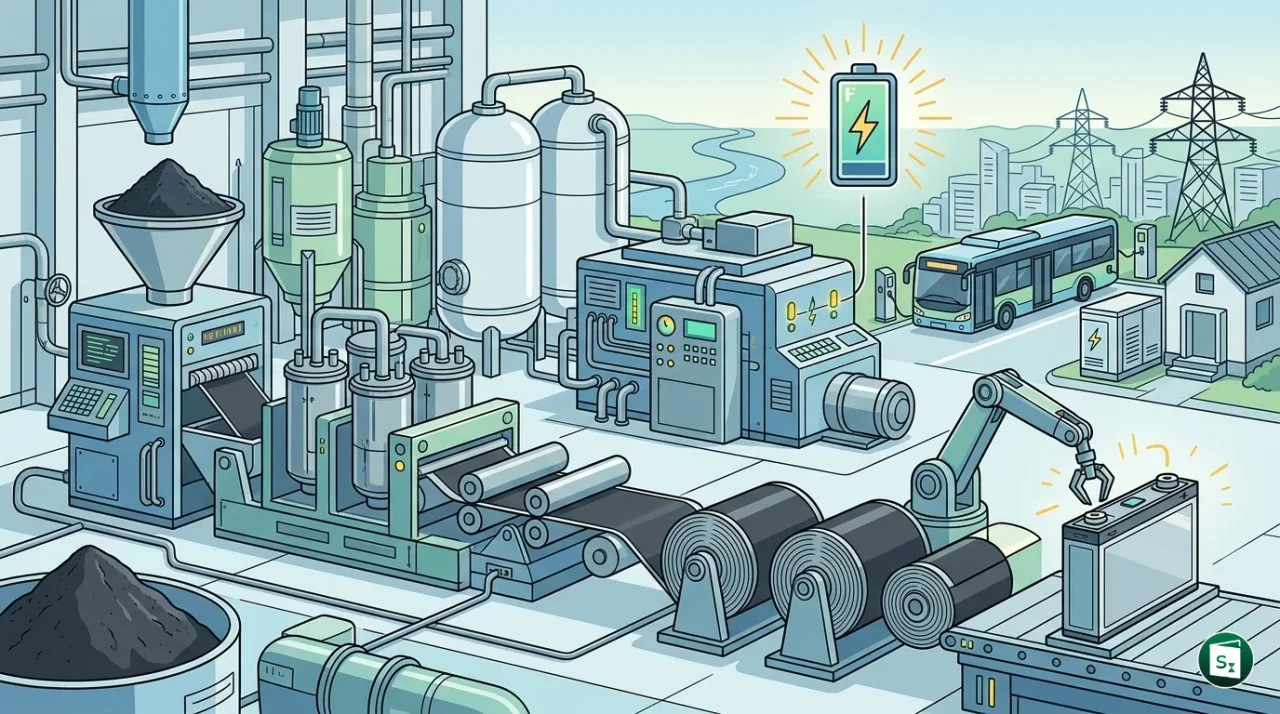
The production process at the Mahistikry facility leverages advanced Meso-coke technology. This method utilizes high-purity coal tar pitch to manufacture synthetic graphite anodes. An anode is the negative electrode in a battery cell, and in lithium-ion batteries, it typically serves as the host for lithium ions during charging.
One of the critical advantages of this facility is its backward integration. Since HSCL is a major player in coal tar distillation, it can source the required raw materials internally, ensuring a resilient and cost-effective supply chain. Synthetic graphite is often preferred over natural graphite for high-performance batteries due to its superior consistency, longer cycle life, and faster charging capabilities.
| Battery Component | Common Materials Used | Function |
|---|---|---|
| Anode | Synthetic Graphite, Natural Graphite | Stores lithium ions during charging |
| Cathode | LFP, NMC, NCA | Source of lithium ions; determines capacity |
| Electrolyte | Lithium salts in organic solvents | Facilitates ion movement between electrodes |
| Separator | Polymer membranes | Prevents physical contact between electrodes |
Strengthening the Domestic Energy Storage Supply Chain
India has set an ambitious target of reaching Net Zero emissions by 2070, and the transition to electric mobility is a cornerstone of this vision. Currently, India imports the vast majority of its lithium-ion cell components, with China being the dominant supplier. The commissioning of this facility is a strategic step toward reducing this import dependency and enhancing national energy security.
The development aligns with the Government of India’s National Mission on Transformative Mobility and Battery Storage. Furthermore, it complements the Production Linked Incentive (PLI) scheme for Advanced Chemistry Cell (ACC) battery storage, which has an outlay of ₹18,100 crore. By producing anodes locally, India can lower the overall cost of battery manufacturing, as anodes account for approximately 10 to 15 percent of the total cell cost.
Himadri’s Vision for the Lithium-ion Value Chain
The Mahistikry facility is just the beginning of HSCL’s broader strategy in the battery materials sector. The company has set a long-term goal of reaching a total annual production capacity of 200,000 metric tonnes for lithium-ion battery components. This expansion is designed to cater to both domestic and international markets, including the United States and Europe.
In addition to anode materials, Himadri is also diversifying into other critical components. The company is planning a Lithium Iron Phosphate (LFP) cathode active material plant, which is expected to be operational by the third quarter of FY27. Parallelly, the company has commissioned a 70,000-MTPA speciality carbon black line at the same location, making Mahistikry a global hub for speciality carbon products.
Key Takeaways
- Himadri Speciality Chemical Ltd commissioned India’s first anode material production facility at Mahistikry in the Hooghly district of West Bengal.
- The facility has an initial operational capacity of 200 Metric Tonnes Per Annum (MTPA).
- It utilizes Meso-coke technology and high-purity coal tar pitch for manufacturing synthetic graphite anodes.
- The project is the result of over 14 years of in-house research and development by the company.
- This development supports India’s National Mission on Transformative Mobility and Battery Storage and the PLI scheme for Advanced Chemistry Cell (ACC) batteries.
- HSCL aims to scale its total annual battery component capacity to 200,000 metric tonnes in the future.