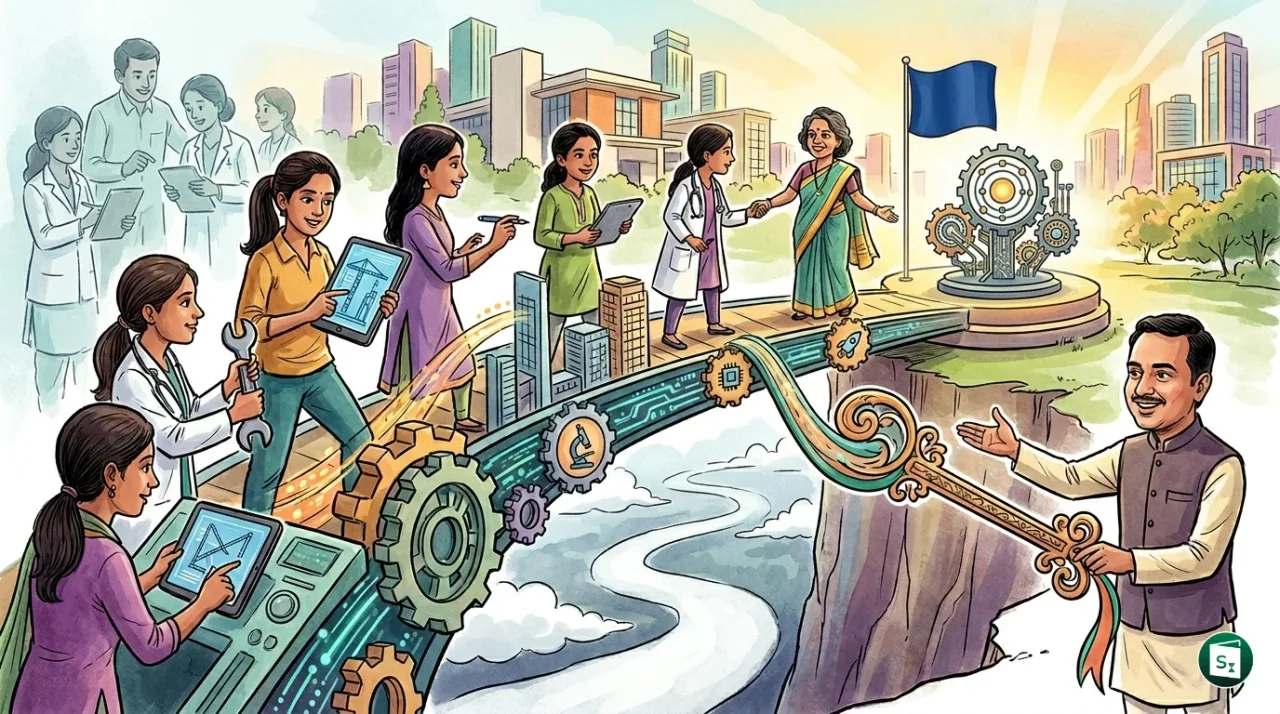
Union Minister of State (Independent Charge) Jayant Chaudhary inaugurated Asia’s first UNESCO Chair on Gender Inclusion and Skill Development at Symbiosis Skills and Professional University in Pune on May 4, 2026. This landmark initiative aims to bridge the gender gap in technical fields by equipping women from underserved communities with industry-relevant expertise in emerging sectors. The launch took place during a global conference focused on women’s leadership in the future of work, marking a significant step for India’s skilling ecosystem.
A Milestone for Gender Parity in Vocational Education
The establishment of the UNESCO Chair on Gender Inclusion and Skill Development at Symbiosis Skills and Professional University (SSPU) marks a historic first for the Asian continent. This designation is part of the UNITWIN/UNESCO Chairs Programme, which promotes international cooperation among higher education institutions to address global challenges. Dr. Swati Mujumdar, the Pro-Chancellor of SSPU and a leading expert in vocational education, has been appointed as the UNESCO Chairholder.
The primary mission of this Chair is to create an inclusive environment for women in technical and vocational education and training (TVET). By focusing on industry-aligned skills in sunrise sectors such as Artificial Intelligence (AI), robotics, and semiconductor technology, the initiative seeks to ensure that women are not left behind in the rapidly evolving global job market. This development aligns with UNESCO’s global priority of achieving gender equality through education and economic empowerment.
The Kushal Saathi Initiative and STEM Mentorship
Alongside the inauguration of the UNESCO Chair, the university introduced the Kushal Saathi initiative. This program is designed to provide structured and long-term mentorship for girls pursuing careers in Science, Technology, Engineering, and Mathematics (STEM). Despite India having one of the highest percentages of female STEM graduates globally, at approximately 42.6%, their representation in the workforce remains significantly lower at roughly 14%.
The Kushal Saathi initiative addresses this ‘leaky pipeline’ by offering career guidance, industry connections, and skill enhancement. It focuses on empowering girls to transition from academic settings to high-growth industries. By providing a support system that spans from education to employment, the program aims to increase the number of women in leadership roles within technical sectors, fostering a more balanced and diverse workforce.
Symbiosis Skills and Professional University: A Pioneer in Skilling
Symbiosis Skills and Professional University (SSPU), located in Pune, Maharashtra, holds the distinction of being India’s first skill development university. It was enacted through a bill passed by the Maharashtra State Legislature in May 2017 with the vision of creating an industry-ready workforce. The university was established under the guidance of Dr. S.B. Mujumdar, the founder of the Symbiosis group, to further the Skill India mission.
SSPU follows a unique pedagogy that emphasizes practical training, with approximately 70% practical learning and 30% theory. The campus in Kiwale is equipped with specialized laboratories and centers of excellence developed in collaboration with leading industries. This hands-on approach is designed to bridge the gap between traditional education and the specific requirements of modern employers, particularly in engineering, manufacturing, and data science.
UNESCO’s Global Footprint and Institutional Context
The United Nations Educational, Scientific and Cultural Organization (UNESCO) is a specialized agency of the United Nations established in 1945. Headquartered in Paris, France, its mission is to promote international peace and security through collaborative efforts in education, science, and culture. The current Director-General of UNESCO is Audrey Azoulay.
The UNITWIN/UNESCO Chairs Programme, launched in 1992, serves as a ‘laboratory of ideas’ and a bridge between academia, civil society, and policy-makers. By establishing the first Chair on Gender Inclusion and Skill Development in Asia, UNESCO is strengthening its commitment to the Sustainable Development Goals (SDGs), particularly SDG 4 (Quality Education), SDG 5 (Gender Equality), and SDG 8 (Decent Work and Economic Growth). This global network now includes over 900 institutions in 120 countries, all working towards shared knowledge and institutional capacity building.
Key Takeaways
- Union Minister Jayant Chaudhary inaugurated Asia’s first UNESCO Chair on Gender Inclusion and Skill Development in Pune on May 4, 2026.
- The Chair is established at Symbiosis Skills and Professional University (SSPU), which is India’s first skill development university, founded in 2017.
- Dr. Swati Mujumdar, the Pro-Chancellor of SSPU, has been named the official UNESCO Chairholder.
- The Kushal Saathi initiative was launched to provide structured mentorship for girls in STEM disciplines and bridge the gap between education and employment.
- The UNITWIN/UNESCO Chairs Programme, established in 1992, now encompasses over 900 institutions worldwide to promote inter-university networking.
- UNESCO was established in 1945 and is headquartered in Paris, France, with Audrey Azoulay serving as its Director-General.