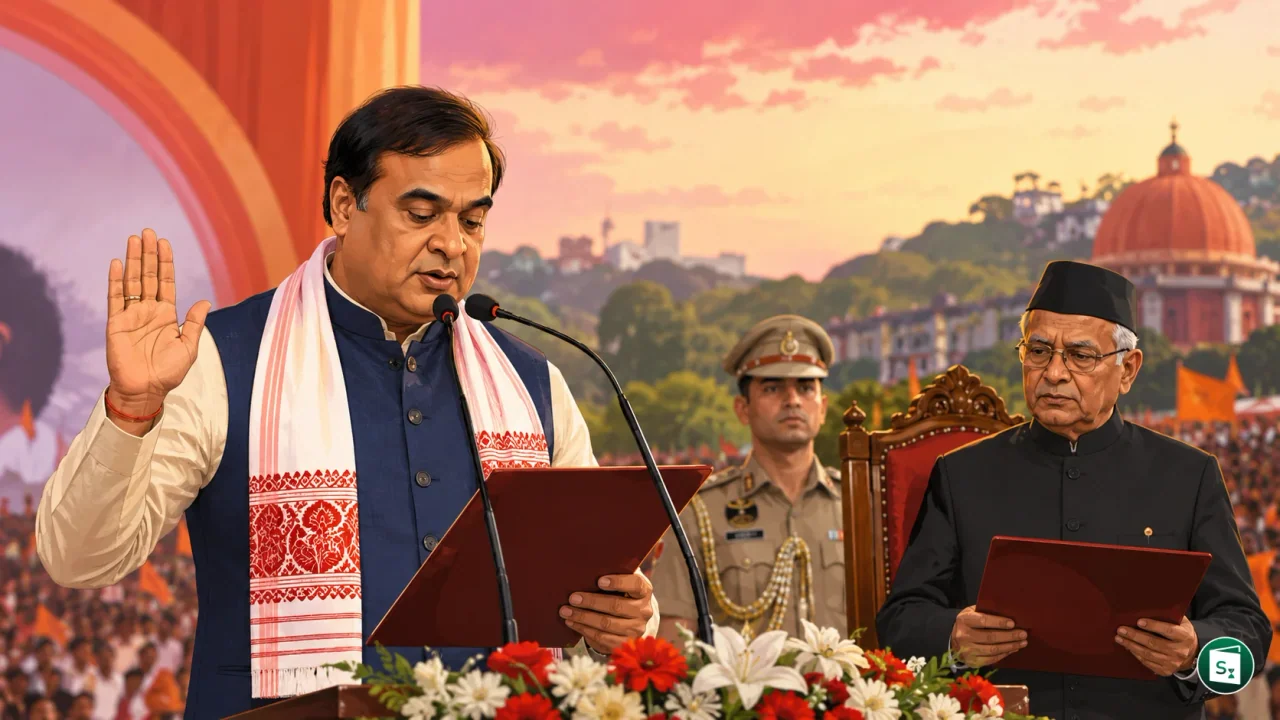
Himanta Biswa Sarma was sworn in as the Chief Minister of Assam for a second consecutive term on May 12, 2026, following the decisive victory of the BJP-led alliance in the state assembly elections. The oath of office was administered by Governor Lakshman Prasad Acharya at a ceremony held at the Veterinary College Field in Khanapara, Guwahati. This victory marks a historic milestone as Sarma becomes the first non-Congress leader in Assam to serve two successive terms as Chief Minister.
Second Consecutive Term for Himanta Biswa Sarma
The Bharatiya Janata Party (BJP) and its allies in the National Democratic Alliance (NDA) secured a landslide victory in the 2026 Assam Assembly elections, winning 102 out of 126 seats. This strong mandate allowed Himanta Biswa Sarma to retain his position as the head of the state government. The alliance, which includes the Asom Gana Parishad (AGP) and the United People’s Party Liberal (UPPL), focused its campaign on infrastructure development, administrative transparency, and regional security.
This appointment is historically significant as Sarma is the first leader from a non-Congress background to serve two consecutive terms as the Chief Minister of Assam. Previously, the state’s political landscape was dominated by the Congress party, which saw leaders like Tarun Gogoi serve multiple terms. Sarma’s continuation in office signals a consolidation of the BJP’s influence in the North-East, where he also serves as the convenor of the North-East Democratic Alliance (NEDA), a coalition of non-Congress parties in the region.
Record-Breaking Victory in Jalukbari Constituency
Himanta Biswa Sarma’s return to power is anchored by his remarkable performance in the Jalukbari constituency, where he was elected for the sixth consecutive time. Since his first victory in 2001, Sarma has maintained an undefeated streak in this constituency, consistently winning with high margins. His long-standing connection with the local electorate and focus on grassroots development have made Jalukbari a political stronghold.
Over the years, the Jalukbari constituency has witnessed significant transformations in terms of urban infrastructure, educational institutions, and healthcare facilities. Sarma’s transition from a prominent minister in the state cabinet to the Chief Minister has further strengthened his influence. His ability to secure a sixth term underscores his personal popularity and the effectiveness of his constituency-level governance model, which many political observers cite as a benchmark for regional leaders.
Constitutional Process and the Oath of Office
The appointment of the Chief Minister is governed by Article 164 of the Constitution of India, which mandates that the Governor shall appoint the Chief Minister, and other ministers shall be appointed by the Governor on the advice of the Chief Minister. Following the victory of the NDA, Governor Lakshman Prasad Acharya formally invited Himanta Biswa Sarma to form the government. The Governor administered the oath of office and secrecy at a high-profile ceremony attended by top national leaders, including Prime Minister Narendra Modi, Union Home Minister Amit Shah, and Defence Minister Rajnath Singh.
The ceremony at the Veterinary College Field in Khanapara also saw the presence of Chief Ministers from several other states and international delegates. A notable highlight of the event was the participation of 15 Satradhikars from Assam’s traditional Vaishnavite monasteries, reflecting the cultural and spiritual heritage of the state. This blend of constitutional formality and cultural tradition emphasized the government’s commitment to both modern governance and the preservation of Assam’s unique identity.
Strategic Importance and Future Priorities for Assam
Assam serves as the gateway to Northeast India and plays a central role in the Union Government’s Act East Policy, which aims to strengthen economic and strategic ties with Southeast Asian nations. Under the second term of Himanta Biswa Sarma, the state government is expected to prioritize large-scale infrastructure projects, including the completion of the Kaziranga Elevated Corridor and the expansion of the national highway network. The administration has also signaled its intent to continue the modernization of healthcare services by establishing more medical colleges and specialized cancer care centers across the state.
Another key focus area for the new government will be the finalization of administrative reforms and the resolution of long-standing border disputes with neighboring states. Sarma has been instrumental in navigating complex peace negotiations with various insurgent groups, and his second term is likely to see further efforts toward permanent peace and stability in the region. By leveraging the double-engine growth model, referring to the synergy between the state and central governments, Assam aims to transform into a major industrial and logistics hub for the entire North-East.
Key Takeaways
- Himanta Biswa Sarma was sworn in as the Chief Minister of Assam for a second consecutive term on May 12, 2026.
- The BJP-led National Democratic Alliance (NDA) secured a landslide victory by winning 102 out of 126 seats in the Assam Legislative Assembly.
- Sarma has been elected from the Jalukbari constituency for the sixth consecutive time since 2001.
- He is the first non-Congress leader in Assam to serve two successive terms as the Chief Minister.
- Governor Lakshman Prasad Acharya administered the oath of office at the Veterinary College Field in Khanapara, Guwahati.
- Under Article 164 of the Constitution, the Chief Minister is appointed by the Governor, who also appoints other ministers on the CM’s advice.