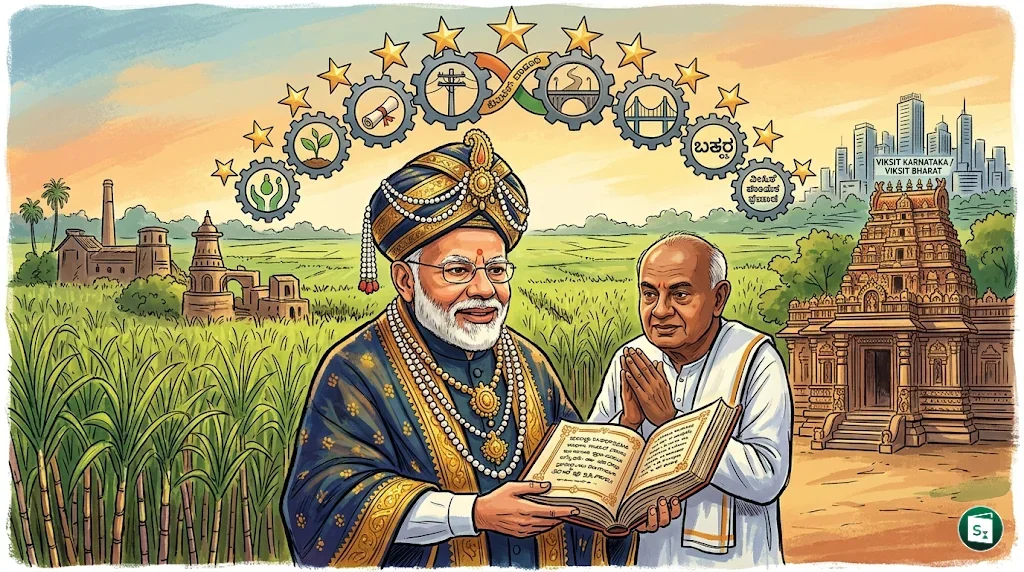
Prime Minister Narendra Modi recently inaugurated the Sri Guru Bhairavaikya Mandira at Sri Kshetra Adichunchanagiri in the Mandya district of Karnataka. The visit highlights the intersection of spiritual heritage and national progress, as the Prime Minister unveiled a nine-point development agenda to realize the vision of Viksit Bharat by 2047. Accompanied by former Prime Minister H.D. Deve Gowda, the event also featured significant cultural tributes and literary releases rooted in the Natha Parampara.
Honouring the Legacy: The Sri Guru Bhairavaikya Mandira
The Sri Guru Bhairavaikya Mandira is a newly constructed memorial dedicated to the memory of Sri Sri Sri Dr. Balagangadharanatha Mahaswamiji, the 71st pontiff of the Adichunchanagiri Mahasamsthana Math. The seer, who headed the Mutt from 1974 to 2013, is celebrated for his immense contribution to education, healthcare, and social service through the pillars of Anna (food), Akshara (education), and Arogya (health). Under his leadership, the Mutt established over 500 institutions, earning him the Padma Bhushan posthumously in 2013.
The Mandira itself is an architectural marvel built in the traditional Dravidian style, featuring elements from the Hoysala, Chola, and Chalukya dynasties. It serves as a central spiritual hub for the Natha Parampara, an ancient tradition of Shaivism associated with yoga and spiritual discipline. The Prime Minister’s visit included prayers at the Sri Kalabhairava Temple and the Jwala Peetha, reflecting the deep historical roots of the region which date back over 1,500 years.
A Cultural Tribute: The Mysuru Peta and Sacred Publications
During the ceremony, the Prime Minister was honoured with a Mysuru Peta, a traditional headgear that serves as a symbol of the rich heritage of the Kingdom of Mysore. This specific Peta was crafted using a blend of Mysuru and Benaras silk and adorned with intricate pearls and pendants. Historically, it was the preferred headgear of the visionary King of Mysuru, Nalwadi Krishnaraja Wadiyar, who is remembered for his administrative reforms and contribution to the industrialization of Karnataka.
In a rare collaborative gesture, PM Modi and former Prime Minister H.D. Deve Gowda released a significant spiritual publication titled ‘Saundarya Lahari and Shiva Mahimna Stotram’. These sacred Sanskrit hymns have been re-interpreted through the lens of the Natha yogis, providing devotees with a deeper understanding of the philosophical underpinnings of the tradition. The joint release by two Prime Ministers underscores the national significance attached to the preservation of India’s classical literary and spiritual archives.
Empowering the Nation: The Nine-Point Development Agenda
The Prime Minister introduced a nine-point, citizen-driven development agenda designed to accelerate progress towards Viksit Karnataka and the broader goal of Viksit Bharat by 2047. This framework shifts the focus from government-led initiatives to people-led movements, emphasizing that individual actions and behavioural changes are key to national transformation.
| Pledge | Objective |
|---|---|
| Water Conservation | Prioritizing efficient management and saving of water resources. |
| Tree Plantation | Participating in the Ek Ped Maa Ke Naam campaign to increase green cover. |
| Cleanliness | Mantaining hygiene in public and religious spaces through collective effort. |
| Vocal for Local | Strengthening the economy by supporting indigenous and locally-made products. |
| Domestic Tourism | Exploring and promoting tourist destinations within India to boost the local economy. |
| Natural Farming | Adopting sustainable, chemical-free agricultural practices for long-term soil health. |
| Healthy Living | Increasing millet consumption and reducing oil intake to combat health challenges. |
| Fitness and Yoga | Integrating yoga and sports into daily lifestyle for a healthier nation. |
| Social Service | Engaging in community service to help the underprivileged and strengthen society. |
This agenda serves as a roadmap for every citizen to contribute to the nation’s journey toward becoming a developed economy. The Prime Minister stressed that these nine resolutions are not just goals but a way of life that will define India’s future.
Mandya: The Heart of Karnataka’s Sugar Industry and Development
Often referred to as the “Sugar City” of Karnataka, Mandya is the center of the state’s vibrant sugarcane belt. The district’s agricultural prosperity is largely attributed to the Visvesvaraya Canal, which draws water from the Krishna Raja Sagara (KRS) dam. This infrastructure transformed the once-arid region into a lush agricultural hub, supporting numerous sugar factories, including the historic Mysugar industrial unit.
Mandya’s role in the primary sector makes it a critical component of the Viksit Karnataka initiative. By focusing on natural farming and water conservation as part of the new nine-point agenda, the region is poised to transition from traditional intensive agriculture to more sustainable and high-value practices. The Prime Minister’s choice of Mandya for this announcement highlights the district’s strategic importance in India’s agricultural and industrial narrative.
Key Takeaways
- Prime Minister Narendra Modi inaugurated the Sri Guru Bhairavaikya Mandira at Sri Kshetra Adichunchanagiri in Mandya, Karnataka.
- The Mandira is a memorial dedicated to Sri Sri Sri Dr. Balagangadharanatha Mahaswamiji, the 71st pontiff of the Adichunchanagiri Math.
- A nine-point, citizen-driven development agenda was unveiled to promote sustainable growth and lifestyle changes for Viksit Bharat.
- The Prime Minister was honoured with a Mysuru Peta, traditionally worn by the former King of Mysuru, Nalwadi Krishnaraja Wadiyar.
- The publication ‘Saundarya Lahari and Shiva Mahimna Stotram’ was jointly released by PM Modi and former PM H.D. Deve Gowda.
- Mandya is known as the “Sugar City” of Karnataka because of its high concentration of sugarcane cultivation and processing units.