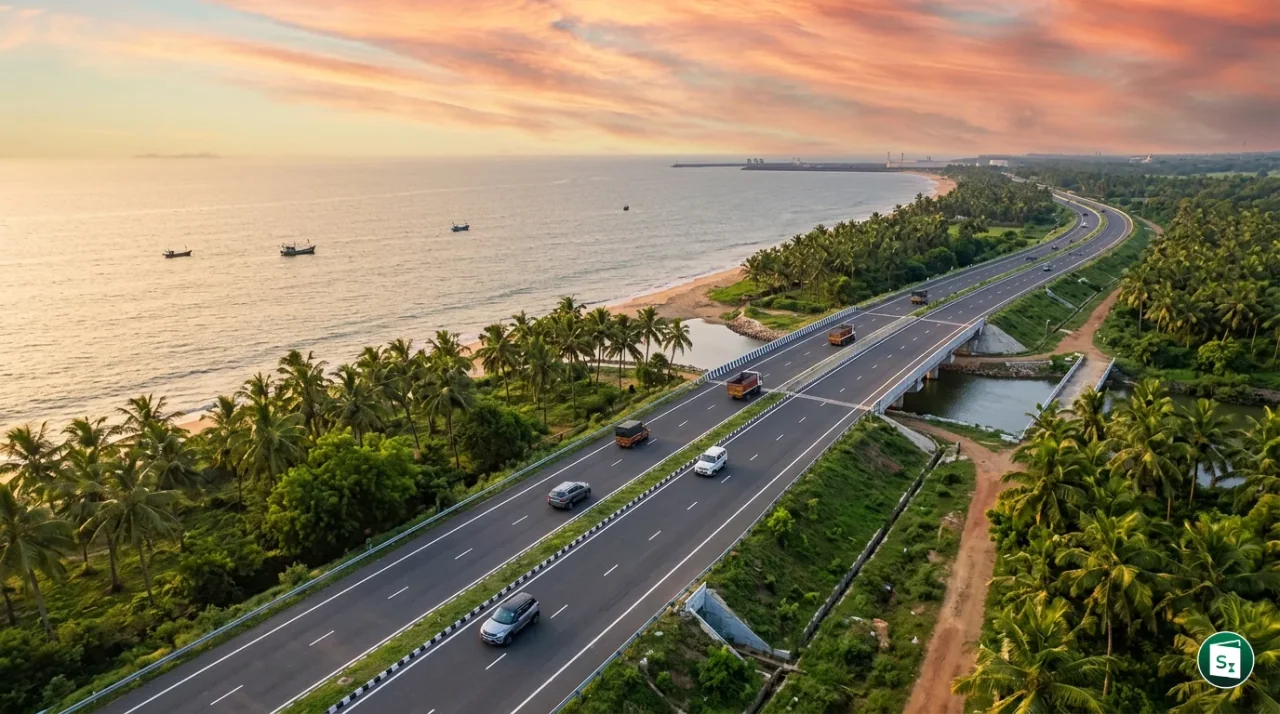
The Cabinet Committee on Economic Affairs approved major road infrastructure initiatives on June 3, 2026, covering the four-laning of key national highways in Telangana and a new coastal highway project in Odisha. With a total length of 350.94 kilometres and a combined investment of ₹15,897.95 crore, these projects are aimed at decongesting key corridors and boosting local trade. These approvals form a crucial part of India’s strategic push to enhance regional connectivity and economic integration under the PM GatiShakti National Master Plan.
Upgrading Telangana’s Highway Network: NH-63 and NH-563
The CCEA approved the four-laning of two crucial highway sections in Telangana with a combined length of 190.76 kilometres at a capital cost of ₹7,597.16 crore. These sections pass through major districts including Nizamabad, Jagtial, Mancherial, and Karimnagar, which are key industrial and agricultural hubs in northern Telangana. The upgraded roads will support design speeds of 100 kilometres per hour, significantly reducing transit times and improving passenger safety.
The expansion will be executed using two distinct public-private partnership models:
- The Armoor-Jagtial-Mancherial section of NH-63 will be widened under the Hybrid Annuity Model (HAM). This model reduces financial risk for private developers as the government provides 40% of the project cost during construction, while the developer funds the remaining 60% and receives regular annuity payments over time.
- The Jagtial-Karimnagar section of NH-563 will be developed under the Build-Operate-Transfer (BOT-Toll) model. Under this mechanism, the private concessionaire finances, builds, and maintains the stretch, recovering the initial capital investment by collecting tolls from road users over a designated concession period.
This dual-model approach allows the government to leverage private sector efficiencies while matching the funding method to the expected traffic volume and revenue potential of each corridor.
The Odisha Coastal Highway: Connecting Rameshwar and Paradeep
The CCEA approved the construction of a brand-new coastal highway in Odisha, spanning 160.18 kilometres with an estimated project cost of ₹8,300.79 crore. To be executed entirely under the Hybrid Annuity Model (HAM), the project aims to develop all-weather coastal connectivity to boost maritime trade, tourism, and regional industrial growth. The corridor will be divided into two distinct development packages:
- Package 1 involves building a 79.4-kilometre four-lane access-controlled highway between Rameshwar in Khurda district and the heritage town of Konark in Puri district.
- Package 2 comprises constructing an 80.78-kilometre two-lane highway featuring paved shoulders between Konark and the port city of Paradeep in Jagatsinghpur district.
Spanning four districts—Khurda, Puri, Kendrapada, and Jagatsinghpur—this greenfield highway is designed to sustain vehicular speeds of up to 100 kilometres per hour. Once completed, it will reduce travel times between Rameshwar and Paradeep by approximately 2.5 hours. It will also help decongest the existing, highly congested NH-316 corridor, which connects Bhubaneswar, Puri, Satapada, and Konark.
Additionally, this project connects nine economic nodes (such as Special Economic Zones, IT hubs, and industrial zones) and five logistics nodes (including major fishing harbours and maritime ports) under the PM GatiShakti National Master Plan. This integration will provide seamless transport links for seafood exporters, manufacturing units, and tourism operators in the region.
Administrative and Financial Overview of the Projects
These road initiatives represent a significant allocation of capital from the central government to modernize regional logistics networks. The implementing agency for these national projects is the National Highways Authority of India (NHAI). Established as an autonomous body under the National Highways Authority of India Act, 1988, the agency operates under the Ministry of Road Transport and Highways and is headquartered in New Delhi.
The Cabinet Committee on Economic Affairs (CCEA), chaired by the Prime Minister of India, serves as the apex decision-making body for economic policies and infrastructure investment approvals.
The breakdown of the newly sanctioned highway projects is summarized below:
| Project Corridor | State | Length (km) | Estimated Capital Cost | Execution Model | Key Districts Benefited |
|---|---|---|---|---|---|
| Armoor–Jagtial–Mancherial (NH-63) | Telangana | 131.90 | ₹7,597.16 crore (Combined) | Hybrid Annuity Model (HAM) | Nizamabad, Jagtial, Mancherial |
| Jagtial–Karimnagar (NH-563) | Telangana | 58.87 | Included in NH-63 Combined Cost | Build-Operate-Transfer (BOT-Toll) | Jagtial, Karimnagar |
| Rameshwar–Paradeep Coastal Highway | Odisha | 160.18 | ₹8,300.79 crore | Hybrid Annuity Model (HAM) | Khurda, Puri, Kendrapada, Jagatsinghpur |
This combined push of 350.94 kilometres of highway development represents a key step in resolving regional logistical bottlenecks, linking agricultural, tourist, and port nodes to national trade corridors.
Key Takeaways
- The Cabinet Committee on Economic Affairs (CCEA), chaired by the Prime Minister of India, approved major national highway developments in Telangana and Odisha.
- The approved projects encompass a total length of 350.94 kilometres with a combined capital outlay of ₹15,897.95 crore.
- In Telangana, the CCEA approved the four-laning of the Armoor–Jagtial–Mancherial section of NH-63 under the Hybrid Annuity Model (HAM).
- The Jagtial–Karimnagar section of NH-563 will be developed under the Build-Operate-Transfer (BOT-Toll) model.
- In Odisha, a new coastal highway between Rameshwar and Paradeep spanning 160.18 kilometres was sanctioned under the Hybrid Annuity Model (HAM).
- The National Highways Authority of India (NHAI), established under the NHAI Act, 1988, is the implementing agency for these highway developments.