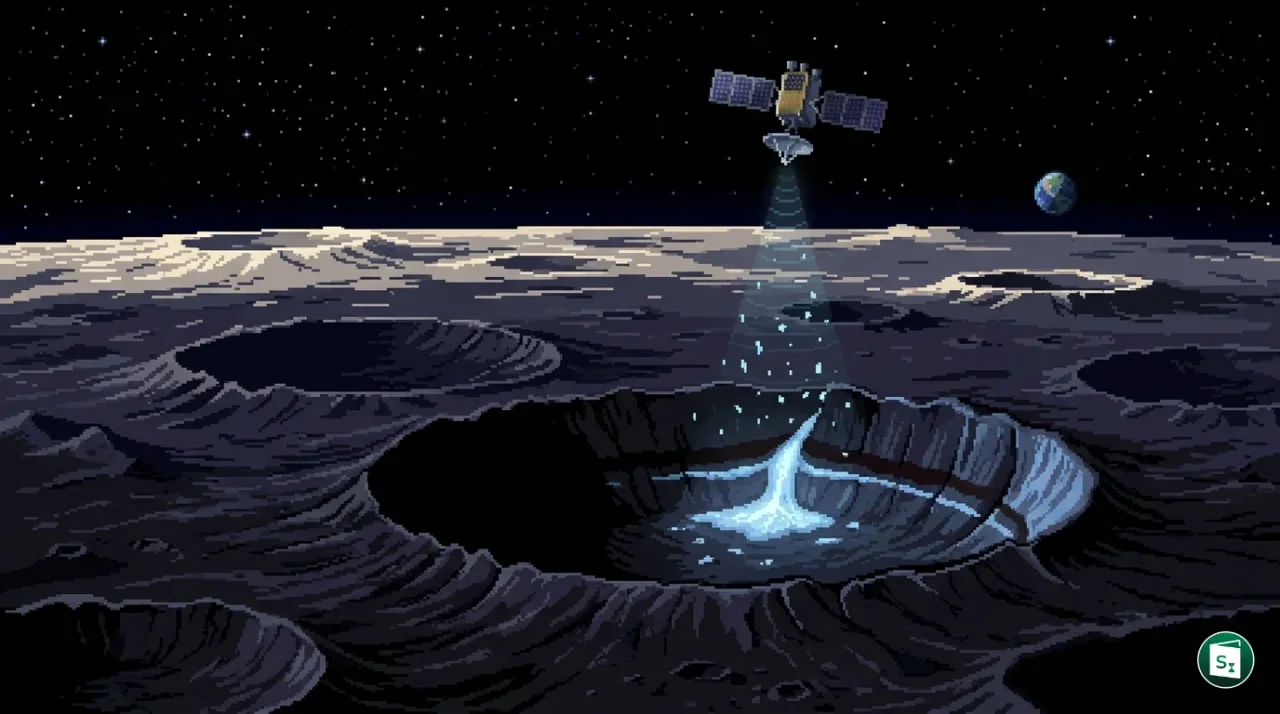
Researchers from the Physical Research Laboratory (PRL) in Ahmedabad have discovered compelling evidence of subsurface water ice within the permanently shadowed regions of the lunar south pole. Utilizing radar data from India’s Chandrayaan-2 orbiter, the study published in the journal npj Space Exploration identified significant ice deposits inside doubly shadowed craters. This breakthrough enhances the understanding of lunar volatiles and provides vital resources for future space exploration missions.
Discovery of Subsurface Ice at the Lunar South Pole
The discovery is based on observations from the Chandrayaan-2 spacecraft, which has been orbiting the Moon since September 2019. The research was conducted by scientists at the Physical Research Laboratory (PRL) in Ahmedabad, a premier research institution founded in 1947 by the father of the Indian space programme, Dr. Vikram Sarabhai. PRL operates as an autonomous unit under the administrative control of the Department of Space, Government of India.
The lunar south pole has attracted global scientific interest because of its unique geometry. Due to the very low axial tilt of the Moon, which is only 1.54 degrees, the sun always remains near the horizon at the poles. Consequently, deep depressions and craters near the poles never receive direct sunlight, forming Permanently Shadowed Regions (PSRs). These regions act as cold traps where temperatures plunge below 25 Kelvin (approximately minus 248 degrees Celsius), allowing water ice and other volatile elements to remain preserved for billions of years without evaporating.
Analyzing Doubly Shadowed Craters
To search for ice in these challenging environments, researchers targeted doubly shadowed craters. These are smaller geological depressions situated entirely within larger permanently shadowed regions. Unlike standard shadowed zones, doubly shadowed craters are shielded not only from direct solar radiation but also from the secondary sunlight reflected off nearby terrain. This absolute shielding creates an exceptionally stable thermal environment where ice can exist right at or just beneath the loose lunar soil, known as regolith.
Refined Polarimetric Criteria for Ice Detection
Radar instruments detect materials by transmitting radio waves and analyzing the polarization of the reflected signals. However, distinguishing between ice deposits and rough rocky surfaces has historically been a significant challenge for scientists. Rocky slopes can scatter radar waves in ways that mimic the signature of ice.
To solve this, the PRL scientific team developed a refined polarimetric criterion. They combined two distinct radar measurements:
- Circular Polarization Ratio (CPR): A ratio of the power received in the same circular polarization as transmitted to that in the opposite polarization. The team established that a CPR greater than 1 indicates either rocky terrain or high ice content.
- Degree of Polarization (DOP): A measure of how ordered the returned radar wave is. The researchers found that a DOP lower than 0.13 combined with high CPR is a signature of volumetric scattering, which is unique to subsurface ice rather than surface rocks.
By applying this combined metric, researchers successfully identified subsurface ice in four out of nine doubly shadowed craters investigated.
The Case of the Faustini Basin Crater
The most compelling evidence of subsurface ice was discovered inside a small, 1.1 km-wide crater situated in the larger Faustini Basin at the lunar south pole. The radar scans revealed that this specific crater possesses a distinctive lobate-rim morphology.
In planetary geology, a lobate-rim describes a flow-like pattern of ejecta surrounding the crater edge. This physical feature suggests that when a meteoroid impacted the area, the energy of the impact penetrated a highly ice-rich subsurface layer. The intense heat briefly melted the subsurface ice, causing the mixture of mud and debris to flow outward like liquid before rapidly refreezing in the vacuum of space. This represents the first geological evidence of fluid-like flow dynamics during a lunar impact event.
Technical Details of DFSAR Instrument
The critical tool that made this discovery possible is the Dual-Frequency Synthetic Aperture Radar (DFSAR) onboard the Chandrayaan-2 orbiter. DFSAR is a state-of-the-art instrument designed to map the lunar surface and estimate the physical properties of the lunar soil. It is the first fully polarimetric synthetic aperture radar operating at the Moon.
DFSAR utilizes two microwave bands:
- L-band: Operating at a frequency of 1.25 Gigahertz (wavelength of approximately 24 centimetres), the L-band is capable of penetrating several metres deep into the lunar regolith.
- S-band: Operating at a frequency of 2.5 Gigahertz (wavelength of approximately 12 centimetres), the S-band provides high-resolution data on the near-surface layers, probing up to a few tens of centimetres.
By transmitting radio pulses and measuring how the signal’s polarization state changes upon reflection, DFSAR provides detailed images of shadowed areas that are completely invisible to optical cameras. The instrument offers a high spatial resolution of up to 2 metres, allowing scientists to study very small geological features, such as the 1.1 km crater inside the Faustini Basin.
The Geopolitics and Strategy of Lunar Water
Water is one of the most precious resources for the future of space exploration. Transporting heavy payloads, especially water, from Earth’s strong gravity well is exceptionally expensive. Finding accessible water deposits directly on the Moon enables In-Situ Resource Utilization (ISRU), which refers to the practice of collecting, processing, and using materials found on other celestial bodies to support space missions.
Harvesting lunar water ice serves several critical purposes:
- Life Support: The ice can be purified into drinking water and processed to extract oxygen, supporting long-term human habitats on the Moon.
- Rocket Propellant: Water can be split into hydrogen and oxygen through electrolysis. These elements are the primary components of liquid rocket fuel. A lunar refueling station could reduce the launch mass of deep space missions, making travel to Mars and beyond far more feasible.
- Scientific Records: Because this ice has remained frozen and undisturbed for billions of years, it preserves a chemical record of the early solar system, including the history of water delivery to the Earth-Moon system by comets and asteroids.
This discovery strengthens the strategic positioning of the Indian Space Research Organisation (ISRO) in the global race for lunar exploration. India’s future lunar roadmap includes Chandrayaan-4, a planned lunar sample return mission, and the Lunar Polar Exploration (LUPEX) mission, a joint venture with the Japan Aerospace Exploration Agency (JAXA) aimed at directly exploring the Moon’s polar regions for water.
Key Takeaways
- The Physical Research Laboratory (PRL), founded in 1947 by Dr. Vikram Sarabhai in Ahmedabad, led the study detecting subsurface lunar water ice.
- The research analyzed data from the Dual-Frequency Synthetic Aperture Radar (DFSAR) onboard India’s Chandrayaan-2 orbiter, which has been operational since September 2019.
- The discovery focused on doubly shadowed craters within the permanently shadowed regions at the lunar south pole, where temperatures drop below 25 Kelvin.
- The detection criteria used to confirm subsurface ice required a Circular Polarization Ratio (CPR) greater than 1 combined with a Degree of Polarization (DOP) of less than 0.13.
- The study identified a 1.1 km-wide crater in the Faustini Basin featuring a lobate-rim morphology, indicating a past impact into an ice-rich subsurface that briefly flowed before refreezing.
- Lunar water ice is critical for In-Situ Resource Utilization (ISRU), which allows space missions to produce life support oxygen, drinking water, and rocket fuel on site.