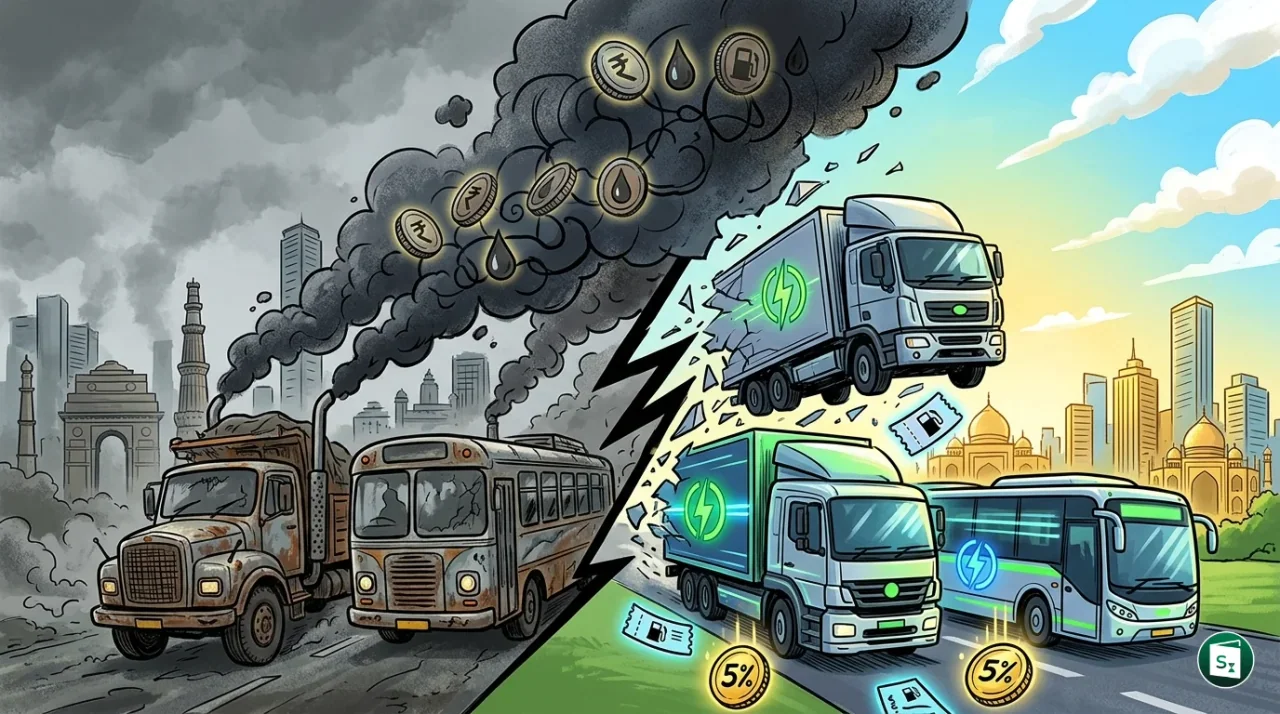
The Union Cabinet approved the Clean Mobility Scheme on June 3, 2026, with a financial outlay of ₹9,585 crore to replace old commercial trucks and buses across the Delhi-National Capital Region. This two-year initiative aims to accelerate the transition to cleaner fuels, targeting a substantial reduction in vehicular emissions and toxic winter smog. By modernizing transport fleets in the capital and surrounding states, the government hopes to establish a sustainable model for regional environmental planning.
What is the Clean Mobility Scheme?
The Clean Mobility Scheme is a targeted environmental and transport intervention designed to phase out highly polluting, aged commercial vehicles from the roads of the National Capital Region. Spanning a implementation period of two years, the program aims to systematically upgrade the region’s transport fleet by replacing vehicles that conform to Bharat Stage-IV (BS-IV) or older emission standards with modern, eco-friendly alternatives. The scheme focuses primarily on the heavy transport segment, which has historically been one of the largest contributors to particulate matter pollution in the winter months.
Under this scheme, the government has set a target to modernize 2.07 lakh older commercial vehicles. This target includes approximately 1.91 lakh commercial trucks and 16,329 public and private buses registered across the national capital and surrounding districts. By facilitating this transition, the policy intends to achieve a double objective of promoting green transport technology and mitigating the severe public health challenges associated with low air quality.
Implementing Agencies and Financial Architecture
The execution of the scheme relies on a collaborative federal structure that coordinates central ministries with state administrations. Funding for the initiative is channeled through the National Capital Region Planning Board (NCRPB), a statutory body established in 1985 under the National Capital Region Planning Board Act, 1985. The board operates under the administrative control of the Ministry of Housing and Urban Affairs (MoHUA). The physical implementation of the modernization guidelines is jointly managed by the Ministry of Road Transport and Highways (MoRTH), which oversees vehicle compliance and scrappage, and the Ministry of Petroleum and Natural Gas (MoPNG), which handles fuel voucher distribution.
The total financial outlay of ₹9,585 crore is distributed between direct central budgetary support, state tax concessions, and contributions from other stakeholders. The table below outlines the specific financial commitments:
| Funding Component | Contributing Entity | Financial Amount |
|---|---|---|
| Central Government Share | National Capital Region Planning Board (MoHUA) | ₹5,041 crore |
| State Tax Concessions | Delhi, Haryana, Rajasthan, and Uttar Pradesh | ₹1,601 crore |
| Supporting Subsidies & Benefits | Automobile Manufacturers, Oil Marketing Companies, and Stakeholders | ₹2,943 crore |
The four participating states are required to coordinate their transport departments to implement uniform concessions and ensure that transport operators can seamlessly access the central subsidies. This multi-ministerial approach ensures that infrastructure, regulation, and financial support are aligned.
Key Incentives and Subsidies for Vehicle Modernization
To lower the entry barrier for fleet operators and individual truck owners, the government has designed a package of financial incentives. The central pillar of this support is a 5% interest subvention on commercial vehicle loans. This subsidy will be valid for a period of five years, significantly reducing the cost of financing new cleaner vehicles. Additionally, state-owned Oil Marketing Companies (OMCs) will distribute monthly fuel vouchers worth up to ₹4,800 per vehicle to offset the higher operational expenses associated with modern compliance.
Automobile manufacturers have also agreed to support the scheme by providing a mandatory 8% discount on the ex-showroom prices of new commercial vehicles purchased under this program. Furthermore, participating states will provide waivers on registration fees and offer motor vehicle tax concessions of up to 100% for ten years on new green vehicles and 50% for ten years on used compliant vehicles. To clear administrative hurdles, any pending traffic liabilities or tax dues on the older replaced vehicles will be waived when owner operators enter the modernization cycle.
Environmental Mandates and Scrappage Rules in Delhi-NCR
The implementation of the program follows distinct rules depending on the age and emission standard of the vehicle. Under the guidelines, all BS-III and older vehicles must be scrapped at authorized Registered Vehicle Scrapping Facilities. The owner will receive a Certificate of Deposit, which can be traded or used to claim additional benefits when purchasing a new vehicle. For slightly newer BS-IV vehicles, owners have the option to either scrap them or sell them outside the Delhi-NCR territory, specifically in cities and towns that are not designated under the National Clean Air Programme (NCAP).
To maximize the environmental benefits in the most congested urban pockets, specific mandates apply to Delhi. Any light goods vehicle purchased in the capital using these incentives must be electric, while new buses must be either electric or BS-VI CNG variants. Crucially, the scheme is aimed entirely at private operators and fleet owners, meaning that all government owned transport vehicles are excluded from receiving these financial benefits. Administration of these rules is streamlined through an integrated digital portal that automates eligibility verification, interest subsidy tracking, and voucher disbursement.
The Broader Context: Delhi-NCR Air Pollution and Policy Frameworks
The Delhi-NCR region faces severe air quality degradation every year, particularly during the winter transition from October to February. High levels of fine particulate matter (PM2.5) and nitrogen oxides are trapped close to the ground due to meteorological conditions such as temperature inversion and low wind speeds. While agricultural stubble burning receives significant attention, vehicle emissions remain a major source of pollution throughout the year. Heavy commercial trucks and buses that run on older diesel engines are responsible for a high proportion of PM2.5 and carbon monoxide emissions in the transport sector.
The Commission for Air Quality Management (CAQM), which is the statutory authority tasked with coordinating air quality improvements in the region, enforces temporary restrictions through the Graded Response Action Plan (GRAP) during high pollution events. However, these emergency measures, which include banning older commercial vehicles when the Air Quality Index exceeds critical thresholds, cause disruption to logistics and supply chains. By introducing a structured two-year modernization roadmap, this new scheme provides a permanent solution to help fleet operators transition before emergency bans disrupt their operations.
Key Takeaways
- The Clean Mobility Scheme was approved by the Union Cabinet on June 3, 2026, with a total financial outlay of ₹9,585 crore to tackle vehicular emissions in the Delhi-NCR.
- The scheme is funded by the National Capital Region Planning Board (NCRPB), a statutory body established in 1985 under the administrative control of the Ministry of Housing and Urban Affairs (MoHUA).
- The initiative targets the replacement of 2.07 lakh older commercial vehicles, consisting of 1.91 lakh commercial trucks and 16,329 buses conforming to BS-IV or older standards, over a two-year period.
- The financial package includes a 5% interest subvention on commercial vehicle loans for five years and monthly fuel vouchers worth up to ₹4,800 provided by Oil Marketing Companies.
- Participating state governments of Delhi, Haryana, Rajasthan, and Uttar Pradesh will provide ₹1,601 crore in tax concessions, which include registration fee waivers and up to 100% motor vehicle tax concessions.
- Under the guidelines, all BS-III and older vehicles must be scrapped, whereas BS-IV vehicles can either be scrapped or sold outside the region in cities not listed under the National Clean Air Programme (NCAP).