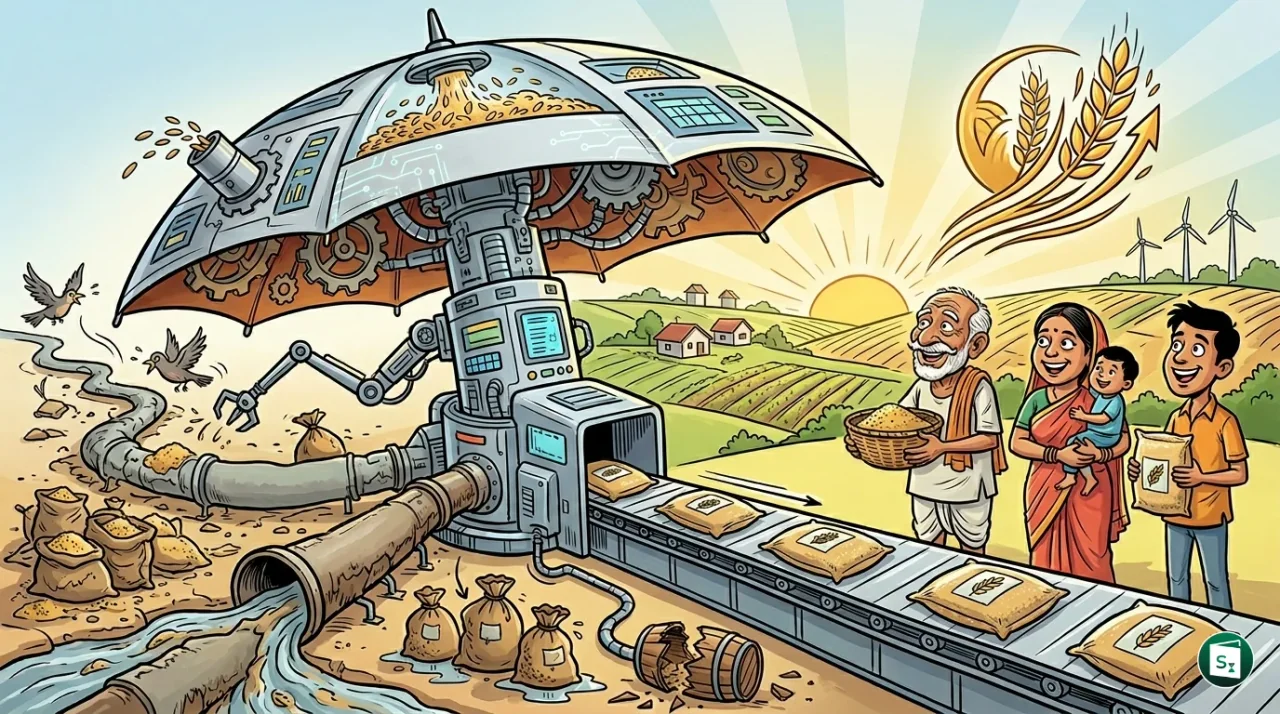
The Cabinet Committee on Economic Affairs (CCEA) has approved the SARTHAK-PDS umbrella scheme with a central outlay of ₹25,530 crore to modernize India’s food subsidy network. Implemented for five years from April 2026 to March 2031, the initiative aims to reduce leakages and streamline operations for citizens covered under the National Food Security Act (NFSA), 2013. This scheme integrates key legacy food distribution programs, leveraging cutting-edge digital technologies to optimize supply chains and citizen feedback.
What Is the SARTHAK-PDS Umbrella Scheme?
The SARTHAK-PDS is an initiative approved by the Union Cabinet to completely revamp the Targeted Public Distribution System (TPDS). Operated under the Department of Food and Public Distribution of the Ministry of Consumer Affairs, Food and Public Distribution, it represents a major push toward tech-driven governance. The program has a dedicated central share allocation of ₹25,530 crore and is scheduled for implementation over a five-year period starting from April 1, 2026, to March 31, 2031. This timeline aligns with the 16th Finance Commission cycle award period.
The main focus of this initiative is to assist states in upgrading their foodgrain logistics while securing the livelihoods of ration shop owners. It also aims to make ration distribution completely transparent and free from leakages. The primary beneficiaries of this scheme are the approximately 81.35 crore citizens covered under the National Food Security Act (NFSA), 2013, who depend on subsidised grains for their daily nutrition.
Integration of Legacy Food Distribution Programs
The SARTHAK-PDS scheme serves as a unified umbrella by bringing together two legacy programs that previously operated independently. This consolidation allows the government to address both logistics funding and technological upgrades under a single administrative framework.
Intra-State Transport Assistance and Dealer Margin Reforms
The first pillar of the integration is the legacy scheme known as Assistance to State Agencies for intra-State movement of foodgrains and FPS dealers’ margin under NFSA. Under this component, the central government shares the financial burden incurred by states and union territories for transporting foodgrains from Food Corporation of India (FCI) godowns to local ration shops.
It also provides financial support to enhance the profit margins of Fair Price Shop (FPS) dealers. By revising assistance norms and ensuring timely commission payouts, the government seeks to improve the financial viability of operating these shops. This helps reduce the temptation for dealers to divert subsidised grains to the black market.
The Digital Core: Leveraging the SMART PDS Framework
The second pillar of the integration is the Scheme for Modernization and Reforms through Technology in Public Distribution System (SMART PDS), which was originally approved in 2023 to run until 2026. By incorporating SMART PDS into the new umbrella scheme, the government has extended its mandate through 2031.
This technological framework replaces fragmented, state-specific databases with a unified national digital architecture. It ensures complete interoperability of ration cards across different states. This interoperability supports the One Nation One Ration Card (ONORC) initiative, allowing migrant workers to claim their food security benefits anywhere in India.
The Technological Architecture: NIRMAL, ASHA, and SAKSHAM
The modernization of the food distribution network relies heavily on three artificial intelligence modules. These systems work together to clean database registries, handle public grievances, and track shipments in real time.
NIRMAL: AI-Driven Beneficiary Registry
The NIRMAL module acts as an intelligent, real-time registry database for identifying and managing beneficiaries. Its primary objective is to clean the distribution database by identifying and removing duplicate, inactive, or fake ration cards, which are often referred to as ghost beneficiaries.
Beyond database cleanup, NIRMAL facilitates real-time data sharing between different ministries. This integration allows for cross-scheme convergence, ensuring that social welfare benefits are directed to the most eligible households.
ASHA: Multilingual Grievance Redressal Assistant
The ASHA module is designed as an interactive, multilingual AI-powered assistant for citizens. It acts as a dedicated grievance redressal platform that can handle up to 3 lakh interactions daily.
Beneficiaries and citizens can interact with ASHA through common platforms like WhatsApp, Interactive Voice Response System (IVRS), and web chatbots. By offering multi-channel support in local languages, it makes it easier for rural and semi-urban users to submit feedback, report supply delays, or lodge complaints.
SAKSHAM: Intelligent Supply Chain Platform
The SAKSHAM module focuses on optimizing the logistics of foodgrain movement. It introduces features like Global Positioning System (GPS) tracking for vehicles and Quick Response (QR) codes printed on grain bags to enable point-to-point traceability.
By analyzing transport data, SAKSHAM assists in route planning and demand forecasting. This optimization is expected to reduce the transport distance of foodgrains by 15 percent to 50 percent, leading to a 35 percent reduction in carbon emissions. The system also connects with newly established State Command Control Centres to provide administrators with live supply chain oversight.
Significance and Policy Impact of SARTHAK-PDS
The implementation of the SARTHAK-PDS scheme is expected to have a far-reaching impact on India’s food security administration. By integrating financial assistance with advanced digital tools, the government aims to create a highly responsive food distribution network that minimizes waste and ensures that foodgrains reach the intended beneficiaries.
One of the most significant benefits is the projected financial efficiency. The combination of route optimization under SAKSHAM and database cleaning under NIRMAL is expected to generate ₹280 crore in annual logistics savings. Additionally, the modernization of FPS dealer margins ensures that local distributors remain financially viable, reducing the incentive for leakages.
From an environmental standpoint, the optimization of transport routes will drastically lower the carbon footprint of India’s food distribution logistics. By reducing transport distances, the scheme aligns with the country’s broader climate goals of reducing emissions in the logistics sector.
The key metrics and targets of the SARTHAK-PDS umbrella scheme are summarized in the table below:
| Feature or Metric | Target or Projected Benefit |
|---|---|
| Central Share Outlay | ₹25,530 crore |
| Implementation Period | 5 years (April 2026 to March 2031) |
| NFSA Beneficiaries Covered | Approximately 81.35 crore citizens |
| ASHA Grievance Handling Capacity | Up to 3 lakh interactions per day |
| Logistics Distance Reduction | 15 percent to 50 percent shorter transport routes |
| Environmental Impact | 35 percent reduction in carbon emissions from transport |
| Projected Financial Savings | ₹280 crore annually in logistics operations |
Key Takeaways
- The Cabinet Committee on Economic Affairs (CCEA) approved the SARTHAK-PDS umbrella scheme with a central share outlay of ₹25,530 crore in May 2026.
- The scheme is scheduled for implementation over a five-year period from April 1, 2026, to March 31, 2031, which aligns with the award period of the 16th Finance Commission.
- The initiative benefits approximately 81.35 crore citizens covered under the National Food Security Act (NFSA), 2013.
- SARTHAK-PDS integrates two legacy programs: the Assistance to State Agencies for intra-State movement and the SMART PDS scheme originally launched in 2023.
- The scheme deploys three artificial intelligence modules: NIRMAL for registry cleaning, ASHA for grievance handling, and SAKSHAM for logistics optimization.
- The logistical optimizations are projected to generate ₹280 crore in annual savings and reduce transportation-related carbon emissions by 35 percent.